




The number of balls of radius 1cm that can be made from a solid sphere of radius 4cm is:
A.64
B.16
C.12
D.4
Answer
 Verified
603.3k+ views
Hint: The volume of the sphere and the balls made from the sphere will be equal. The volume of the sphere is given by the formula: $\dfrac{4}{3}\pi {r^3}$ , where r is the radius of the sphere. Hence, we will equate the volume of both of them and then we will calculate the number of balls that can be formed.
Complete step-by-step answer:
We are given that a solid sphere of radius 4cm is converted into a number of balls with radius 1cm.
Let n balls be made from the sphere with radius 4 cm.
Visual representation:
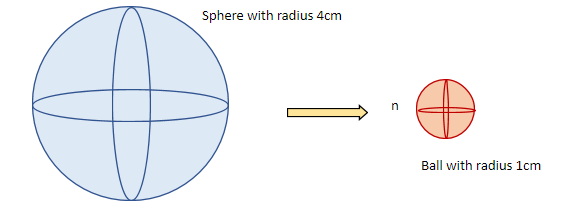
The volume of the solid sphere is given by $\dfrac{4}{3}\pi {r^3}$where r is its radius = 4cm
The balls are also spherical so their volume will be given as: $\dfrac{4}{3}\pi {R^3}$where R is their radius = 1cm
Now, as we know that all the balls are formed from the solid sphere, therefore, the volume of the solid sphere will be equal to the total volume of all the balls. Now, since all the balls are identical and there are n balls in total, the volume of all the balls will be $n \times \dfrac{4}{3}\pi {R^3}$ .
$ \Rightarrow \dfrac{4}{3}\pi {r^3} = n \times \dfrac{4}{3}\pi {R^3}$
Substituting the values, we get
$
\Rightarrow \dfrac{4}{3}\pi {\left( 4 \right)^3} = n \times \dfrac{4}{3}\pi {\left( 1 \right)^3} \\
\Rightarrow 64 = n \\
$
Hence, the total number of balls that can be made from the given solid sphere is 64.
Therefore, option(B) is correct.
Note: In this question, you need to take care of the fact that the volume of the sphere will be equal to the total volume of all the balls. You may go wrong while equating the volumes of the sphere and of the balls.
Complete step-by-step answer:
We are given that a solid sphere of radius 4cm is converted into a number of balls with radius 1cm.
Let n balls be made from the sphere with radius 4 cm.
Visual representation:
The volume of the solid sphere is given by $\dfrac{4}{3}\pi {r^3}$where r is its radius = 4cm
The balls are also spherical so their volume will be given as: $\dfrac{4}{3}\pi {R^3}$where R is their radius = 1cm
Now, as we know that all the balls are formed from the solid sphere, therefore, the volume of the solid sphere will be equal to the total volume of all the balls. Now, since all the balls are identical and there are n balls in total, the volume of all the balls will be $n \times \dfrac{4}{3}\pi {R^3}$ .
$ \Rightarrow \dfrac{4}{3}\pi {r^3} = n \times \dfrac{4}{3}\pi {R^3}$
Substituting the values, we get
$
\Rightarrow \dfrac{4}{3}\pi {\left( 4 \right)^3} = n \times \dfrac{4}{3}\pi {\left( 1 \right)^3} \\
\Rightarrow 64 = n \\
$
Hence, the total number of balls that can be made from the given solid sphere is 64.
Therefore, option(B) is correct.
Note: In this question, you need to take care of the fact that the volume of the sphere will be equal to the total volume of all the balls. You may go wrong while equating the volumes of the sphere and of the balls.

Recently Updated Pages
Master Class 8 Social Science: Engaging Questions & Answers for Success

Master Class 8 Science: Engaging Questions & Answers for Success
Master Class 8 Maths: Engaging Questions & Answers for Success
Class 8 Question and Answer - Your Ultimate Solutions Guide
Master Class 9 Social Science: Engaging Questions & Answers for Success
Master Class 9 Science: Engaging Questions & Answers for Success
Trending doubts
What are gulf countries and why they are called Gulf class 8 social science CBSE
What is BLO What is the full form of BLO class 8 social science CBSE
Citizens of India can vote at the age of A 18 years class 8 social science CBSE
Advantages and disadvantages of science
Full form of STD, ISD and PCO
Give me the opposite gender of Duck class 8 english CBSE