




The number of 5 digit telephone numbers having least one of their digits repeated.
a) 90,000
b) 100,000
c) 30,240
d) 69,760
Answer
 Verified
646.5k+ views
Hint: At least one digit repeated numbers can be given by the difference of total numbers of 5 digits from the digits 0, 1, 2, 3, 4, 5, 6, 7, 8, 9. with allowed repetition and the numbers with no repetition (distinct digits). Selection of ‘r’ different things from the total ‘n’ different things is given by $ C_{r}^{n}=\dfrac{n!}{r!\left( n-r \right)!} $ . Arrangement of ‘r’ digit numbers from ‘n’ digits with allowed repetition is given as $ {{n}^{r}} $ .
Complete step-by-step answer:
As we know there are 10 digits 0, 1, 2, 3, 4, 5, 6, 7, 8, 9 that can be used for making a 5 digit telephone number and as we need to determine total telephonic numbers of 5 digits having at least one digit repeated. It means there may be repetition of one digit or repetition of two digits or three but all the digits involved for making 5 digits cannot be distinct to each other i.e. at least one digit should be repeated.
So, in other words we need to calculate all the 5 digit numbers except the numbers which have all 5 digit different. It means total telephonic numbers with 5 digits having at least one digit repeated can be calculated by the difference of total numbers of 5 digits and the numbers with all distinct 5 digits. So, total 5 digit numbers with the help of 10 digit numbers and repetition is allowed with the formation of numbers can be given as
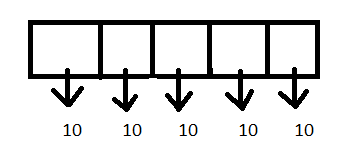
As digits can be repeated it means there are 10 possibilities for a single digit. Hence, total 5 digit numbers can be given as
$ 10\times 10\times 10\times 10\times 10={{\left( 10 \right)}^{5}} $
Now, as we know, selection of r different things from ‘n’ different numbers is given by relation $ C_{r}^{n}=\dfrac{n!}{r!\left( n-r \right)!} $ . Hence, we can select 5 different digits from the total 10 digits i.e. 0, 1, 2, 3, 4, 5, 6, 7, 8, 9 by $ C_{5}^{10} $ ways. Now, we need to arrange these digits to get the total number of 5 digits.
Now, as we know that the total 5 digit numbers with no repetition can be calculated as
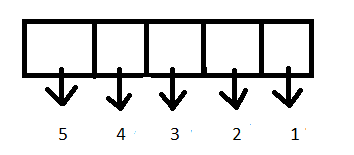
The first digit can be filled by 5 ways and second by 4 because the same digit cannot be occupied at two places as repetition is not allowed. Similarly, 3rd place can be filled by 3 ways as two digits are already occupied with two different numbers. Hence, we can get total number of 5 digits telephonic number with 5 selected digits
$ C_{5}^{10}\times 5\times 4\times 3\times 2\times 1=C_{5}^{10}\times 120 $
So, numbers with at least one digit repeated are given by the difference of total numbers possible with repetition and without repetition. So, we get total 5 digit telephone numbers with having at least one of the digit repeated
$ {{\left( 10 \right)}^{5}}-C_{5}^{10}\times 5\times 4\times 3\times 2\times 1 $
= 100,000 – 30240
= 69760.
Hence, option (d) is correct.
Note: One may go wrong if he or she select 5 digits from the given numbers by $ C_{5}^{10} $ ways for the formation of numbers with repetition allowed case as $ C_{5}^{10} $ used for selecting 5 different numbers from 10 different numbers. So, don’t be confused with that part. One may use formula $ P_{r}^{n} $ for selecting 5 different digits and arranging them for the formation of numbers with distinct digits. As $ P_{r}^{n} $ gives selection and arrangement both at a time. So, it can be another approach for this step in the solution.
One may arrange the 5 different digits by 5! Ways directly for the second case in the solution. The arrangement of ‘n’ different things can be given by formula n!.
Complete step-by-step answer:
As we know there are 10 digits 0, 1, 2, 3, 4, 5, 6, 7, 8, 9 that can be used for making a 5 digit telephone number and as we need to determine total telephonic numbers of 5 digits having at least one digit repeated. It means there may be repetition of one digit or repetition of two digits or three but all the digits involved for making 5 digits cannot be distinct to each other i.e. at least one digit should be repeated.
So, in other words we need to calculate all the 5 digit numbers except the numbers which have all 5 digit different. It means total telephonic numbers with 5 digits having at least one digit repeated can be calculated by the difference of total numbers of 5 digits and the numbers with all distinct 5 digits. So, total 5 digit numbers with the help of 10 digit numbers and repetition is allowed with the formation of numbers can be given as
As digits can be repeated it means there are 10 possibilities for a single digit. Hence, total 5 digit numbers can be given as
$ 10\times 10\times 10\times 10\times 10={{\left( 10 \right)}^{5}} $
Now, as we know, selection of r different things from ‘n’ different numbers is given by relation $ C_{r}^{n}=\dfrac{n!}{r!\left( n-r \right)!} $ . Hence, we can select 5 different digits from the total 10 digits i.e. 0, 1, 2, 3, 4, 5, 6, 7, 8, 9 by $ C_{5}^{10} $ ways. Now, we need to arrange these digits to get the total number of 5 digits.
Now, as we know that the total 5 digit numbers with no repetition can be calculated as
The first digit can be filled by 5 ways and second by 4 because the same digit cannot be occupied at two places as repetition is not allowed. Similarly, 3rd place can be filled by 3 ways as two digits are already occupied with two different numbers. Hence, we can get total number of 5 digits telephonic number with 5 selected digits
$ C_{5}^{10}\times 5\times 4\times 3\times 2\times 1=C_{5}^{10}\times 120 $
So, numbers with at least one digit repeated are given by the difference of total numbers possible with repetition and without repetition. So, we get total 5 digit telephone numbers with having at least one of the digit repeated
$ {{\left( 10 \right)}^{5}}-C_{5}^{10}\times 5\times 4\times 3\times 2\times 1 $
= 100,000 – 30240
= 69760.
Hence, option (d) is correct.
Note: One may go wrong if he or she select 5 digits from the given numbers by $ C_{5}^{10} $ ways for the formation of numbers with repetition allowed case as $ C_{5}^{10} $ used for selecting 5 different numbers from 10 different numbers. So, don’t be confused with that part. One may use formula $ P_{r}^{n} $ for selecting 5 different digits and arranging them for the formation of numbers with distinct digits. As $ P_{r}^{n} $ gives selection and arrangement both at a time. So, it can be another approach for this step in the solution.
One may arrange the 5 different digits by 5! Ways directly for the second case in the solution. The arrangement of ‘n’ different things can be given by formula n!.
Recently Updated Pages
Master Class 12 Economics: Engaging Questions & Answers for Success

Master Class 12 English: Engaging Questions & Answers for Success
Master Class 12 Social Science: Engaging Questions & Answers for Success
Master Class 12 Maths: Engaging Questions & Answers for Success
Master Class 12 Physics: Engaging Questions & Answers for Success
Master Class 9 General Knowledge: Engaging Questions & Answers for Success
Trending doubts
Which are the Top 10 Largest Countries of the World?
Draw a labelled sketch of the human eye class 12 physics CBSE
Differentiate between homogeneous and heterogeneous class 12 chemistry CBSE
Sulphuric acid is known as the king of acids State class 12 chemistry CBSE
Why is the cell called the structural and functional class 12 biology CBSE
Draw ray diagrams each showing i myopic eye and ii class 12 physics CBSE