




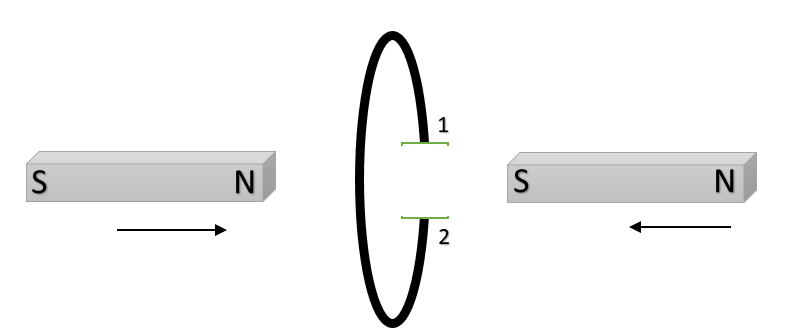
The north and south poles of two identical magnets approach a coil, containing a condenser, with equal speed from opposite sides. Then
A. Plate 1 will be negative and plate 2 positive
B. Plate 2 will be positive and plate 2 negative
C. Both the plates will be positive
D. Both the plates will be negative.
Answer
 Verified
591.3k+ views
Hint: These types of problems could be easily solved by applying the basic statement of Lenz law, which states that emf is generated if the magnetic flux linked with a coil changes. The direction of emf is such that it opposes the cause of motion or effect.
Complete answer:
According to Faraday’s law, if there is a change in flux in a coil, it will produce or generate an E.M.F. in the coil. According to Lenz law, the change in magnetic field is opposed in such a manner that the current inside the coil will resist the magnetic field by flowing in a particular direction.
Now, as we know that magnetic field is generated from the north pole of the magnet and enters the south pole of the magnet. Now, as the two magnets approach each other, more and more magnetic lines of flux enter the loop. This means the magnetic field is increasing from left to right.
Now, according to Lenz law, the loop will oppose the cause of this increase in magnetic field. Hence the loop will produce the magnetic field from right to left (in order to oppose).
Now, to produce the magnetic field from right to left, the current must be flowing from ‘2’ to ‘1’. This is because a current carrying wire starts acting as a small bar magnet. Thus, point ‘2’ must be high potential.
So, the correct answer is “Option B”.
Note:
Lenz law is just an extension of Faraday’s law. According to Faraday’s law, the E.M.F. produced inside a coil is has a magnitude equal to the rate of change of magnetic flux i.e. $|\varepsilon|= \dfrac{d\phi}{dt}$. But the direction in which the current will flow (i.e. clockwise or anti-clockwise) is given by Lenz law. Hence the complete law is $\varepsilon = -\dfrac{d\phi}{dt}$.
Complete answer:
According to Faraday’s law, if there is a change in flux in a coil, it will produce or generate an E.M.F. in the coil. According to Lenz law, the change in magnetic field is opposed in such a manner that the current inside the coil will resist the magnetic field by flowing in a particular direction.
Now, as we know that magnetic field is generated from the north pole of the magnet and enters the south pole of the magnet. Now, as the two magnets approach each other, more and more magnetic lines of flux enter the loop. This means the magnetic field is increasing from left to right.
Now, according to Lenz law, the loop will oppose the cause of this increase in magnetic field. Hence the loop will produce the magnetic field from right to left (in order to oppose).
Now, to produce the magnetic field from right to left, the current must be flowing from ‘2’ to ‘1’. This is because a current carrying wire starts acting as a small bar magnet. Thus, point ‘2’ must be high potential.
So, the correct answer is “Option B”.
Note:
Lenz law is just an extension of Faraday’s law. According to Faraday’s law, the E.M.F. produced inside a coil is has a magnitude equal to the rate of change of magnetic flux i.e. $|\varepsilon|= \dfrac{d\phi}{dt}$. But the direction in which the current will flow (i.e. clockwise or anti-clockwise) is given by Lenz law. Hence the complete law is $\varepsilon = -\dfrac{d\phi}{dt}$.
Recently Updated Pages
Basicity of sulphurous acid and sulphuric acid are

Master Class 12 English: Engaging Questions & Answers for Success
Master Class 12 Social Science: Engaging Questions & Answers for Success
Master Class 12 Maths: Engaging Questions & Answers for Success
Master Class 12 Economics: Engaging Questions & Answers for Success
Master Class 12 Physics: Engaging Questions & Answers for Success
Trending doubts
Which are the Top 10 Largest Countries of the World?
Draw a labelled sketch of the human eye class 12 physics CBSE
Give 10 examples of unisexual and bisexual flowers
Coming together federation is practiced in A India class 12 social science CBSE
Write the formula to find the shortest distance between class 12 maths CBSE
Find the foot of the perpendicular from point232to class 12 maths CBSE