




The normal or polygonum type of embryo sac is
(a)Bisporic eight nucleate
(b)Monosporic four nucleate
(c)Tetrasporic sixteen nucleate
(d)Monosporic eight nucleate
Answer
 Verified
611.1k+ views
Hint: In plants, the structure enclosing the reproductive cells in females, contains the nucleus, the integument, and the female gametophyte. The oval structure present in the ovule of flowering plants is known as the embryo sac or female gametophyte.
Complete step-by-step answer:
The normal or polygonum type of embryo sac is a monosporic eight nucleate. The embryo sac develops from the chalazal megaspore. Its nucleus divides thrice to form eight nuclei. This type is known as normal or polygonum type (first time described in polygonum divaricatum by Starsburger) of embryo sac.
Additional Information:
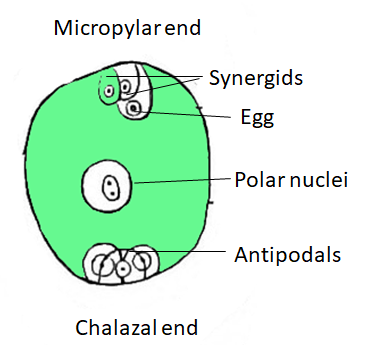
-Embryo sac in plants helps in developing the egg cell or nucleus after fertilization.
-Out of the eight nuclei, 2 haploid nuclei do have cell walls and 6 haploid cells do not have cell walls.
-The embryo sac formation:
Stage 1: The first stage is the megasporogenesis, where the meiosis of a single diploid mother cell leads to the formation of haploid megaspore.
-Out of this, one sustains (later develops into the embryo sac) and three disintegrates.
Stage 2: The second stage is the megagametogenesis, where the mitosis of the functional haploid megaspore to produce 8-nucleate, 7-celled gametophyte leading to the formation of an embryo sac.
-The polar nuclei move to the center out of all the eight nuclei, to combine and generate a single diploid cell. This single diploid cell fuses with the sperm from the male to generate the triploid endosperm.
-The other two modify into synergid cells which degenerate gradually and three nuclei grow into antipodal cells.
So, the correct answer is 'Monosporic eight nucleated'.
Note: Megaspore (or macrospores) are a type of spore that is present in certain plants. The megaspore is produced inside the nucleus of the ovule in the gymnosperms and flowering plants.
Complete step-by-step answer:
The normal or polygonum type of embryo sac is a monosporic eight nucleate. The embryo sac develops from the chalazal megaspore. Its nucleus divides thrice to form eight nuclei. This type is known as normal or polygonum type (first time described in polygonum divaricatum by Starsburger) of embryo sac.
Additional Information:
Figure: Polygonum type of embryo sac
-Embryo sac in plants helps in developing the egg cell or nucleus after fertilization.
-Out of the eight nuclei, 2 haploid nuclei do have cell walls and 6 haploid cells do not have cell walls.
-The embryo sac formation:
Stage 1: The first stage is the megasporogenesis, where the meiosis of a single diploid mother cell leads to the formation of haploid megaspore.
-Out of this, one sustains (later develops into the embryo sac) and three disintegrates.
Stage 2: The second stage is the megagametogenesis, where the mitosis of the functional haploid megaspore to produce 8-nucleate, 7-celled gametophyte leading to the formation of an embryo sac.
-The polar nuclei move to the center out of all the eight nuclei, to combine and generate a single diploid cell. This single diploid cell fuses with the sperm from the male to generate the triploid endosperm.
-The other two modify into synergid cells which degenerate gradually and three nuclei grow into antipodal cells.
So, the correct answer is 'Monosporic eight nucleated'.
Note: Megaspore (or macrospores) are a type of spore that is present in certain plants. The megaspore is produced inside the nucleus of the ovule in the gymnosperms and flowering plants.
Recently Updated Pages
Master Class 11 Social Science: Engaging Questions & Answers for Success

Master Class 11 English: Engaging Questions & Answers for Success
Master Class 11 Maths: Engaging Questions & Answers for Success
Master Class 11 Chemistry: Engaging Questions & Answers for Success
Master Class 11 Biology: Engaging Questions & Answers for Success
Master Class 11 Physics: Engaging Questions & Answers for Success
Trending doubts
One Metric ton is equal to kg A 10000 B 1000 C 100 class 11 physics CBSE
Difference Between Prokaryotic Cells and Eukaryotic Cells
How many of the following diseases can be studied with class 11 biology CBSE
Which of the following enzymes is used for carboxylation class 11 biology CBSE
Draw a diagram of a plant cell and label at least eight class 11 biology CBSE
Two of the body parts which do not appear in MRI are class 11 biology CBSE