




The normal at the point $\left( at_{1}^{2},2a{{t}_{1}} \right)$ meets the parabola again in the point $\left( at_{2}^{2},2a{{t}_{2}} \right)$ , prove that ${{t}_{2}}=-{{t}_{1}}-\dfrac{2}{{{t}_{1}}}$.
Answer
 Verified
643.8k+ views
Hint: To establish the relation between ${{t}_{1}}$ and ${{t}_{2}}$ . Find the equation of the normal at point $P\left( at_{1}^{2},2a{{t}_{1}} \right)$ .Now put $Q\left( at_{2}^{2},2a{{t}_{2}} \right)$ in this equation. Simplify the equation using basic formulas and prove the relation given.
Complete step-by-step answer:
It is said that the normal at the point $\left( at_{1}^{2},2a{{t}_{1}} \right)$ meets the parabola again in the point $\left( at_{2}^{2},2a{{t}_{2}} \right)$.
Let cut the equation of parabola ${{y}^{2}}=4ax$ .
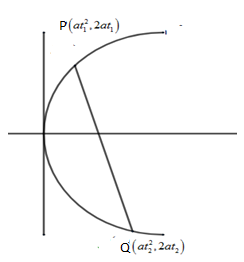
Let the 2 point on the parabola be $P\left( at_{1}^{2},2a{{t}_{1}} \right)$ and $Q\left( at_{2}^{2},2a{{t}_{2}} \right)$ .
We need to establish the relation between ${{t}_{1}}$ and ${{t}_{2}}$ .
Normally a point P is given by the equation $y=-{{t}_{1}}x+2a{{t}_{1}}+at_{1}^{3}$ . We know $Q\left( at_{2}^{2},2a{{t}_{2}} \right)$ , thus this point should be able to satisfy the equation. Put $y=2a{{t}_{2}}$ and $x=at_{2}^{2}$ in the above equation. Thus we get-
$2a{{t}_{2}}=-{{t}_{1}}\left( at_{2}^{2} \right)+2a{{t}_{1}}+at_{1}^{3}$
Now let us simplify this above equation.
The equation of normal for the general equation parabola ${{y}^{2}}=4ax$ is given as,
$y-{{y}_{1}}=\dfrac{-{{y}_{1}}}{2a}\left( x-{{x}_{1}} \right)$ .
Now let us find the equation of normal for point $P\left( at_{1}^{2},2a{{t}_{1}} \right)$. Thus, put $x=at_{1}^{2}$ and ${{y}_{1}}=2a{{t}_{1}}$ in the above equation.
$y-2a{{t}_{1}}=\dfrac{-2a{{t}_{1}}}{2a}\left( x-at_{1}^{2} \right)$
Now cancel out the like terms and simplify the above expression,
$\begin{align}
& y-2a{{t}_{1}}=-{{t}_{1}}\left( x-at_{1}^{2} \right) \\
& y-2a{{t}_{1}}=-x{{t}_{1}}+at_{1}^{3} \\
& \Rightarrow y=-{{t}_{1}}x+at_{1}^{3} \\
\end{align}$
Normally a point P is given by the equation $y=-{{t}_{1}}x+2a{{t}_{1}}+at_{1}^{3}$ . We know $Q\left( at_{2}^{2},2a{{t}_{2}} \right)$ , thus this point should be able to satisfy the equation. Put $y=2a{{t}_{2}}$ and $x=at_{2}^{2}$ in the above equation. Thus we get-
$2a{{t}_{2}}=-{{t}_{1}}\left( at_{2}^{2} \right)+2a{{t}_{1}}+at_{1}^{3}$
Now let us simplify this above equation.
$\begin{align}
& 2a{{t}_{2}}=-a{{t}_{1}}t_{2}^{2}+2a{{t}_{1}}+at_{1}^{3} \\
& \Rightarrow at_{2}^{2}{{t}_{1}}-at_{1}^{3}=2a{{t}_{1}}-2a{{t}_{2}} \\
& a{{t}_{1}}\left( t_{2}^{2}-t_{1}^{2} \right)=2a\left( {{t}_{1}}-{{t}_{2}} \right) \\
& a{{t}_{1}}\left( t_{2}^{2}-t_{1}^{2} \right)-2a\left( {{t}_{1}}-{{t}_{2}} \right)=0 \\
& a{{t}_{1}}\left( {{t}_{2}}-{{t}_{1}} \right)\left( {{t}_{2}}+{{t}_{1}} \right)+2a\left( {{t}_{2}}-{{t}_{1}} \right)=0 \\
\end{align}$ (We know ${{a}^{2}}-{{b}^{2}}=\left( a+b \right)\left( a-b \right)$)
Take out $a\left( {{t}_{2}}-{{t}_{1}} \right)$ from both terms.
$a\left( {{t}_{2}}-{{t}_{1}} \right)\left[ {{t}_{1}}\left( {{t}_{2}}+{{t}_{1}} \right)+2 \right]=0$
Thus $a\left( {{t}_{2}}-{{t}_{1}} \right)=0$
\[\begin{align}
& {{t}_{1}}\left( {{t}_{2}}+{{t}_{1}} \right)+2=0 \\
& \Rightarrow {{t}_{1}}\left( {{t}_{2}}+{{t}_{1}} \right)=-2 \\
& {{t}_{2}}+{{t}_{1}}=\dfrac{-2}{{{t}_{1}}} \\
& \therefore {{t}_{2}}=-t-\dfrac{2}{{{t}_{1}}} \\
\end{align}\]
Thus, we provide that the normal at the point $\left( at_{1}^{2},2a{{t}_{1}} \right)$ meets the parabola again in the point $\left( at_{2}^{2},2a{{t}_{2}} \right)$ and we get ${{t}_{2}}=-{{t}_{1}}-\dfrac{2}{{{t}_{1}}}$ .
Note: If normal at the point $a{{t}_{1}}$ meets the parabola again at $a{{t}_{2}}$ then $a{{t}_{2}}=a{{t}_{1}}-\dfrac{2}{a{{t}_{1}}}$ , The point of intersection of the normal to the parabola ${{y}^{2}}=4ax$ , ${{t}_{1}}$ and ${{t}_{2}}$ are $\left( 2a+a\left( t_{1}^{2}+{{t}_{1}}{{t}_{2}}+t_{2}^{2} \right),-a{{t}_{1}}{{t}_{2}}\left( {{t}_{1}}+{{t}_{2}} \right) \right)$ .
Complete step-by-step answer:
It is said that the normal at the point $\left( at_{1}^{2},2a{{t}_{1}} \right)$ meets the parabola again in the point $\left( at_{2}^{2},2a{{t}_{2}} \right)$.
Let cut the equation of parabola ${{y}^{2}}=4ax$ .
Let the 2 point on the parabola be $P\left( at_{1}^{2},2a{{t}_{1}} \right)$ and $Q\left( at_{2}^{2},2a{{t}_{2}} \right)$ .
We need to establish the relation between ${{t}_{1}}$ and ${{t}_{2}}$ .
Normally a point P is given by the equation $y=-{{t}_{1}}x+2a{{t}_{1}}+at_{1}^{3}$ . We know $Q\left( at_{2}^{2},2a{{t}_{2}} \right)$ , thus this point should be able to satisfy the equation. Put $y=2a{{t}_{2}}$ and $x=at_{2}^{2}$ in the above equation. Thus we get-
$2a{{t}_{2}}=-{{t}_{1}}\left( at_{2}^{2} \right)+2a{{t}_{1}}+at_{1}^{3}$
Now let us simplify this above equation.
The equation of normal for the general equation parabola ${{y}^{2}}=4ax$ is given as,
$y-{{y}_{1}}=\dfrac{-{{y}_{1}}}{2a}\left( x-{{x}_{1}} \right)$ .
Now let us find the equation of normal for point $P\left( at_{1}^{2},2a{{t}_{1}} \right)$. Thus, put $x=at_{1}^{2}$ and ${{y}_{1}}=2a{{t}_{1}}$ in the above equation.
$y-2a{{t}_{1}}=\dfrac{-2a{{t}_{1}}}{2a}\left( x-at_{1}^{2} \right)$
Now cancel out the like terms and simplify the above expression,
$\begin{align}
& y-2a{{t}_{1}}=-{{t}_{1}}\left( x-at_{1}^{2} \right) \\
& y-2a{{t}_{1}}=-x{{t}_{1}}+at_{1}^{3} \\
& \Rightarrow y=-{{t}_{1}}x+at_{1}^{3} \\
\end{align}$
Normally a point P is given by the equation $y=-{{t}_{1}}x+2a{{t}_{1}}+at_{1}^{3}$ . We know $Q\left( at_{2}^{2},2a{{t}_{2}} \right)$ , thus this point should be able to satisfy the equation. Put $y=2a{{t}_{2}}$ and $x=at_{2}^{2}$ in the above equation. Thus we get-
$2a{{t}_{2}}=-{{t}_{1}}\left( at_{2}^{2} \right)+2a{{t}_{1}}+at_{1}^{3}$
Now let us simplify this above equation.
$\begin{align}
& 2a{{t}_{2}}=-a{{t}_{1}}t_{2}^{2}+2a{{t}_{1}}+at_{1}^{3} \\
& \Rightarrow at_{2}^{2}{{t}_{1}}-at_{1}^{3}=2a{{t}_{1}}-2a{{t}_{2}} \\
& a{{t}_{1}}\left( t_{2}^{2}-t_{1}^{2} \right)=2a\left( {{t}_{1}}-{{t}_{2}} \right) \\
& a{{t}_{1}}\left( t_{2}^{2}-t_{1}^{2} \right)-2a\left( {{t}_{1}}-{{t}_{2}} \right)=0 \\
& a{{t}_{1}}\left( {{t}_{2}}-{{t}_{1}} \right)\left( {{t}_{2}}+{{t}_{1}} \right)+2a\left( {{t}_{2}}-{{t}_{1}} \right)=0 \\
\end{align}$ (We know ${{a}^{2}}-{{b}^{2}}=\left( a+b \right)\left( a-b \right)$)
Take out $a\left( {{t}_{2}}-{{t}_{1}} \right)$ from both terms.
$a\left( {{t}_{2}}-{{t}_{1}} \right)\left[ {{t}_{1}}\left( {{t}_{2}}+{{t}_{1}} \right)+2 \right]=0$
Thus $a\left( {{t}_{2}}-{{t}_{1}} \right)=0$
\[\begin{align}
& {{t}_{1}}\left( {{t}_{2}}+{{t}_{1}} \right)+2=0 \\
& \Rightarrow {{t}_{1}}\left( {{t}_{2}}+{{t}_{1}} \right)=-2 \\
& {{t}_{2}}+{{t}_{1}}=\dfrac{-2}{{{t}_{1}}} \\
& \therefore {{t}_{2}}=-t-\dfrac{2}{{{t}_{1}}} \\
\end{align}\]
Thus, we provide that the normal at the point $\left( at_{1}^{2},2a{{t}_{1}} \right)$ meets the parabola again in the point $\left( at_{2}^{2},2a{{t}_{2}} \right)$ and we get ${{t}_{2}}=-{{t}_{1}}-\dfrac{2}{{{t}_{1}}}$ .
Note: If normal at the point $a{{t}_{1}}$ meets the parabola again at $a{{t}_{2}}$ then $a{{t}_{2}}=a{{t}_{1}}-\dfrac{2}{a{{t}_{1}}}$ , The point of intersection of the normal to the parabola ${{y}^{2}}=4ax$ , ${{t}_{1}}$ and ${{t}_{2}}$ are $\left( 2a+a\left( t_{1}^{2}+{{t}_{1}}{{t}_{2}}+t_{2}^{2} \right),-a{{t}_{1}}{{t}_{2}}\left( {{t}_{1}}+{{t}_{2}} \right) \right)$ .
Recently Updated Pages
Master Class 11 English: Engaging Questions & Answers for Success

Master Class 11 Social Science: Engaging Questions & Answers for Success
Master Class 11 Maths: Engaging Questions & Answers for Success
Master Class 11 Biology: Engaging Questions & Answers for Success
Master Class 11 Physics: Engaging Questions & Answers for Success
Master Class 11 Chemistry: Engaging Questions & Answers for Success
Trending doubts
One Metric ton is equal to kg A 10000 B 1000 C 100 class 11 physics CBSE
What is cell theory Who formulated it class 11 biology CBSE
Phyllotaxy is the arrangement of ALeaflets BLeaves class 11 biology CBSE
Difference Between Prokaryotic Cells and Eukaryotic Cells
The symbiotic association of fungi and algae is called class 11 biology CBSE
Cell theory was formulated by A Schleiden and Schwann class 11 biology CBSE