




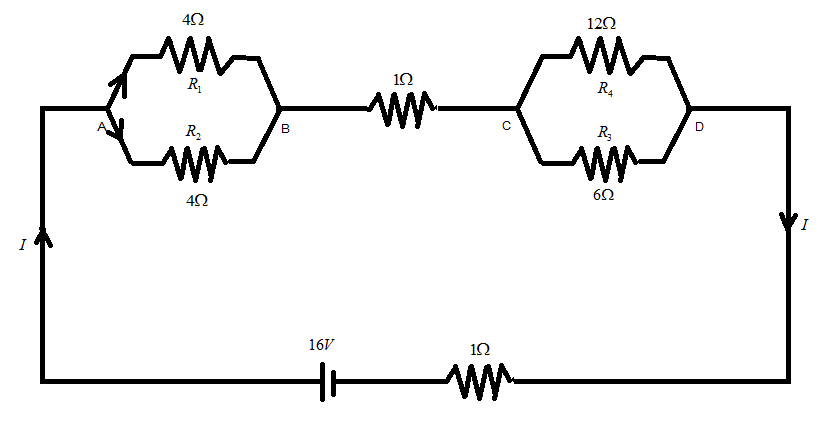
The network resistance is connected to $ 16V $ battery with internal resistance of $ 1\Omega $ as shown in figure as:
1. Find equivalent resistance of the network.
2. Find current in each resistor.
3. Find voltage drops $ {V_{AB}} $ , $ {V_{BC}} $ , $ {V_{CD}} $ .
Answer
 Verified
534k+ views
Hint: We know that, when this type of circuit is given and we have to calculate the equivalent resistance, we have to solve it carefully using the formulas for resistances in parallel and series combination. For the resistances between A and B the current is divided into two equal parts since the resistances are of equal value i.e. the value of current depends on the value of resistance from which it is flowing.
Complete answer:
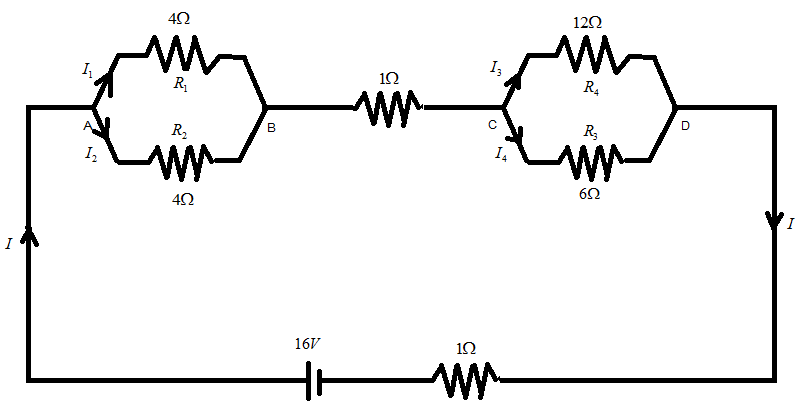
Let us first divide current in between A and B and C and D, and show it in the diagram such that as shown in the figure below:
For (1),
We have, resistances in parallel between A and B, so we will use the formula for equivalent resistance in parallel as
$ {R_{eq}} = \dfrac{{4 \times 4}}{{4 + 4}} = \dfrac{{16}}{8} = 2\Omega $
Therefore, resistance between A and B is $ 2\Omega $ .
Similarly between C and D,
$ {R_{eq}} = \dfrac{{12 \times 6}}{{12 + 6}} = \dfrac{{72}}{{18}} = 4\Omega $
Therefore, resistance between C and D is $ 4\Omega $ .
These all are in series now after solving the parallel resistances these resistances are now in parallel with the other two resistances such that $ 2\Omega $ , $ 1\Omega $ , $ 4\Omega $ and $ 1\Omega $ are in series in the above circuit.
Thus the equivalent resistance is given by the formula of the resistances in series combination is as follows in the whole network:
$ {R_{eq}} = 2\Omega + 1\Omega + 4\Omega + 1\Omega = 8\Omega $
Hence, the equivalent resistance in the whole circuit is $ 8\Omega $ .
For (2),
Current in each resistor,
Let us first divide the current flowing in each resistor such that current flowing from $ {R_1} $ is $ {I_1} $ , $ {R_2} $ is $ {I_2} $ , $ {R_3} $ is $ {I_3} $ and $ {R_4} $ is $ {I_4} $ .
$ I = {I_1} + {I_2} $
$ \therefore {I_1} = 1A $ and $ {I_2} = 1A $
The current moving out of the point B is $ 2A $ , this current is divided between two resistors equally but here the resistances are different so the currents are equal such that:
$ {I_3} \times 12 = {I_4} \times 6 $
$ \Rightarrow {I_4} = 2{I_3} $
But, $ 2A = {I_3} + {I_4} $
$ \Rightarrow {I_3} = \dfrac{2}{3}A $ (by ohm’s law)
$ \therefore {I_4} = \dfrac{4}{3}A $
For (3),
Here, we have to find the voltage drops $ {V_{AB}} $ , $ {V_{BC}} $ , $ {V_{CD}} $ .
By considering current flowing in any one of the resistors which are in parallel, we get
$ {V_{AB}} = {I_1} \times 4 = 1 \times 4 = 4V $ (current from $ {R_1} $ between A and B)
Similarly, between B and C only one resistor is here so:
$ {V_{BC}} = I \times 1 = 2 \times 1 = 2V $ (current between B and C is $ 2A $ )
Now, for C and D,
$ {V_{CD}} = {I_3} \times 12 = \dfrac{2}{3} \times 12 = 8V $ (current from $ {R_3} $ between C and D)
Hence, we have obtained all the answers.
Note:
In these types of circuit problems we must know that it is very important to understand the combinations of resistors if they are in parallel combination or in series combination. When the voltage drop is asked and not specified from which resistor just go for any one of them since the current will be equally distributed from the junction. Junction is the point where current is divided into two or more currents.
Complete answer:
Let us first divide current in between A and B and C and D, and show it in the diagram such that as shown in the figure below:
For (1),
We have, resistances in parallel between A and B, so we will use the formula for equivalent resistance in parallel as
$ {R_{eq}} = \dfrac{{4 \times 4}}{{4 + 4}} = \dfrac{{16}}{8} = 2\Omega $
Therefore, resistance between A and B is $ 2\Omega $ .
Similarly between C and D,
$ {R_{eq}} = \dfrac{{12 \times 6}}{{12 + 6}} = \dfrac{{72}}{{18}} = 4\Omega $
Therefore, resistance between C and D is $ 4\Omega $ .
These all are in series now after solving the parallel resistances these resistances are now in parallel with the other two resistances such that $ 2\Omega $ , $ 1\Omega $ , $ 4\Omega $ and $ 1\Omega $ are in series in the above circuit.
Thus the equivalent resistance is given by the formula of the resistances in series combination is as follows in the whole network:
$ {R_{eq}} = 2\Omega + 1\Omega + 4\Omega + 1\Omega = 8\Omega $
Hence, the equivalent resistance in the whole circuit is $ 8\Omega $ .
For (2),
Current in each resistor,
Let us first divide the current flowing in each resistor such that current flowing from $ {R_1} $ is $ {I_1} $ , $ {R_2} $ is $ {I_2} $ , $ {R_3} $ is $ {I_3} $ and $ {R_4} $ is $ {I_4} $ .
$ I = {I_1} + {I_2} $
$ \therefore {I_1} = 1A $ and $ {I_2} = 1A $
The current moving out of the point B is $ 2A $ , this current is divided between two resistors equally but here the resistances are different so the currents are equal such that:
$ {I_3} \times 12 = {I_4} \times 6 $
$ \Rightarrow {I_4} = 2{I_3} $
But, $ 2A = {I_3} + {I_4} $
$ \Rightarrow {I_3} = \dfrac{2}{3}A $ (by ohm’s law)
$ \therefore {I_4} = \dfrac{4}{3}A $
For (3),
Here, we have to find the voltage drops $ {V_{AB}} $ , $ {V_{BC}} $ , $ {V_{CD}} $ .
By considering current flowing in any one of the resistors which are in parallel, we get
$ {V_{AB}} = {I_1} \times 4 = 1 \times 4 = 4V $ (current from $ {R_1} $ between A and B)
Similarly, between B and C only one resistor is here so:
$ {V_{BC}} = I \times 1 = 2 \times 1 = 2V $ (current between B and C is $ 2A $ )
Now, for C and D,
$ {V_{CD}} = {I_3} \times 12 = \dfrac{2}{3} \times 12 = 8V $ (current from $ {R_3} $ between C and D)
Hence, we have obtained all the answers.
Note:
In these types of circuit problems we must know that it is very important to understand the combinations of resistors if they are in parallel combination or in series combination. When the voltage drop is asked and not specified from which resistor just go for any one of them since the current will be equally distributed from the junction. Junction is the point where current is divided into two or more currents.
Recently Updated Pages
Master Class 12 Economics: Engaging Questions & Answers for Success

Master Class 12 Physics: Engaging Questions & Answers for Success
Master Class 12 English: Engaging Questions & Answers for Success
Master Class 12 Social Science: Engaging Questions & Answers for Success
Master Class 12 Maths: Engaging Questions & Answers for Success
Master Class 12 Business Studies: Engaging Questions & Answers for Success
Trending doubts
Which are the Top 10 Largest Countries of the World?
What are the major means of transport Explain each class 12 social science CBSE
Draw a labelled sketch of the human eye class 12 physics CBSE
Differentiate between insitu conservation and exsitu class 12 biology CBSE
Draw a neat and well labeled diagram of TS of ovary class 12 biology CBSE
Give 10 examples of unisexual and bisexual flowers