




The near point of a hypermetropic eye is 1m. What is the nature and power of the lens required to correct this defect? (Assume that the near point of the normal eye is 25 cm).
Answer
 Verified
593.4k+ views
Hint: To solve this problem first we will discuss Hypermetropia and its effect on forming image behind the retina and by using lens formula to calculate power of the lens to correct this defect, we will also discuss about different corrective measures for the same.
Formula used:
Len’s formula,
$\Rightarrow \dfrac{1}{f}=\dfrac{1}{v}-\dfrac{1}{u}$
Power,
$\Rightarrow P=\dfrac{1}{f}$
Complete answer:
Hypermetropia can also be termed as farsightedness in which light rays focus on behind the retina instead of retina which results in blurry image. This is a type of defect not disease so it can be corrected artificially by different types of measures.
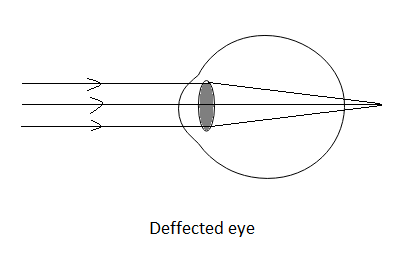
As, we know that our eye behaves as convex lens so virtual and erect image will be formed so,
Object distance U=-25 cm,
Image distance V=-1 m = -100 cm
Now, by using lens formula
$\Rightarrow \dfrac{1}{f}=\dfrac{1}{V}-\dfrac{1}{U}$
$\Rightarrow \dfrac{1}{f}=\dfrac{1}{(-100)}-\dfrac{1}{(-25)}$
$\Rightarrow \dfrac{1}{f}=-\dfrac{1}{100}+\dfrac{1}{25}$
$\Rightarrow \dfrac{1}{f}=\dfrac{-1+4}{100}=\dfrac{3}{100}$
So, focal length
$\Rightarrow f=\dfrac{100}{3}=33cm=0.33m$
Now, power of the lens is given by,$P=\dfrac{1}{f}$
$\Rightarrow P=\dfrac{1}{0.33}=3D$(Diopters)
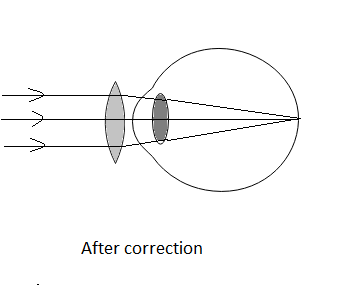
So, to correct the defect of this hypermetropic eye lens of 3 diopters will be used.
Note:
Hypermetropic eyes can be corrected by three corrective measures. First, by using corrective eyeglasses, which depends on how much focal length has been changed due to defect, so the convex lenses in eyeglasses can correct this problem and it is the most widely accepted corrective measure. Second, by using contact lenses which provide the same effect as eyeglasses but in a more convenient and comfortable option but little bit expensive as well and for the last option refractive surgery is done to alter the defect of the eye by means of surgery.
Formula used:
Len’s formula,
$\Rightarrow \dfrac{1}{f}=\dfrac{1}{v}-\dfrac{1}{u}$
Power,
$\Rightarrow P=\dfrac{1}{f}$
Complete answer:
Hypermetropia can also be termed as farsightedness in which light rays focus on behind the retina instead of retina which results in blurry image. This is a type of defect not disease so it can be corrected artificially by different types of measures.
As, we know that our eye behaves as convex lens so virtual and erect image will be formed so,
Object distance U=-25 cm,
Image distance V=-1 m = -100 cm
Now, by using lens formula
$\Rightarrow \dfrac{1}{f}=\dfrac{1}{V}-\dfrac{1}{U}$
$\Rightarrow \dfrac{1}{f}=\dfrac{1}{(-100)}-\dfrac{1}{(-25)}$
$\Rightarrow \dfrac{1}{f}=-\dfrac{1}{100}+\dfrac{1}{25}$
$\Rightarrow \dfrac{1}{f}=\dfrac{-1+4}{100}=\dfrac{3}{100}$
So, focal length
$\Rightarrow f=\dfrac{100}{3}=33cm=0.33m$
Now, power of the lens is given by,$P=\dfrac{1}{f}$
$\Rightarrow P=\dfrac{1}{0.33}=3D$(Diopters)
So, to correct the defect of this hypermetropic eye lens of 3 diopters will be used.
Note:
Hypermetropic eyes can be corrected by three corrective measures. First, by using corrective eyeglasses, which depends on how much focal length has been changed due to defect, so the convex lenses in eyeglasses can correct this problem and it is the most widely accepted corrective measure. Second, by using contact lenses which provide the same effect as eyeglasses but in a more convenient and comfortable option but little bit expensive as well and for the last option refractive surgery is done to alter the defect of the eye by means of surgery.
Recently Updated Pages
Master Class 12 Business Studies: Engaging Questions & Answers for Success

Master Class 12 Chemistry: Engaging Questions & Answers for Success
Master Class 12 Biology: Engaging Questions & Answers for Success
Class 12 Question and Answer - Your Ultimate Solutions Guide
Master Class 11 English: Engaging Questions & Answers for Success
Master Class 11 Social Science: Engaging Questions & Answers for Success
Trending doubts
Which are the Top 10 Largest Countries of the World?
Draw a labelled sketch of the human eye class 12 physics CBSE
The end of compass needle which points towards north class 12 physics CBSE
Differentiate between homogeneous and heterogeneous class 12 chemistry CBSE
Why is the cell called the structural and functional class 12 biology CBSE
When was the first election held in India a 194748 class 12 sst CBSE