




The name of the given compound is Hexa-1,3,5-triyne.

(A) True
(B) False
Answer
 Verified
531.3k+ views
Hint: Alkynes are unsaturated hydrocarbons containing carbon-carbon triple bonds and they are named by adding -yne as the suffix to the parent carbon chain. In case of more than one bond, preference is given to triple bonds,
Complete answer:
Unsaturated hydrocarbons containing carbon-carbon triple bonds fall under the category of alkynes. The general formula of this group of compounds is ${{\text{C}}_{\text{n}}}{{\text{H}}_{\text{2n}-\text{2}}}$. The nomenclature of alkynes is done by adding -yne as a suffix to the parent hydrocarbon chain. The following steps should be followed to name such compound:
(1) – Find the longest chain of carbon that includes all the triple bonds present.
(2) – Start numbering this longest carbon chain from the end nearest to the triple bond.
(3) – Arrange substituents' names in alphabetical order, if any.
(5) – When there is more than one triple bond in the molecule, choose the longest chain such that it contains these triple bonds and then follow rule (2) for numbering the carbon chain.
(6) – Name the compound by writing the longest carbon chain name first, then add suffix -yne to it along with the position numbers of each bond separated by commas.
Now, keeping these rules in mind let us write the name of the given compound.

(1) – Here, the longest carbon chain contains 6 carbon atoms, that is, hexane.
(2) – Numbering the carbon chain such that it includes triple bonds. In this case, the compound is symmetrical, so numbering from either side will not make any difference.
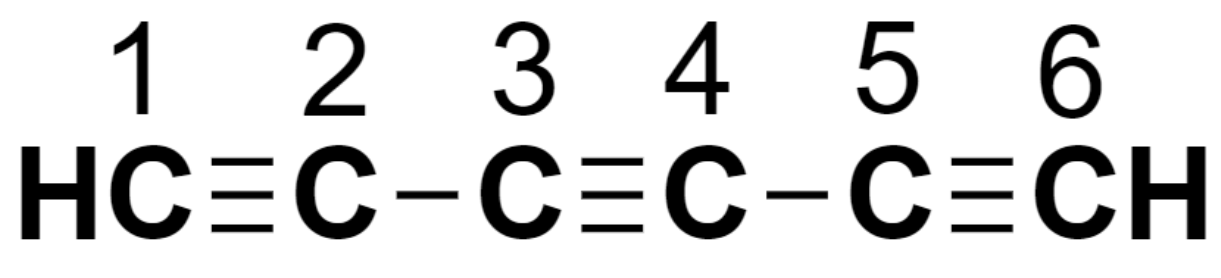
(3) – There is no substituent group. And three triple bonds are present at 1, 3, and 5 positions. So, the name of the compound will be – Hexa-1,2,3-triyne.
Hence, the answer is (A) True.
Note:
If there are both double and triple bonds present in a molecule, then the numbering of the carbon chain should start from the end which is closest to one of the multiple bonds.
Complete answer:
Unsaturated hydrocarbons containing carbon-carbon triple bonds fall under the category of alkynes. The general formula of this group of compounds is ${{\text{C}}_{\text{n}}}{{\text{H}}_{\text{2n}-\text{2}}}$. The nomenclature of alkynes is done by adding -yne as a suffix to the parent hydrocarbon chain. The following steps should be followed to name such compound:
(1) – Find the longest chain of carbon that includes all the triple bonds present.
(2) – Start numbering this longest carbon chain from the end nearest to the triple bond.
(3) – Arrange substituents' names in alphabetical order, if any.
(5) – When there is more than one triple bond in the molecule, choose the longest chain such that it contains these triple bonds and then follow rule (2) for numbering the carbon chain.
(6) – Name the compound by writing the longest carbon chain name first, then add suffix -yne to it along with the position numbers of each bond separated by commas.
Now, keeping these rules in mind let us write the name of the given compound.
(1) – Here, the longest carbon chain contains 6 carbon atoms, that is, hexane.
(2) – Numbering the carbon chain such that it includes triple bonds. In this case, the compound is symmetrical, so numbering from either side will not make any difference.
(3) – There is no substituent group. And three triple bonds are present at 1, 3, and 5 positions. So, the name of the compound will be – Hexa-1,2,3-triyne.
Hence, the answer is (A) True.
Note:
If there are both double and triple bonds present in a molecule, then the numbering of the carbon chain should start from the end which is closest to one of the multiple bonds.
Recently Updated Pages
Master Class 11 Computer Science: Engaging Questions & Answers for Success

Master Class 11 Business Studies: Engaging Questions & Answers for Success
Master Class 11 Economics: Engaging Questions & Answers for Success
Master Class 11 English: Engaging Questions & Answers for Success
Master Class 11 Maths: Engaging Questions & Answers for Success
Master Class 11 Biology: Engaging Questions & Answers for Success
Trending doubts
One Metric ton is equal to kg A 10000 B 1000 C 100 class 11 physics CBSE
There are 720 permutations of the digits 1 2 3 4 5 class 11 maths CBSE
Discuss the various forms of bacteria class 11 biology CBSE
Draw a diagram of a plant cell and label at least eight class 11 biology CBSE
State the laws of reflection of light
Explain zero factorial class 11 maths CBSE