




The n identical cells, each of EMF $\varepsilon $ and internal resistance r, are joined in series to form a closed circuit. The potential difference across any one cell is:
A. Zero
B. $\varepsilon $
C. $\dfrac{\varepsilon }{n}$
D. $\dfrac{n-1}{n}\varepsilon $
Answer
 Verified
573k+ views
Hint: Here, the emf of each cell is the same, it means they will send out the same potential difference when connected to an external circuit. Also, according to Ohm's law current is defined as the ratio of total EMF to the total resistance(r),\[i=\dfrac{emf}{r}\]. The net EMF of a series circuit is \[n\varepsilon \] and the net internal resistance is $nr$. Now to find out the potential across any one cell we write the equation of voltage (according to Kirchhoff’s voltage law) through that cell.
Complete step by step answer:
We know that in series combination current remains same and in case of parallel combination the potential difference remains same. The emf of each is $\varepsilon $, so the net emf of the cells will become $n\varepsilon $. Also, the resistances are in series combination and so the net resistance is given by:$r+r+r+r..........n \, times=nr$.
According to Ohm's law current is defined as the ratio of total EMF to the total resistance, \[i=\dfrac{V}{r}\]
Therefore the current in the circuit is $i=\dfrac{n\varepsilon }{nr}=\dfrac{\varepsilon }{r}$.
Drawing the equivalent circuit,
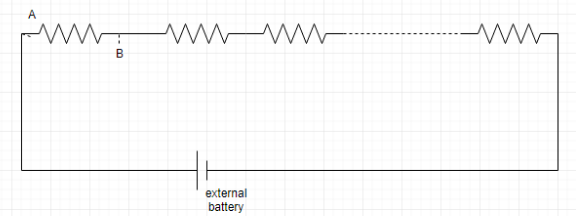
The potential across any cell can be given as,
${{V}_{a}}-{{V}_{b}}=-\varepsilon +ir\\
\Rightarrow{{V}_{a}}-{{V}_{b}} =-\varepsilon +\dfrac{\varepsilon }{r}\times r\\
\Rightarrow{{V}_{a}}-{{V}_{b}} =-\varepsilon +\varepsilon \\
\therefore{{V}_{a}}-{{V}_{b}} =0\\$
Therefore the potential difference across any one cell is zero.
Note:One should know to write the potential across two points in a circuit using Kirchhoff's voltage law equation. EMF or the electromotive force is defined as a potential difference across a cell when the cell is not in use and is the maximum potential difference across the cell. The potential difference of a cell is defined as the difference in potential between the two terminals of the cell when the cell is being used, that is when current passes through the cell. Internal resistance of a cell is defined as the opposition to the flow of current by the cell.
Complete step by step answer:
We know that in series combination current remains same and in case of parallel combination the potential difference remains same. The emf of each is $\varepsilon $, so the net emf of the cells will become $n\varepsilon $. Also, the resistances are in series combination and so the net resistance is given by:$r+r+r+r..........n \, times=nr$.
According to Ohm's law current is defined as the ratio of total EMF to the total resistance, \[i=\dfrac{V}{r}\]
Therefore the current in the circuit is $i=\dfrac{n\varepsilon }{nr}=\dfrac{\varepsilon }{r}$.
Drawing the equivalent circuit,
The potential across any cell can be given as,
${{V}_{a}}-{{V}_{b}}=-\varepsilon +ir\\
\Rightarrow{{V}_{a}}-{{V}_{b}} =-\varepsilon +\dfrac{\varepsilon }{r}\times r\\
\Rightarrow{{V}_{a}}-{{V}_{b}} =-\varepsilon +\varepsilon \\
\therefore{{V}_{a}}-{{V}_{b}} =0\\$
Therefore the potential difference across any one cell is zero.
Note:One should know to write the potential across two points in a circuit using Kirchhoff's voltage law equation. EMF or the electromotive force is defined as a potential difference across a cell when the cell is not in use and is the maximum potential difference across the cell. The potential difference of a cell is defined as the difference in potential between the two terminals of the cell when the cell is being used, that is when current passes through the cell. Internal resistance of a cell is defined as the opposition to the flow of current by the cell.
Recently Updated Pages
Three beakers labelled as A B and C each containing 25 mL of water were taken A small amount of NaOH anhydrous CuSO4 and NaCl were added to the beakers A B and C respectively It was observed that there was an increase in the temperature of the solutions contained in beakers A and B whereas in case of beaker C the temperature of the solution falls Which one of the following statements isarecorrect i In beakers A and B exothermic process has occurred ii In beakers A and B endothermic process has occurred iii In beaker C exothermic process has occurred iv In beaker C endothermic process has occurred

Master Class 12 Social Science: Engaging Questions & Answers for Success
Master Class 12 Physics: Engaging Questions & Answers for Success
Master Class 12 Maths: Engaging Questions & Answers for Success
Master Class 12 Economics: Engaging Questions & Answers for Success
Master Class 12 Chemistry: Engaging Questions & Answers for Success
Three beakers labelled as A B and C each containing 25 mL of water were taken A small amount of NaOH anhydrous CuSO4 and NaCl were added to the beakers A B and C respectively It was observed that there was an increase in the temperature of the solutions contained in beakers A and B whereas in case of beaker C the temperature of the solution falls Which one of the following statements isarecorrect i In beakers A and B exothermic process has occurred ii In beakers A and B endothermic process has occurred iii In beaker C exothermic process has occurred iv In beaker C endothermic process has occurred
Master Class 12 Social Science: Engaging Questions & Answers for Success
Master Class 12 Physics: Engaging Questions & Answers for Success
Trending doubts
Which are the Top 10 Largest Countries of the World?
Draw a labelled sketch of the human eye class 12 physics CBSE
What are the major means of transport Explain each class 12 social science CBSE
Differentiate between homogeneous and heterogeneous class 12 chemistry CBSE
Sulphuric acid is known as the king of acids State class 12 chemistry CBSE
Why should a magnesium ribbon be cleaned before burning class 12 chemistry CBSE