




The motion of a pendulum is an example of:
A. Translatory motion
B. Rotational motion
C. Oscillatory motion
D. Curvilinear motion
Answer
 Verified
621.6k+ views
Hint: A motion in which a particle undergoes periodic motion is called Simple harmonic motion (S.H.M). Not every periodic motion is S.H.M but every S.H.M is periodic motion. The revolution of earth about the sun is an example of periodic motion but it is not simple harmonic. A motion is said to be simple harmonic only if the acceleration of the particle is the function of first power of displacement and having direction opposite of the displacement.
Complete answer:
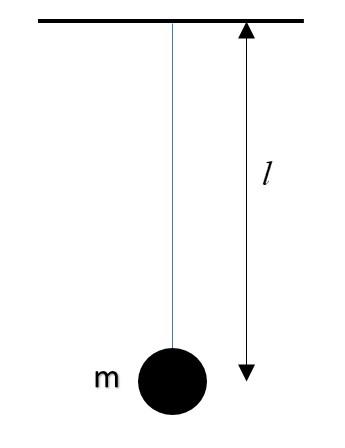
Mathematically we can say that if the motion is simple harmonic, it must follow the standard differential equation of simple harmonic motion which is given by $\dfrac{d^2x}{dt^2} = -\omega^2 x$. Let’s consider a bob of mass ‘m’ tied with a string of length ‘l’, pivoted vertically as shown in the figure.
Let’s now displace the bob by a small angle $\theta$, the only force acting on the pendulum is its weight.
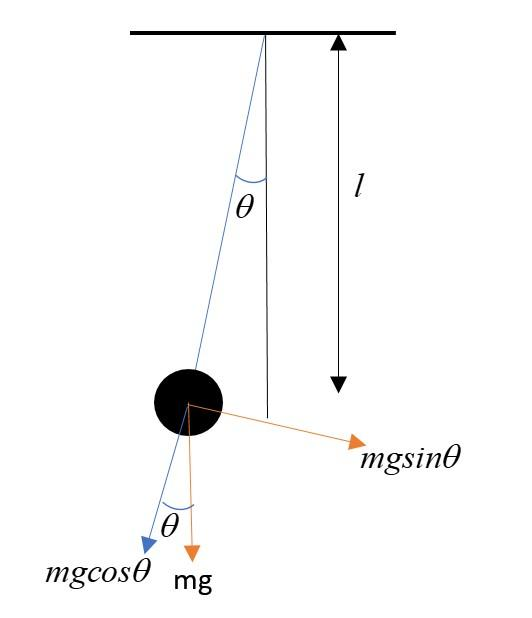
After taking components of the weight, we can see that the only force responsible for the restoring motion of the pendulum is $mgsin\theta$. Thus, writing the equation of motion:
$ma = -mg sin\theta$
Or $a=-gsin\theta$
For smaller angles, $sin \theta \approx \theta$
Thus, $a = -g\theta$
Now, we know that $a_{linear} = r \alpha$, where ‘r’ is the radius in which the body is revolving. So,
$l \alpha = -g \theta$
$\alpha = -\dfrac{g}{l}\theta$
Also, $\alpha = \dfrac{d^2 \theta}{dt^2}$
So $\dfrac{d^2 \theta}{dt^2} = - \dfrac{g}{l}\theta$
Which is the equation of S.H.M. Thus the given motion is simple harmonic. Since simple harmonic motion is an oscillatory motion.
So, the correct answer is “Option C”.
Note:
Students can make mistakes about the fact that every simple harmonic motion is periodic but not every periodic motion is simple harmonic. The revolution of a fan about its own axis is an example of simple harmonic motion. On comparing the obtained equation with the equation of S.H.M, we get a time period of a simple pendulum is $T = 2\pi \sqrt{\dfrac lg}$.
Complete answer:
Mathematically we can say that if the motion is simple harmonic, it must follow the standard differential equation of simple harmonic motion which is given by $\dfrac{d^2x}{dt^2} = -\omega^2 x$. Let’s consider a bob of mass ‘m’ tied with a string of length ‘l’, pivoted vertically as shown in the figure.
Let’s now displace the bob by a small angle $\theta$, the only force acting on the pendulum is its weight.
After taking components of the weight, we can see that the only force responsible for the restoring motion of the pendulum is $mgsin\theta$. Thus, writing the equation of motion:
$ma = -mg sin\theta$
Or $a=-gsin\theta$
For smaller angles, $sin \theta \approx \theta$
Thus, $a = -g\theta$
Now, we know that $a_{linear} = r \alpha$, where ‘r’ is the radius in which the body is revolving. So,
$l \alpha = -g \theta$
$\alpha = -\dfrac{g}{l}\theta$
Also, $\alpha = \dfrac{d^2 \theta}{dt^2}$
So $\dfrac{d^2 \theta}{dt^2} = - \dfrac{g}{l}\theta$
Which is the equation of S.H.M. Thus the given motion is simple harmonic. Since simple harmonic motion is an oscillatory motion.
So, the correct answer is “Option C”.
Note:
Students can make mistakes about the fact that every simple harmonic motion is periodic but not every periodic motion is simple harmonic. The revolution of a fan about its own axis is an example of simple harmonic motion. On comparing the obtained equation with the equation of S.H.M, we get a time period of a simple pendulum is $T = 2\pi \sqrt{\dfrac lg}$.
Recently Updated Pages
Master Class 11 English: Engaging Questions & Answers for Success

Master Class 11 Social Science: Engaging Questions & Answers for Success
Master Class 11 Maths: Engaging Questions & Answers for Success
Master Class 11 Biology: Engaging Questions & Answers for Success
Master Class 11 Physics: Engaging Questions & Answers for Success
Master Class 11 Chemistry: Engaging Questions & Answers for Success
Trending doubts
One Metric ton is equal to kg A 10000 B 1000 C 100 class 11 physics CBSE
Difference Between Prokaryotic Cells and Eukaryotic Cells
Find the value of the expression given below sin 30circ class 11 maths CBSE
1 ton equals to A 100 kg B 1000 kg C 10 kg D 10000 class 11 physics CBSE
Two of the body parts which do not appear in MRI are class 11 biology CBSE
What are hard magnetic materials class 11 physics CBSE