




The most useful plasmid for cloning is
Answer
 Verified
541.2k+ views
Hint: The process of making multiple copies of a fragment of DNA is called DNA cloning. A plasmid is used as a vector to carry the desired DNA fragment into bacteria which reproduces to produce multiple copies of this DNA which are called clones.
Complete answer:
The plasmid is a small, circular, extrachromosomal DNA molecule. It is single-stranded and has the ability to replicate autonomously and is not under the control of chromosomal DNA. It is found in bacteria and some eukaryotes like yeast.
Because of its ability to replicate, plasmid acts as a cloning vector in recombinant DNA technology for manipulating genes. The most useful plasmid for cloning is pBR322.
Following are the characteristics of pBR322-
- Restriction sites: BamH I, Hind III, Pvu I, Pvu II, Pst I, EcoR I
- Selectable marker: antibiotic resistance genes for ampicillin and tetracycline
- ORI: the origin of replication
- ROP: It codes for proteins involved in the process of replication of plasmid
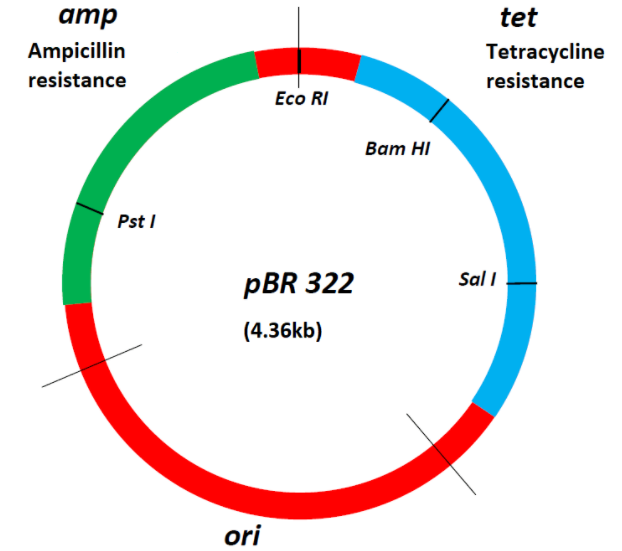
Hence, we can say that the most useful plasmid for cloning is pBR322.
Additional Information: The technology used to produce artificial DNA by combining various DNA fragments having desired genes is called recombinant DNA technology or genetic engineering. It can be accomplished by using specific tools- restriction enzymes, polymerase enzymes, ligases, cloning vectors and the host organism.
Note: Alternative selectable marker help in differentiating recombinants from non-recombinants by producing coloured colonies when reacted with a chromogenic substrate. A recombinant DNA is inserted within the coding sequence of an enzyme, β-galactosidase. This causes the inactivation of the gene for the synthesis of this enzyme. This is referred to as insertional inactivation.
Complete answer:
The plasmid is a small, circular, extrachromosomal DNA molecule. It is single-stranded and has the ability to replicate autonomously and is not under the control of chromosomal DNA. It is found in bacteria and some eukaryotes like yeast.
Because of its ability to replicate, plasmid acts as a cloning vector in recombinant DNA technology for manipulating genes. The most useful plasmid for cloning is pBR322.
Following are the characteristics of pBR322-
- Restriction sites: BamH I, Hind III, Pvu I, Pvu II, Pst I, EcoR I
- Selectable marker: antibiotic resistance genes for ampicillin and tetracycline
- ORI: the origin of replication
- ROP: It codes for proteins involved in the process of replication of plasmid
Hence, we can say that the most useful plasmid for cloning is pBR322.
Additional Information: The technology used to produce artificial DNA by combining various DNA fragments having desired genes is called recombinant DNA technology or genetic engineering. It can be accomplished by using specific tools- restriction enzymes, polymerase enzymes, ligases, cloning vectors and the host organism.
Note: Alternative selectable marker help in differentiating recombinants from non-recombinants by producing coloured colonies when reacted with a chromogenic substrate. A recombinant DNA is inserted within the coding sequence of an enzyme, β-galactosidase. This causes the inactivation of the gene for the synthesis of this enzyme. This is referred to as insertional inactivation.
Recently Updated Pages
Master Class 12 Economics: Engaging Questions & Answers for Success

Master Class 12 English: Engaging Questions & Answers for Success
Master Class 12 Social Science: Engaging Questions & Answers for Success
Master Class 12 Maths: Engaging Questions & Answers for Success
Master Class 12 Physics: Engaging Questions & Answers for Success
Master Class 9 General Knowledge: Engaging Questions & Answers for Success
Trending doubts
One Metric ton is equal to kg A 10000 B 1000 C 100 class 11 physics CBSE
Difference Between Prokaryotic Cells and Eukaryotic Cells
Two of the body parts which do not appear in MRI are class 11 biology CBSE
1 ton equals to A 100 kg B 1000 kg C 10 kg D 10000 class 11 physics CBSE
Draw a diagram of nephron and explain its structur class 11 biology CBSE
10 examples of friction in our daily life