




The most stable conformer of Cis-1,4-cyclohexan-1,4-diol is:
A.Diaxial boat form
B.Diequatorial boat form
C.Diaxial chair form
D.Diequatorial chair form
Answer
 Verified
650.4k+ views
Hint: Draw all the forms one by one and compare their stability. Also check the possibility of 1,3 diaxial repulsion and steric hindrance while assigning the stability priority.
Complete step by step answer:
We will draw the structure for every form and then we will decide which is stable or which is not. Let’s start with option A-Diaxial boat form
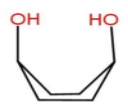
Here we can see there will be a strong intramolecular hydrogen bonding. In cyclohexane boat form 1, 4 interaction is known as Flagpole interaction which makes it unstable. But in case of Cis-1,4-cyclohexan-1,4-diol ,\[ - OH\] groups are present instead of hydrogen then there will be a strong hydrogen bonding and no flagpole interaction. Hence Diaxial boat form is stable.
Let’s move to option B – Diequatorial boat form.
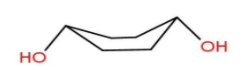
Here we can see that \[ - OH\] groups are at equilibrium but hydrogens present at axial position will show flagpole interaction. Due to this interaction Diequatorial boat form is unstable.
Now Option C- Diaxial chair form.
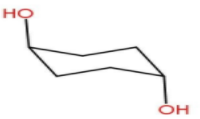
In Diaxial chair form there is a high possibility of 1, 3-Diaxial repulsion . Due to this interaction there will
be a strong steric hindrance in this form. Hence this is also unstable.
Let’s move to the last option D- Diequatorial form.
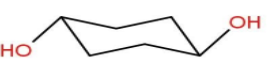
Though \[ - OH\] groups being bulky are placed at equatorial positions. Still there is a 1,3-Diaxial repulsion present in this form hence, making it unstable.
So, we have seen from all the four forms Diaxial boat form is the most stable form.
Hence the correct answer is option A.
Note:
Not every time equatorial forms will be the most stable one. There can be exceptions where axial and boat forms can be more stable than equatorial and chair forms. Take the example of 3-aminocyclohexanol. You might think that equatorial form must be a stable one because $ - N{H_2}$ is bulky than hydrogens. So if we keep the bulkier group at equatorial position it will provide stability to the compound. But that’s not the case. Here, also in axial form strong intramolecular hydrogen bonding takes place making the axial form more stable than equatorial form
Complete step by step answer:
We will draw the structure for every form and then we will decide which is stable or which is not. Let’s start with option A-Diaxial boat form
Here we can see there will be a strong intramolecular hydrogen bonding. In cyclohexane boat form 1, 4 interaction is known as Flagpole interaction which makes it unstable. But in case of Cis-1,4-cyclohexan-1,4-diol ,\[ - OH\] groups are present instead of hydrogen then there will be a strong hydrogen bonding and no flagpole interaction. Hence Diaxial boat form is stable.
Let’s move to option B – Diequatorial boat form.
Here we can see that \[ - OH\] groups are at equilibrium but hydrogens present at axial position will show flagpole interaction. Due to this interaction Diequatorial boat form is unstable.
Now Option C- Diaxial chair form.
In Diaxial chair form there is a high possibility of 1, 3-Diaxial repulsion . Due to this interaction there will
be a strong steric hindrance in this form. Hence this is also unstable.
Let’s move to the last option D- Diequatorial form.
Though \[ - OH\] groups being bulky are placed at equatorial positions. Still there is a 1,3-Diaxial repulsion present in this form hence, making it unstable.
So, we have seen from all the four forms Diaxial boat form is the most stable form.
Hence the correct answer is option A.
Note:
Not every time equatorial forms will be the most stable one. There can be exceptions where axial and boat forms can be more stable than equatorial and chair forms. Take the example of 3-aminocyclohexanol. You might think that equatorial form must be a stable one because $ - N{H_2}$ is bulky than hydrogens. So if we keep the bulkier group at equatorial position it will provide stability to the compound. But that’s not the case. Here, also in axial form strong intramolecular hydrogen bonding takes place making the axial form more stable than equatorial form
Recently Updated Pages
If x a + bt + ct2 where x is in meters and t is in class 11 physics CBSE

A car covers the first half distance between two places class 11 physics CBSE
The resultant of two vectors overrightarrow P and overrightarrow class 11 physics CBSE
Find the value of cos 135 class 11 maths CBSE
A mass M is held in place by an applied force F and class 11 physics CBSE
A solution of glucose in water is labelled as 10 dfracwv class 11 chemistry CBSE
Trending doubts
One Metric ton is equal to kg A 10000 B 1000 C 100 class 11 physics CBSE
Find the value of the expression given below sin 30circ class 11 maths CBSE
What do you mean by retardation What is its SI uni class 11 physics CBSE
Draw a diagram of nephron and explain its structur class 11 biology CBSE
10 examples of friction in our daily life
Difference between physical and chemical change class 11 chemistry CBSE