




The most distinctive character of the sponge is
A. Presence of choanocytes
B. Unicellular
C. Marine
D. Asexual reproduction
Answer
 Verified
585.6k+ views
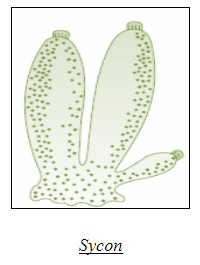
Hint: The Phylum porifers are strange, apparently lifeless and plant-like creatures commonly called the sponges. The body form varies considerably. Some sponges are vase-like or cylindrical, but the majority form flat, globular or irregular, or branching masses.
Complete answer: The unique features of sponges are as follows-
1. Pores all over the body
2. The cellular level of body organization.
3. A canal system of intercommunicating cavities for the passage of water current.
4. Lack of mouth and digestive cavity.
5. Chaonocytes lining the main cavity (spongocoel) or certain canals ( radial canals).
So, the correct answer is “Option A”.
Additional Information: The body wall consists of two imperfect layers: outer dermal layer, or pinacoderm, and inner chaonocytic layer or chanoderm.
The dermal layers consist of flat cells called pinacocytes and oval porocytes.
The chronic layer consists of characteristic flagellated collar cells or choanocytes.
Between these layers is a gelatinous material named mesophyll or mesenchyme.
It contains numerous free amoeboid cells, the amoebocytes, of several kinds, such as scleroblasts, spongioblasts, phagocytes, trophocytes, archaeocytes, collencytes, chromocytes, porocytes, and gland cells. The entire body bears pores.
Note: The sponges show advancement over protists in having a large multicellular body, a greater division of labour among the cells, male and female gametes in the form of spermatozoa and ova, and development from zygote by segmentation instead of by mere growth.
Complete answer: The unique features of sponges are as follows-
1. Pores all over the body
2. The cellular level of body organization.
3. A canal system of intercommunicating cavities for the passage of water current.
4. Lack of mouth and digestive cavity.
5. Chaonocytes lining the main cavity (spongocoel) or certain canals ( radial canals).
So, the correct answer is “Option A”.
Additional Information: The body wall consists of two imperfect layers: outer dermal layer, or pinacoderm, and inner chaonocytic layer or chanoderm.
The dermal layers consist of flat cells called pinacocytes and oval porocytes.
The chronic layer consists of characteristic flagellated collar cells or choanocytes.
Between these layers is a gelatinous material named mesophyll or mesenchyme.
It contains numerous free amoeboid cells, the amoebocytes, of several kinds, such as scleroblasts, spongioblasts, phagocytes, trophocytes, archaeocytes, collencytes, chromocytes, porocytes, and gland cells. The entire body bears pores.
Note: The sponges show advancement over protists in having a large multicellular body, a greater division of labour among the cells, male and female gametes in the form of spermatozoa and ova, and development from zygote by segmentation instead of by mere growth.
Recently Updated Pages
Master Class 11 Computer Science: Engaging Questions & Answers for Success

Master Class 11 Business Studies: Engaging Questions & Answers for Success
Master Class 11 Economics: Engaging Questions & Answers for Success
Master Class 11 English: Engaging Questions & Answers for Success
Master Class 11 Maths: Engaging Questions & Answers for Success
Master Class 11 Biology: Engaging Questions & Answers for Success
Trending doubts
One Metric ton is equal to kg A 10000 B 1000 C 100 class 11 physics CBSE
There are 720 permutations of the digits 1 2 3 4 5 class 11 maths CBSE
Discuss the various forms of bacteria class 11 biology CBSE
Draw a diagram of a plant cell and label at least eight class 11 biology CBSE
State the laws of reflection of light
Explain zero factorial class 11 maths CBSE