




The moon’s distance from the earth is 360000 km and its diameter subtends an angle of 42’ at the eye of the observer. The diameter of the moon is?
(a) 4400 km
(b) 1000km
(c) 3600km
(d) 8800km
Answer
 Verified
649.2k+ views
Hint: In the question the key is approximation. As the angle subtended by the diameter in the eye of the observer is very small, i.e., 42’, we can say that the diameter of the moon is equal to $R\theta $ , where R is equal to the distance and $\theta $ is the angle subtended in radians.
Complete step-by-step answer:
Let us start the solution to the above question by drawing a rough figure of the situation given.
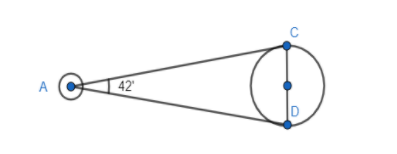
In the given figure, A is the eye of the observer. CD is the diameter of the moon.
Now, as the angle subtended by the diameter in the eye of the observer is very small, i.e., 42’, we can say that the diameter of the moon is equal to $R\theta $ , where R is equal to the distance and $\theta $ is the angle subtended in radians.
So, let us first convert 42’ to radians. We know that $180{}^\circ ={{\pi }^{c}}$ and $1{}^\circ =60'$ . So, we can say that
${{\pi }^{c}}=180\times 60'=10800'$
As 10800’ is equal to ${{\pi }^{c}}$ , we can say that 1’ is equal to $\dfrac{{{\pi }^{c}}}{10800}$ . Using this we can say that 42’ corresponds to $\dfrac{42{{\pi }^{c}}}{10800}=0.0039{{\pi }^{c}}$ .
Therefore, the diameter Cd is given by:
$R\theta =360000\times 0.0039\pi =1404\pi km$
And if we put the value of $\pi =3.14$ , we get CD=4408.56 km, which is approximately equal to 4400 km.
Hence, the answer to the above question is option (a).
Note: Remember that the answers you get in such questions are not exact but are approximate values, as the first approximation we did was taking $R\theta $ as the diameter, next was the value of 42’ in radians which was approximated value and finally the value of $\pi $ which is also taken only to two decimal places.
Complete step-by-step answer:
Let us start the solution to the above question by drawing a rough figure of the situation given.
In the given figure, A is the eye of the observer. CD is the diameter of the moon.
Now, as the angle subtended by the diameter in the eye of the observer is very small, i.e., 42’, we can say that the diameter of the moon is equal to $R\theta $ , where R is equal to the distance and $\theta $ is the angle subtended in radians.
So, let us first convert 42’ to radians. We know that $180{}^\circ ={{\pi }^{c}}$ and $1{}^\circ =60'$ . So, we can say that
${{\pi }^{c}}=180\times 60'=10800'$
As 10800’ is equal to ${{\pi }^{c}}$ , we can say that 1’ is equal to $\dfrac{{{\pi }^{c}}}{10800}$ . Using this we can say that 42’ corresponds to $\dfrac{42{{\pi }^{c}}}{10800}=0.0039{{\pi }^{c}}$ .
Therefore, the diameter Cd is given by:
$R\theta =360000\times 0.0039\pi =1404\pi km$
And if we put the value of $\pi =3.14$ , we get CD=4408.56 km, which is approximately equal to 4400 km.
Hence, the answer to the above question is option (a).
Note: Remember that the answers you get in such questions are not exact but are approximate values, as the first approximation we did was taking $R\theta $ as the diameter, next was the value of 42’ in radians which was approximated value and finally the value of $\pi $ which is also taken only to two decimal places.
Recently Updated Pages
Basicity of sulphurous acid and sulphuric acid are

Master Class 12 Economics: Engaging Questions & Answers for Success
Master Class 12 Biology: Engaging Questions & Answers for Success
Master Class 11 English: Engaging Questions & Answers for Success
Master Class 11 Physics: Engaging Questions & Answers for Success
Master Class 11 Computer Science: Engaging Questions & Answers for Success
Trending doubts
What is the Total Duration of Football Match?
Explain the Treaty of Vienna of 1815 class 10 social science CBSE
In football, which nation is called "La Roja"?
Why is there a time difference of about 5 hours between class 10 social science CBSE
10 examples of evaporation in daily life with explanations
What is the full form of POSCO class 10 social science CBSE