




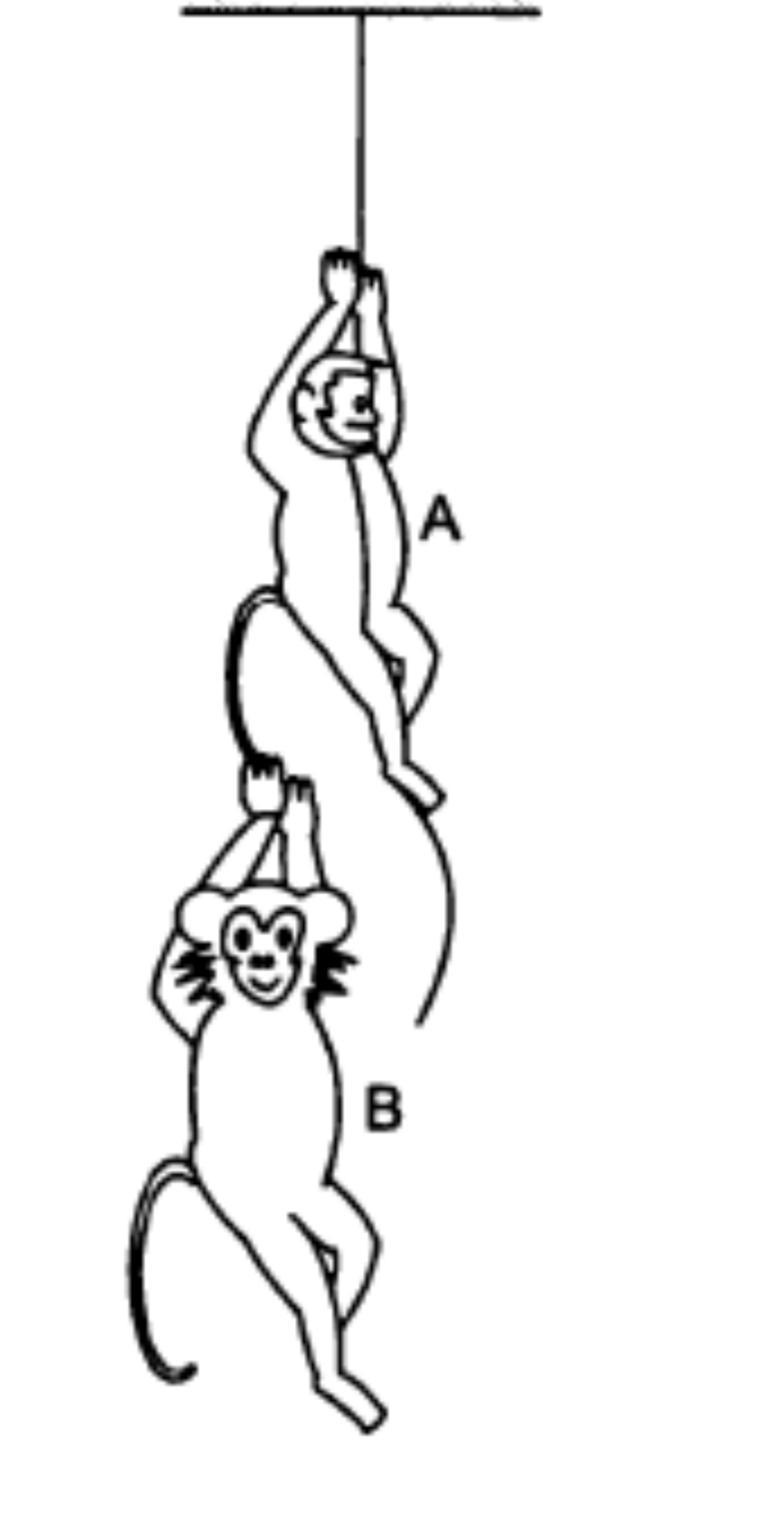
The monkey B shown in figure is holding on to the tail of monkey A which is climbing up a rope. The masses of the monkeys A and B are 5 kg and 2 kg respectively. If A can tolerate a tension of 30 N in its tail , what force should it apply on the rope in order to carry monkey B with it ? Take $ g = 10m{s^{ - 2}} $
Answer
 Verified
570.3k+ views
Hint :The net acceleration given to objects owing to the combined influence of gravitation and centrifugal force is indicated by g, the gravity of Earth. This acceleration is measured in metres per second squared or newtons per kilogram in SI units. To answer this question, we use F = mg.
Complete Step By Step Answer:
The monkey B (the kid of monkey A) is immobile in relation to monkey A, and they both move at the same rate,a. Now, the force that should be used to pull monkey B upwards in order for him to be raised with acceleration a must be equal to m(g+a), where m is the mass of monkey B. Because monkey A's tail has a maximum tension of 30N.
So, 30=m(g+a)=2(10+a)
Hence, $ \Rightarrow a = 5m{s^{ - 2}} $
This is the greatest upward acceleration that both systems can achieve as a combined system. The tail of monkey A will break if the acceleration exceeds this amount. Now, the force that monkey A must apply to the rope in order for this force to be performed onto him as the reaction force must be adequate to raise both the monkey A and the kid monkey B at a common acceleration of $ a = 5m{s^{ - 2}} $ .
Now, $ {F_{max}} $ =(M+m)(g+a)=7×15=105N
This is the maximum force that monkey A should apply to the rope in order for the entire system to travel at maximum speed. When both the monkey and the child go up at the same speed, the situation of minimal force acting on the combined system of the monkey and the child will occur. If that's the case, $ {F_{min}} = (M + m)g = 70N. $
To go up with maximal acceleration, monkey A should pull the rope with a force of 70N, so that the strain on his tail is just equal to the breaking strength of the tail.
Hence option C is correct.
Note :
Do be careful where you add up the masses and where you subtract the given two masses.
It asserts that an object's rate of change of velocity is directly proportional to the force applied and occurs in the force's direction. The equation is as follows: force (N) = mass (kg) x acceleration ( $ m{s^{ - 2}} $ ). As a result, the acceleration of a constant mass object is proportional to the force applied.
Complete Step By Step Answer:
The monkey B (the kid of monkey A) is immobile in relation to monkey A, and they both move at the same rate,a. Now, the force that should be used to pull monkey B upwards in order for him to be raised with acceleration a must be equal to m(g+a), where m is the mass of monkey B. Because monkey A's tail has a maximum tension of 30N.
So, 30=m(g+a)=2(10+a)
Hence, $ \Rightarrow a = 5m{s^{ - 2}} $
This is the greatest upward acceleration that both systems can achieve as a combined system. The tail of monkey A will break if the acceleration exceeds this amount. Now, the force that monkey A must apply to the rope in order for this force to be performed onto him as the reaction force must be adequate to raise both the monkey A and the kid monkey B at a common acceleration of $ a = 5m{s^{ - 2}} $ .
Now, $ {F_{max}} $ =(M+m)(g+a)=7×15=105N
This is the maximum force that monkey A should apply to the rope in order for the entire system to travel at maximum speed. When both the monkey and the child go up at the same speed, the situation of minimal force acting on the combined system of the monkey and the child will occur. If that's the case, $ {F_{min}} = (M + m)g = 70N. $
To go up with maximal acceleration, monkey A should pull the rope with a force of 70N, so that the strain on his tail is just equal to the breaking strength of the tail.
Hence option C is correct.
Note :
Do be careful where you add up the masses and where you subtract the given two masses.
It asserts that an object's rate of change of velocity is directly proportional to the force applied and occurs in the force's direction. The equation is as follows: force (N) = mass (kg) x acceleration ( $ m{s^{ - 2}} $ ). As a result, the acceleration of a constant mass object is proportional to the force applied.
Recently Updated Pages
If x a + bt + ct2 where x is in meters and t is in class 11 physics CBSE

A car covers the first half distance between two places class 11 physics CBSE
The resultant of two vectors overrightarrow P and overrightarrow class 11 physics CBSE
Find the value of cos 135 class 11 maths CBSE
A mass M is held in place by an applied force F and class 11 physics CBSE
A solution of glucose in water is labelled as 10 dfracwv class 11 chemistry CBSE
Trending doubts
One Metric ton is equal to kg A 10000 B 1000 C 100 class 11 physics CBSE
Find the value of the expression given below sin 30circ class 11 maths CBSE
What do you mean by retardation What is its SI uni class 11 physics CBSE
Draw a diagram of nephron and explain its structur class 11 biology CBSE
10 examples of friction in our daily life
Difference between physical and chemical change class 11 chemistry CBSE