




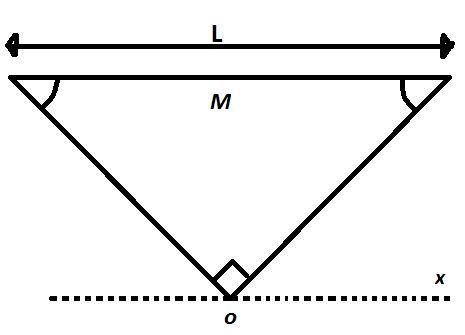
The moment of inertia of the plate about its base parallel to the x-axis is
A. $\dfrac{M{{L}^{2}}}{18}$
B. $\dfrac{M{{L}^{2}}}{36}$
C. $\dfrac{M{{L}^{2}}}{24}$
D. None of these
Answer
 Verified
652.2k+ views
Hint: We could call the moment of inertia as the rotational analogue of mass. It is a parameter characterizing a rigid body that depends on the distribution of mass about the body’s axis of rotation. In order to find the moment of inertia of this whole triangular plate, we could first find the moment of inertia for an infinitely small rectangular strip and then integrate the same to get the answer.
Formula used:
$I=\sum\limits_{i=1}^{n}{{{m}_{i}}{{r}_{i}}^{2}}$
$I=\int{dI}$
Complete step by step answer:
We know that, moment of inertia ‘I’ of an object is given by,
$I=\sum\limits_{i=1}^{n}{{{m}_{i}}{{r}_{i}}^{2}}$ ……………. (1)
We are going to follow the method of direct integration so as to find the moment of inertia of the given triangle about its base. Consider the figure,

Let us first find out the moment of inertia of an infinitely small rectangular strip of thickness ‘da’ and then integrate that value to find the required inertia.
With basic ideas in geometry (the triangle given in the question is a right angled triangle), we know that all the marked angles are 45°.
Since the sides opposite to equal angles are equal, the height of the bigger triangle is equal to half its base-length, that is, $\dfrac{L}{2}$
Also, half the length of the base of the smaller triangle is $\left( \dfrac{L}{2}-a \right)$.
Base of the smaller triangle= $2\left( \dfrac{L}{2}-a \right)$ = base of the infinitely small rectangular strip ……. (2)
Density ρ of the given triangular plate $=\dfrac{M}{A}$
Area A of the triangular plate is $=\dfrac{1}{2}\times L\times \dfrac{L}{2}=\dfrac{{{L}^{2}}}{4}$
Therefore,
$\rho =\dfrac{4M}{{{L}^{2}}}$ …………… (3)
Moment of inertia of infinitely small rectangular strip of width da and mass dm from (1) is,
$dI=dm\times {{a}^{2}}$ ……………… (4)
dm can be expressed in terms of density ρ and area. Area of the rectangular strip is,
${{A}_{r}}=2\left( \dfrac{L}{2}-a \right)da$
So,
$dm=\rho \times 2\left( \dfrac{L}{2}-a \right)da$ …………… (5)
Substituting (5) in (4),
$dI=\rho \times 2\left( \dfrac{L}{2}-a \right)da\times {{a}^{2}}$
We get Inertia of the given triangular plate by integrating $dI$
$I=\int\limits_{0}^{\dfrac{L}{2}}{dI}$
$I=\int\limits_{0}^{\dfrac{L}{2}}{\rho \left( {{a}^{2}}L-2{{a}^{3}} \right)}da$
$I=\rho \mathop{\left| \dfrac{{{a}^{3}}L}{3}-\dfrac{2{{a}^{4}}}{4} \right|}_{0}^{\dfrac{L}{2}}$
Applying limits we get,
$I=\rho \left( \dfrac{{{L}^{4}}}{24}-\dfrac{{{L}^{4}}}{32} \right)$
$I=\rho \times \dfrac{{{L}^{4}}}{96}$ …………….. (6)
We can now substitute value of ρ from equation (3) in (6)
$I=\dfrac{4M}{{{L}^{2}}}\times \dfrac{{{L}^{4}}}{96}$
$I=\dfrac{M{{L}^{2}}}{24}$
Hence, the solution of the question is option C.
Note:
If you wish to avoid this messy and lengthy integration, you could go for using perpendicular axes theorem and hence find the answer. Doing so, you could save time and find the answer in a few simple steps. Perpendicular axes theorem, if you may recall, gives the moment of inertia about an axis perpendicular to the plate as the sum of moment of inertia of the same plate about its mutually perpendicular axes. $\left( {{I}_{Z}}={{I}_{X}}+{{I}_{Y}} \right)$
Formula used:
$I=\sum\limits_{i=1}^{n}{{{m}_{i}}{{r}_{i}}^{2}}$
$I=\int{dI}$
Complete step by step answer:
We know that, moment of inertia ‘I’ of an object is given by,
$I=\sum\limits_{i=1}^{n}{{{m}_{i}}{{r}_{i}}^{2}}$ ……………. (1)
We are going to follow the method of direct integration so as to find the moment of inertia of the given triangle about its base. Consider the figure,
Let us first find out the moment of inertia of an infinitely small rectangular strip of thickness ‘da’ and then integrate that value to find the required inertia.
With basic ideas in geometry (the triangle given in the question is a right angled triangle), we know that all the marked angles are 45°.
Since the sides opposite to equal angles are equal, the height of the bigger triangle is equal to half its base-length, that is, $\dfrac{L}{2}$
Also, half the length of the base of the smaller triangle is $\left( \dfrac{L}{2}-a \right)$.
Base of the smaller triangle= $2\left( \dfrac{L}{2}-a \right)$ = base of the infinitely small rectangular strip ……. (2)
Density ρ of the given triangular plate $=\dfrac{M}{A}$
Area A of the triangular plate is $=\dfrac{1}{2}\times L\times \dfrac{L}{2}=\dfrac{{{L}^{2}}}{4}$
Therefore,
$\rho =\dfrac{4M}{{{L}^{2}}}$ …………… (3)
Moment of inertia of infinitely small rectangular strip of width da and mass dm from (1) is,
$dI=dm\times {{a}^{2}}$ ……………… (4)
dm can be expressed in terms of density ρ and area. Area of the rectangular strip is,
${{A}_{r}}=2\left( \dfrac{L}{2}-a \right)da$
So,
$dm=\rho \times 2\left( \dfrac{L}{2}-a \right)da$ …………… (5)
Substituting (5) in (4),
$dI=\rho \times 2\left( \dfrac{L}{2}-a \right)da\times {{a}^{2}}$
We get Inertia of the given triangular plate by integrating $dI$
$I=\int\limits_{0}^{\dfrac{L}{2}}{dI}$
$I=\int\limits_{0}^{\dfrac{L}{2}}{\rho \left( {{a}^{2}}L-2{{a}^{3}} \right)}da$
$I=\rho \mathop{\left| \dfrac{{{a}^{3}}L}{3}-\dfrac{2{{a}^{4}}}{4} \right|}_{0}^{\dfrac{L}{2}}$
Applying limits we get,
$I=\rho \left( \dfrac{{{L}^{4}}}{24}-\dfrac{{{L}^{4}}}{32} \right)$
$I=\rho \times \dfrac{{{L}^{4}}}{96}$ …………….. (6)
We can now substitute value of ρ from equation (3) in (6)
$I=\dfrac{4M}{{{L}^{2}}}\times \dfrac{{{L}^{4}}}{96}$
$I=\dfrac{M{{L}^{2}}}{24}$
Hence, the solution of the question is option C.
Note:
If you wish to avoid this messy and lengthy integration, you could go for using perpendicular axes theorem and hence find the answer. Doing so, you could save time and find the answer in a few simple steps. Perpendicular axes theorem, if you may recall, gives the moment of inertia about an axis perpendicular to the plate as the sum of moment of inertia of the same plate about its mutually perpendicular axes. $\left( {{I}_{Z}}={{I}_{X}}+{{I}_{Y}} \right)$
Recently Updated Pages
If x a + bt + ct2 where x is in meters and t is in class 11 physics CBSE

A car covers the first half distance between two places class 11 physics CBSE
The resultant of two vectors overrightarrow P and overrightarrow class 11 physics CBSE
Find the value of cos 135 class 11 maths CBSE
A mass M is held in place by an applied force F and class 11 physics CBSE
A solution of glucose in water is labelled as 10 dfracwv class 11 chemistry CBSE
Trending doubts
One Metric ton is equal to kg A 10000 B 1000 C 100 class 11 physics CBSE
Find the value of the expression given below sin 30circ class 11 maths CBSE
What do you mean by retardation What is its SI uni class 11 physics CBSE
Draw a diagram of nephron and explain its structur class 11 biology CBSE
10 examples of friction in our daily life
Difference between physical and chemical change class 11 chemistry CBSE