




The moment of inertia of a square plate about a diagonal is \[{I_d}\] and that about aside in its plane is \[{I_s}\] then
A) \[{I_s} = {I_d}\]
B) \[{I_s} < {I_d}\]
C) \[{I_s} > {I_d}\]
D) None of these
Answer
 Verified
638.4k+ views
Hint: Inertia is the property of an object to resist the change in its position. Also, the moment of inertia is the measure of the resistance of a body to angular acceleration.
Complete step by step solution:
Step I:
The moment of inertia depends on the mass and angular velocity of the object. In the case of any rotating object, the moment of inertia is calculated by taking the square of the distance of each particle from the axis of rotation \['{r^2}'\] and its mass \['m'\].
It is written as
\[I = m{r^2}\]
Step II:
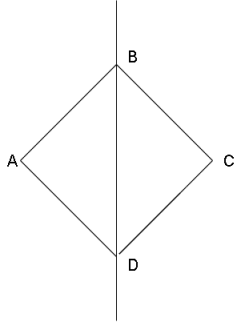
The moment of inertia is higher for a body if more mass is distributed away from the rotational axis. For a square rotating about a diagonal equal mass is distributed about its rotational axis, thus its moment of inertia will be lower.
Step III:
In the case of a square plate, the moment of inertia is more about the side in its plane \[{I_s}\] as more mass will be distributed along the sides away from the plane of rotation. So its moment of inertia will also be higher.
But in the case of its diagonal, a square is a sum of two triangles. The moment of inertia is dependent on its mass and not on the axis of rotation, so its moment of inertia will be lower.
\[{I_s} > {I_d}\]
Therefore, option (C) is the correct answer.
Note:
The moment of inertia helps in calculating the force required to move an object. A higher moment of inertia means that a large amount of force is required to rotate the object, whereas small inertia describes that the force applied to rotate the object is smaller.
Complete step by step solution:
Step I:
The moment of inertia depends on the mass and angular velocity of the object. In the case of any rotating object, the moment of inertia is calculated by taking the square of the distance of each particle from the axis of rotation \['{r^2}'\] and its mass \['m'\].
It is written as
\[I = m{r^2}\]
Step II:
The moment of inertia is higher for a body if more mass is distributed away from the rotational axis. For a square rotating about a diagonal equal mass is distributed about its rotational axis, thus its moment of inertia will be lower.
Step III:
In the case of a square plate, the moment of inertia is more about the side in its plane \[{I_s}\] as more mass will be distributed along the sides away from the plane of rotation. So its moment of inertia will also be higher.
But in the case of its diagonal, a square is a sum of two triangles. The moment of inertia is dependent on its mass and not on the axis of rotation, so its moment of inertia will be lower.
\[{I_s} > {I_d}\]
Therefore, option (C) is the correct answer.
Note:
The moment of inertia helps in calculating the force required to move an object. A higher moment of inertia means that a large amount of force is required to rotate the object, whereas small inertia describes that the force applied to rotate the object is smaller.
Recently Updated Pages
Basicity of sulphurous acid and sulphuric acid are

Master Class 11 English: Engaging Questions & Answers for Success
Master Class 11 Physics: Engaging Questions & Answers for Success
Master Class 11 Computer Science: Engaging Questions & Answers for Success
Master Class 11 Chemistry: Engaging Questions & Answers for Success
Master Class 11 Social Science: Engaging Questions & Answers for Success
Trending doubts
Difference Between Prokaryotic Cells and Eukaryotic Cells
Two of the body parts which do not appear in MRI are class 11 biology CBSE
One Metric ton is equal to kg A 10000 B 1000 C 100 class 11 physics CBSE
10 examples of friction in our daily life
Draw a diagram of nephron and explain its structur class 11 biology CBSE
What will happen if the mucus is not secreted by the class 11 biology CBSE