




The moment of inertia of a metre stick of mass 300g, about an axis at right angles to the stick and located at the 30cm mark, is.
A. $8.3 \times {10^5}g - c{m^2}$
B. $5.8g - c{m^2}$
C. $3.7 \times {10^5}g - c{m^2}$
D. None of these
Answer
 Verified
647.4k+ views
Hint:Whenever a body is set into motion, it is observed that the body will not respond quickly to the rotation. This is due to the fact there is something called inertia which indicates the inability to adapt to the quick change in the state of the body. When this inertia is associated with rotation, we call it a moment of inertia.
Complete step-by-step answer:
The moment of inertia basically, gives us the distribution of mass of a body around its axis of rotation and it is the quantity that determines the torque required to produce an angular acceleration in the rotating body.
Consider a metre stick of mass m as shown.
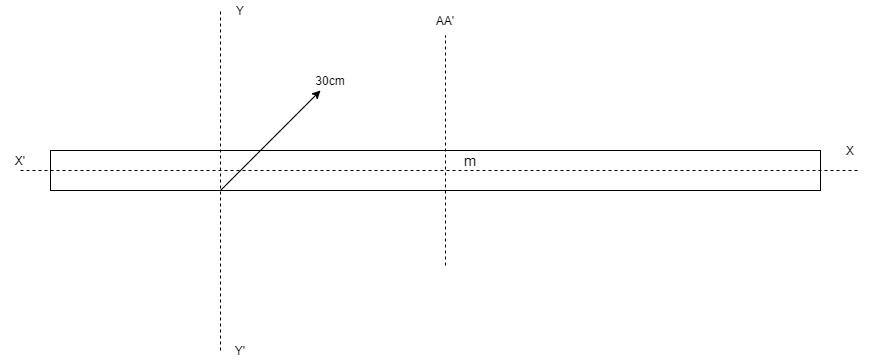
The moment of inertia of the metre scale along right angle at the axis AA’ is given by -
${I_{AA}} = \dfrac{{M{L^2}}}{{12}}$
The moment of inertia about the axis Y-Y’ which is parallel to the axis AA’ and at a distance of 20 cm from the centre (since it is 30cm from one end, from the centre, it will be 50-30= 20cm) is calculated by the Parallel Axis theorem.
It states that - The moment of inertia of a body about an axis parallel to the body passing through its centre is equal to the sum of moment of inertia of body about the axis passing through the centre and product of mass of the body times the square of distance between the two axes.
${I_{YY}} = {I_{AA}} + M{d^2}$
In the problem,
Mass, M = 300 g
Distance from the axis, $d = 50 - 30 = 20cm = 0.2m$
Length, L = 100 cm = 1m
Applying the formula for moment of inertia over the axis Y-Y’, we get –
$
{I_{YY}} = {I_{AA}} + M{d^2} \\
\to {I_{YY}} = \dfrac{{M{L^2}}}{2} + M{d^2} \\
Substituting, \\
{I_{YY}} = \dfrac{{300 \times {{100}^2}}}{{12}} + 300 \times {20^2} \\
Solving, \\
{I_{YY}} = 25 \times {10^4} + 300 \times 400 \\
\to {I_{YY}} = 25 \times {10^4} + 12 \times {10^4} \\
\to {I_{YY}} = 37 \times {10^4} \\
\to {I_{YY}} = 3.7 \times {10^5}g - c{m^2} \\
$
Thus, the correct option is Option C.
Note: There are 2 ways of compressive stress failure in columns – Crushing and Buckling. Crushing occurs for shorter columns, also called struts and Buckling occurs in longer columns. Even though you may think that their classification of long and short columns is subjective, it depends on a number known as Slenderness Ratio, which is dependent on moment of inertia.
Slenderness ratio = $\dfrac{l}{k}$
Complete step-by-step answer:
The moment of inertia basically, gives us the distribution of mass of a body around its axis of rotation and it is the quantity that determines the torque required to produce an angular acceleration in the rotating body.
Consider a metre stick of mass m as shown.
The moment of inertia of the metre scale along right angle at the axis AA’ is given by -
${I_{AA}} = \dfrac{{M{L^2}}}{{12}}$
The moment of inertia about the axis Y-Y’ which is parallel to the axis AA’ and at a distance of 20 cm from the centre (since it is 30cm from one end, from the centre, it will be 50-30= 20cm) is calculated by the Parallel Axis theorem.
It states that - The moment of inertia of a body about an axis parallel to the body passing through its centre is equal to the sum of moment of inertia of body about the axis passing through the centre and product of mass of the body times the square of distance between the two axes.
${I_{YY}} = {I_{AA}} + M{d^2}$
In the problem,
Mass, M = 300 g
Distance from the axis, $d = 50 - 30 = 20cm = 0.2m$
Length, L = 100 cm = 1m
Applying the formula for moment of inertia over the axis Y-Y’, we get –
$
{I_{YY}} = {I_{AA}} + M{d^2} \\
\to {I_{YY}} = \dfrac{{M{L^2}}}{2} + M{d^2} \\
Substituting, \\
{I_{YY}} = \dfrac{{300 \times {{100}^2}}}{{12}} + 300 \times {20^2} \\
Solving, \\
{I_{YY}} = 25 \times {10^4} + 300 \times 400 \\
\to {I_{YY}} = 25 \times {10^4} + 12 \times {10^4} \\
\to {I_{YY}} = 37 \times {10^4} \\
\to {I_{YY}} = 3.7 \times {10^5}g - c{m^2} \\
$
Thus, the correct option is Option C.
Note: There are 2 ways of compressive stress failure in columns – Crushing and Buckling. Crushing occurs for shorter columns, also called struts and Buckling occurs in longer columns. Even though you may think that their classification of long and short columns is subjective, it depends on a number known as Slenderness Ratio, which is dependent on moment of inertia.
Slenderness ratio = $\dfrac{l}{k}$
Recently Updated Pages
Which will be the least stable resonating structure class 11 chemistry CBSE

How many 5 digit telephone numbers can be construc-class-11-maths-CBSE
How do you find the angle of the resultant vector class 11 physics CBSE
Draw labelled diagram of the following i Gram seed class 11 biology CBSE
1 Quintal is equal to a 110 kg b 10 kg c 100kg d 1000 class 11 physics CBSE
What is the need and importance of classification class 11 biology CBSE
Trending doubts
One Metric ton is equal to kg A 10000 B 1000 C 100 class 11 physics CBSE
Find the value of the expression given below sin 30circ class 11 maths CBSE
Draw a diagram of nephron and explain its structur class 11 biology CBSE
10 examples of friction in our daily life
Proton was discovered by A Thomson B Rutherford C Chadwick class 11 chemistry CBSE
The teeth used for biting and cutting food are called class 11 biology CBSE