




The molecular formula of chlorine is $C{l_4}$
A. True
B. False
Answer
 Verified
620.4k+ views
b>Hint: Chlorine is a chemical element with the symbol $Cl$ and atomic number 17. It is the second lightest element of the halogens, and it appears between fluorine and bromine in the periodic table. It is yellow-green gas at room temperature.
Complete step by step answer:
Chlorine is a green yellow gas with a very pungent odor that is twice as dense as air. It is basically a chemical element that belongs to the halogen group with the symbol $Cl$. It was discovered in 1770 and soon became useful as a commercial agent.
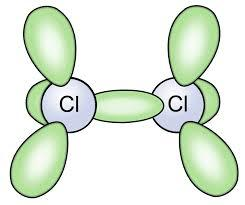
The molecular formula of this gas is $C{l_2}$ and it is a diatomic molecule which means that it has two atoms of the same element in the molecule. Its structure is as shown:
Moreover, chlorine reacts with organic compounds and ammonia to form chloro-organics or chloramines. These are the part of the group of chlorine compounds that have disinfectant properties and show up as part of chlorine.
It also acts as a reducing agent present in wastewater. These reactions are called chlorine demand. The reaction is as shown:
${H_2}O + C{l_2} \to HCl + HClO$
Therefore, in the given question the molecular formula of chlorine is wrong.
Hence, it is false. Option B is correct.
Note: Chlorine gas was used by the Germans as a chemical weapon against the allied troops during the First World War. It is an intermediate water-soluble pulmonary irritant that causes acute damage in the upper and lower respiratory tract. Furthermore, it is also used to prevent the spread of various waterborne diseases.
Complete step by step answer:
Chlorine is a green yellow gas with a very pungent odor that is twice as dense as air. It is basically a chemical element that belongs to the halogen group with the symbol $Cl$. It was discovered in 1770 and soon became useful as a commercial agent.
The molecular formula of this gas is $C{l_2}$ and it is a diatomic molecule which means that it has two atoms of the same element in the molecule. Its structure is as shown:
Moreover, chlorine reacts with organic compounds and ammonia to form chloro-organics or chloramines. These are the part of the group of chlorine compounds that have disinfectant properties and show up as part of chlorine.
It also acts as a reducing agent present in wastewater. These reactions are called chlorine demand. The reaction is as shown:
${H_2}O + C{l_2} \to HCl + HClO$
Therefore, in the given question the molecular formula of chlorine is wrong.
Hence, it is false. Option B is correct.
Note: Chlorine gas was used by the Germans as a chemical weapon against the allied troops during the First World War. It is an intermediate water-soluble pulmonary irritant that causes acute damage in the upper and lower respiratory tract. Furthermore, it is also used to prevent the spread of various waterborne diseases.
Recently Updated Pages
Master Class 12 Economics: Engaging Questions & Answers for Success

Master Class 12 English: Engaging Questions & Answers for Success
Master Class 12 Social Science: Engaging Questions & Answers for Success
Master Class 12 Maths: Engaging Questions & Answers for Success
Master Class 12 Physics: Engaging Questions & Answers for Success
Master Class 11 Social Science: Engaging Questions & Answers for Success
Trending doubts
One Metric ton is equal to kg A 10000 B 1000 C 100 class 11 physics CBSE
Difference Between Prokaryotic Cells and Eukaryotic Cells
Two of the body parts which do not appear in MRI are class 11 biology CBSE
1 ton equals to A 100 kg B 1000 kg C 10 kg D 10000 class 11 physics CBSE
Draw a diagram of nephron and explain its structur class 11 biology CBSE
10 examples of friction in our daily life