




The minimum value of the expression cos2x+cosx for real values of x is:
[a] $\dfrac{-9}{8}$
[b] 0
[c] -2
[d] None of these
Answer
 Verified
611.4k+ views
Hint: Checking for critical points in the intervale $[0,2\pi )$ is sufficient due to periodicity of cos x and cos2x. Differentiate once w.r.t x and put derivative equal to 0 to find the critical points. Use the first derivative test to determine whether a critical point is local maxima or minima.
Complete step-by-step answer:
First derivative test: If f(x) is a continuous and differentiable function and f’(a) = 0, then
[i] If $\underset{x\to {{a}^{-}}}{\mathop{\lim }}\,f'\left( x \right)>0$ and $\underset{x\to {{a}^{+}}}{\mathop{\lim }}\,f'\left( x \right)<0$, then x = a is a point of local maxima
[ii] If $\underset{x\to {{a}^{-}}}{\mathop{\lim }}\,f'\left( x \right)<0$ and $\underset{x\to {{a}^{+}}}{\mathop{\lim }}\,f'\left( x \right)>0$, then x = a is a point of local minima
Let f(x) = cos2x+cosx
Differentiating once we get
f’(x) = -2sin2x-sinx = 0
i.e. 2sin2x+sinx = 0
We know that sin2x = 2sinx cosx
Using the above formula, we get
4sinxcosx+sinx = 0
Taking sinx common, we get
sinx(4cosx+1)=0
i.e sinx = 0 or 4cosx + 1 = 0
if sinx = 0 then $x=0,\pi ${Because sinx = 0 when $x=n\pi $ }
if 4cosx +1 = 0 then
$\begin{align}
& \cos x=\dfrac{-1}{4} \\
& \Rightarrow x=\pi +\arccos \left( \dfrac{1}{4} \right),\pi -\arccos \left( \dfrac{1}{4} \right) \\
\end{align}$
In finding the above roots, we have used the property $\cos \left( \arccos x \right)=x$ and $\cos \left( \pi -\theta \right)=\cos \left( \pi +\theta \right)=-\cos \theta $.
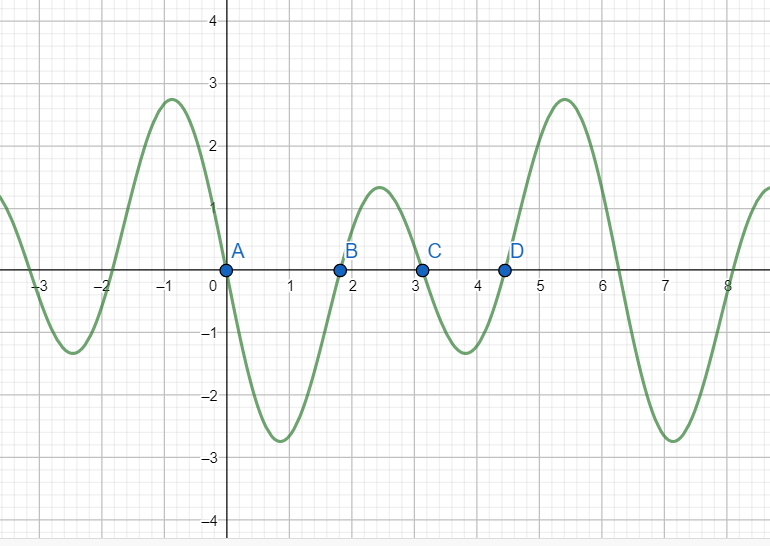
The graph of f’(x) is shown above.
Around point x = 0(Point A in the graph of f’(x)): f’(x) changes sign from +ve to -ve as we move left of 0 to right of 0. Hence, from first derivative test, x = 0 is a point of local maxima
Around point $x=\pi -\arccos \left( \dfrac{1}{4} \right)$(Point B in the graph of f’(x)): f’(x) changes sign from -ve to +ve as we move left of $\pi -\arccos \left( \dfrac{1}{4} \right)$ to the right of $\pi -\arccos \left( \dfrac{1}{4} \right)$. Hence, from the first derivative test, $x=\pi -\arccos \left( \dfrac{1}{4} \right)$ is a point of local minima.
Around point $x=\pi $ (Point C in the graph of f’(x)): f’(x) changes sign from +ve to -ve as we move left of $\pi $ to the right of $\pi $.
Around point $x=\pi +\arccos \left( \dfrac{1}{4} \right)$ (Point D in the graph of f(x)): f’(x) changes sign from -ve to +ve as we move left of $\pi +\arccos \left( \dfrac{1}{4} \right)$ to the right of $\pi +\arccos \left( \dfrac{1}{4} \right)$. Hence $x=\pi +\arccos \left( \dfrac{1}{4} \right)$ is a point of local minima.
Now
$\begin{align}
& f\left( \pi -\arccos \left( \dfrac{1}{4} \right) \right)=\cos \left( 2\pi -2\arccos \left( \dfrac{1}{4} \right) \right)+\cos \left( \pi -\arccos \left( \dfrac{1}{4} \right) \right) \\
& =\cos \left( 2\arccos \left( \dfrac{1}{4} \right) \right)-\cos \left( \arccos \left( \dfrac{1}{4} \right) \right) \\
& =2{{\cos }^{2}}\left( \arccos \left( \dfrac{1}{4} \right) \right)-1-\dfrac{1}{4} \\
& =\dfrac{2}{16}-\dfrac{5}{4} \\
& =\dfrac{-9}{8} \\
\end{align}$
and
$\begin{align}
& f\left( \pi +\arccos \left( \dfrac{1}{4} \right) \right)=\cos \left( 2\pi +2\arccos \left( \dfrac{1}{4} \right) \right)+\cos \left( \pi +\arccos \left( \dfrac{1}{4} \right) \right) \\
& =\cos \left( 2\arccos \left( \dfrac{1}{4} \right) \right)-\cos \left( \arccos \left( \dfrac{1}{4} \right) \right) \\
& =2{{\cos }^{2}}\left( \arccos \left( \dfrac{1}{4} \right) \right)-1-\dfrac{1}{4} \\
& =\dfrac{2}{16}-\dfrac{5}{4} \\
& =\dfrac{-9}{8} \\
\end{align}$
Hence the minimum value of the trigonometric expression cos2x+cosx is $\dfrac{-9}{8}$.
Hence option [a] is correct.
Note: Alternative solution:
We know $\cos 2x=2{{\cos }^{2}}x-1$
Hence $\cos 2x+\cos x=2{{\cos }^{2}}x-1+\cos x$
Put $t=\cos x$ we get\[f\left( t \right)=2{{t}^{2}}+t-1,-1\le t\le 1\]
We know the quadratic expression $a{{x}^{2}}+bx+c$ where a>0 attains minima when $x=\dfrac{-b}{2a}$
Since $\dfrac{-b}{2a}=\dfrac{-1}{2\times 2}=\dfrac{-1}{4}$ is in the domain of t.
We have the minimum value of f(x) = minimum value of f(t)
$\begin{align}
& =2{{\left( \dfrac{-1}{4} \right)}^{2}}+\dfrac{-1}{4}-1 \\
& =\dfrac{1}{8}-\dfrac{5}{4} \\
& =\dfrac{-9}{8} \\
\end{align}$
which is the same as obtained above.
Complete step-by-step answer:
First derivative test: If f(x) is a continuous and differentiable function and f’(a) = 0, then
[i] If $\underset{x\to {{a}^{-}}}{\mathop{\lim }}\,f'\left( x \right)>0$ and $\underset{x\to {{a}^{+}}}{\mathop{\lim }}\,f'\left( x \right)<0$, then x = a is a point of local maxima
[ii] If $\underset{x\to {{a}^{-}}}{\mathop{\lim }}\,f'\left( x \right)<0$ and $\underset{x\to {{a}^{+}}}{\mathop{\lim }}\,f'\left( x \right)>0$, then x = a is a point of local minima
Let f(x) = cos2x+cosx
Differentiating once we get
f’(x) = -2sin2x-sinx = 0
i.e. 2sin2x+sinx = 0
We know that sin2x = 2sinx cosx
Using the above formula, we get
4sinxcosx+sinx = 0
Taking sinx common, we get
sinx(4cosx+1)=0
i.e sinx = 0 or 4cosx + 1 = 0
if sinx = 0 then $x=0,\pi ${Because sinx = 0 when $x=n\pi $ }
if 4cosx +1 = 0 then
$\begin{align}
& \cos x=\dfrac{-1}{4} \\
& \Rightarrow x=\pi +\arccos \left( \dfrac{1}{4} \right),\pi -\arccos \left( \dfrac{1}{4} \right) \\
\end{align}$
In finding the above roots, we have used the property $\cos \left( \arccos x \right)=x$ and $\cos \left( \pi -\theta \right)=\cos \left( \pi +\theta \right)=-\cos \theta $.
The graph of f’(x) is shown above.
Around point x = 0(Point A in the graph of f’(x)): f’(x) changes sign from +ve to -ve as we move left of 0 to right of 0. Hence, from first derivative test, x = 0 is a point of local maxima
Around point $x=\pi -\arccos \left( \dfrac{1}{4} \right)$(Point B in the graph of f’(x)): f’(x) changes sign from -ve to +ve as we move left of $\pi -\arccos \left( \dfrac{1}{4} \right)$ to the right of $\pi -\arccos \left( \dfrac{1}{4} \right)$. Hence, from the first derivative test, $x=\pi -\arccos \left( \dfrac{1}{4} \right)$ is a point of local minima.
Around point $x=\pi $ (Point C in the graph of f’(x)): f’(x) changes sign from +ve to -ve as we move left of $\pi $ to the right of $\pi $.
Around point $x=\pi +\arccos \left( \dfrac{1}{4} \right)$ (Point D in the graph of f(x)): f’(x) changes sign from -ve to +ve as we move left of $\pi +\arccos \left( \dfrac{1}{4} \right)$ to the right of $\pi +\arccos \left( \dfrac{1}{4} \right)$. Hence $x=\pi +\arccos \left( \dfrac{1}{4} \right)$ is a point of local minima.
Now
$\begin{align}
& f\left( \pi -\arccos \left( \dfrac{1}{4} \right) \right)=\cos \left( 2\pi -2\arccos \left( \dfrac{1}{4} \right) \right)+\cos \left( \pi -\arccos \left( \dfrac{1}{4} \right) \right) \\
& =\cos \left( 2\arccos \left( \dfrac{1}{4} \right) \right)-\cos \left( \arccos \left( \dfrac{1}{4} \right) \right) \\
& =2{{\cos }^{2}}\left( \arccos \left( \dfrac{1}{4} \right) \right)-1-\dfrac{1}{4} \\
& =\dfrac{2}{16}-\dfrac{5}{4} \\
& =\dfrac{-9}{8} \\
\end{align}$
and
$\begin{align}
& f\left( \pi +\arccos \left( \dfrac{1}{4} \right) \right)=\cos \left( 2\pi +2\arccos \left( \dfrac{1}{4} \right) \right)+\cos \left( \pi +\arccos \left( \dfrac{1}{4} \right) \right) \\
& =\cos \left( 2\arccos \left( \dfrac{1}{4} \right) \right)-\cos \left( \arccos \left( \dfrac{1}{4} \right) \right) \\
& =2{{\cos }^{2}}\left( \arccos \left( \dfrac{1}{4} \right) \right)-1-\dfrac{1}{4} \\
& =\dfrac{2}{16}-\dfrac{5}{4} \\
& =\dfrac{-9}{8} \\
\end{align}$
Hence the minimum value of the trigonometric expression cos2x+cosx is $\dfrac{-9}{8}$.
Hence option [a] is correct.
Note: Alternative solution:
We know $\cos 2x=2{{\cos }^{2}}x-1$
Hence $\cos 2x+\cos x=2{{\cos }^{2}}x-1+\cos x$
Put $t=\cos x$ we get\[f\left( t \right)=2{{t}^{2}}+t-1,-1\le t\le 1\]
We know the quadratic expression $a{{x}^{2}}+bx+c$ where a>0 attains minima when $x=\dfrac{-b}{2a}$
Since $\dfrac{-b}{2a}=\dfrac{-1}{2\times 2}=\dfrac{-1}{4}$ is in the domain of t.
We have the minimum value of f(x) = minimum value of f(t)
$\begin{align}
& =2{{\left( \dfrac{-1}{4} \right)}^{2}}+\dfrac{-1}{4}-1 \\
& =\dfrac{1}{8}-\dfrac{5}{4} \\
& =\dfrac{-9}{8} \\
\end{align}$
which is the same as obtained above.
Recently Updated Pages
Master Class 11 Computer Science: Engaging Questions & Answers for Success

Master Class 11 Business Studies: Engaging Questions & Answers for Success
Master Class 11 Economics: Engaging Questions & Answers for Success
Master Class 11 English: Engaging Questions & Answers for Success
Master Class 11 Maths: Engaging Questions & Answers for Success
Master Class 11 Biology: Engaging Questions & Answers for Success
Trending doubts
One Metric ton is equal to kg A 10000 B 1000 C 100 class 11 physics CBSE
There are 720 permutations of the digits 1 2 3 4 5 class 11 maths CBSE
Discuss the various forms of bacteria class 11 biology CBSE
Draw a diagram of a plant cell and label at least eight class 11 biology CBSE
State the laws of reflection of light
Explain zero factorial class 11 maths CBSE