




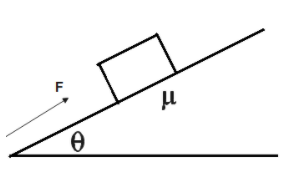
The minimum value of \[F\] for which the block remains at rest will be –
(A). \[mg(\sin \theta -\mu \cos \theta )\]
(B). \[mg(\sin \theta +\mu \cos \theta )\]
(C). \[mg(\tan \theta -\mu \sin \theta )\]
(D). \[mg(\cos \theta -\mu \sin \theta )\]
Answer
 Verified
629.1k+ views
Hint: According to the second law of motion, an external force is required to change the state of rest or motion of a body. Resolve all the forces acting on the block into its components individually for x components and y components of the forces and use the equations to find the minimum value of force.
Formulas Used:
\[F+{{F}_{\mu }}=mg\sin \theta \]
\[N=mg\cos \theta \]
\[{{F}_{\mu }}=\mu N\]
Complete answer:
A block of mass \[m\]is kept on an inclined plane with a coefficient of friction, \[\mu \]. The forces acting on the body are-
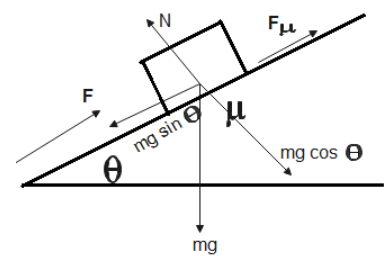
\[mg\] is resolved into its x and y components.
\[\theta \] is the angle of inclination of the slide
In the x-direction, the forces acting are-
\[F+{{F}_{\mu }}=mg\sin \theta \] - (1)
Here,
\[{{F}_{\mu }}\] is the frictional force
Forces acting in the y-direction,
\[N=mg\cos \theta \] - (2)
Here,\[N\] is the normal force acting between the surfaces in contact
We know that,
\[{{F}_{\mu }}=\mu N\]
Therefore, from eq (2), we get,
\[{{F}_{\mu }}=\mu mg\cos \theta \] - (3)
Substituting eq (3) in eq (1), we get,
\[\begin{align}
& F+\mu mg\cos \theta =mg\sin \theta \\
& \therefore F=mg\sin \theta -\mu mg\cos \theta \\
& \Rightarrow F=mg(\sin \theta -\mu \cos \theta ) \\
\end{align}\]
Therefore, the value of \[F\] for which the block will remain in the position of rest is \[F=mg(\sin \theta -\mu \cos \theta )\].
So, the correct option is (A).
Note:
Normal force is also called contact force. It is exerted by surfaces on each other to prevent them from passing through them. Frictional force is the force that opposes the motion of an object. It occurs due to the locking of irregularities between surfaces. All forces acting on the block are considered internal forces of the system as the system is at rest.
Formulas Used:
\[F+{{F}_{\mu }}=mg\sin \theta \]
\[N=mg\cos \theta \]
\[{{F}_{\mu }}=\mu N\]
Complete answer:
A block of mass \[m\]is kept on an inclined plane with a coefficient of friction, \[\mu \]. The forces acting on the body are-
\[mg\] is resolved into its x and y components.
\[\theta \] is the angle of inclination of the slide
In the x-direction, the forces acting are-
\[F+{{F}_{\mu }}=mg\sin \theta \] - (1)
Here,
\[{{F}_{\mu }}\] is the frictional force
Forces acting in the y-direction,
\[N=mg\cos \theta \] - (2)
Here,\[N\] is the normal force acting between the surfaces in contact
We know that,
\[{{F}_{\mu }}=\mu N\]
Therefore, from eq (2), we get,
\[{{F}_{\mu }}=\mu mg\cos \theta \] - (3)
Substituting eq (3) in eq (1), we get,
\[\begin{align}
& F+\mu mg\cos \theta =mg\sin \theta \\
& \therefore F=mg\sin \theta -\mu mg\cos \theta \\
& \Rightarrow F=mg(\sin \theta -\mu \cos \theta ) \\
\end{align}\]
Therefore, the value of \[F\] for which the block will remain in the position of rest is \[F=mg(\sin \theta -\mu \cos \theta )\].
So, the correct option is (A).
Note:
Normal force is also called contact force. It is exerted by surfaces on each other to prevent them from passing through them. Frictional force is the force that opposes the motion of an object. It occurs due to the locking of irregularities between surfaces. All forces acting on the block are considered internal forces of the system as the system is at rest.
Recently Updated Pages
Which will be the least stable resonating structure class 11 chemistry CBSE

How many 5 digit telephone numbers can be construc-class-11-maths-CBSE
How do you find the angle of the resultant vector class 11 physics CBSE
Draw labelled diagram of the following i Gram seed class 11 biology CBSE
What is the need and importance of classification class 11 biology CBSE
The way in which the sparrows expressed their sorrow class 11 english CBSE
Trending doubts
One Metric ton is equal to kg A 10000 B 1000 C 100 class 11 physics CBSE
Find the value of the expression given below sin 30circ class 11 maths CBSE
1 Quintal is equal to a 110 kg b 10 kg c 100kg d 1000 class 11 physics CBSE
Draw a diagram of nephron and explain its structur class 11 biology CBSE
10 examples of friction in our daily life
Proton was discovered by A Thomson B Rutherford C Chadwick class 11 chemistry CBSE