




What should be the minimum length of antenna for the efficient transmission of signals of the wavelength?
$\begin{align}
& A.\dfrac{\lambda }{2} \\
& B.\dfrac{\lambda }{3} \\
& C.\dfrac{\lambda }{4} \\
& D.\dfrac{\lambda }{5} \\
\end{align}$
Answer
 Verified
579.6k+ views
Hint: For efficient radiation and reception, the height of transmitting and receiving antennas should be comparable to a quarter of wavelength of the frequency used. Then only, efficient transmission occurs. These may help you to solve this question.
Complete step by step answer:
An antenna is an equipment or a device in order to convert electromagnetic radiation in space into electrical currents in conductors. This can be in the opposite sense also. It depends on whether it is being used for receiving or for transmitting, respectively. As an example, we can say that the passive radio telescopes are receiving antennas. In order to accomplish an efficient radiation or an efficient reception, there are some requirements about the height of the transmitting and receiving antennas.
The receiving antennas should be comparable to a quarter of wavelength of the frequency used. That is the receiving antennas should have a length equal to one fourth of the wavelength of light. Let us assume that the wavelength of light is given as $\lambda $,
Therefore we can write that,
$L=\dfrac{\lambda }{4}$
Where $L$ be the minimum length of the antenna.
So, the correct answer is “Option C”.
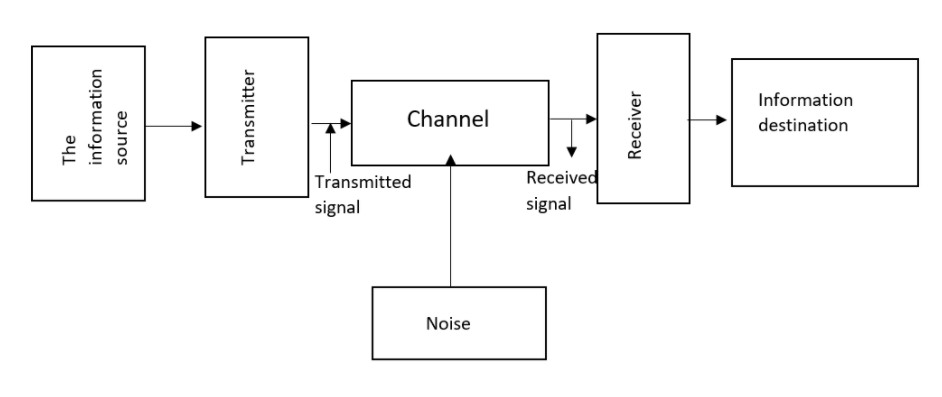
Note: The basic communication system includes a transmitter, a channel for the transmission and the receiver. The transmitter will modulate the signal with a carrier signal, then amplify it and make it ready to enter the channel. Channel is a medium which transports these signals in order to reach the receiver. The receiver will receive the signal and demodulate it and retrieve the information from it. Demodulation is the process of removing the signal from the carrier signal.
Complete step by step answer:
An antenna is an equipment or a device in order to convert electromagnetic radiation in space into electrical currents in conductors. This can be in the opposite sense also. It depends on whether it is being used for receiving or for transmitting, respectively. As an example, we can say that the passive radio telescopes are receiving antennas. In order to accomplish an efficient radiation or an efficient reception, there are some requirements about the height of the transmitting and receiving antennas.
The receiving antennas should be comparable to a quarter of wavelength of the frequency used. That is the receiving antennas should have a length equal to one fourth of the wavelength of light. Let us assume that the wavelength of light is given as $\lambda $,
Therefore we can write that,
$L=\dfrac{\lambda }{4}$
Where $L$ be the minimum length of the antenna.
So, the correct answer is “Option C”.
Note: The basic communication system includes a transmitter, a channel for the transmission and the receiver. The transmitter will modulate the signal with a carrier signal, then amplify it and make it ready to enter the channel. Channel is a medium which transports these signals in order to reach the receiver. The receiver will receive the signal and demodulate it and retrieve the information from it. Demodulation is the process of removing the signal from the carrier signal.
Recently Updated Pages
Master Class 11 English: Engaging Questions & Answers for Success

Master Class 11 Maths: Engaging Questions & Answers for Success
Master Class 11 Biology: Engaging Questions & Answers for Success
Master Class 11 Social Science: Engaging Questions & Answers for Success
Master Class 11 Physics: Engaging Questions & Answers for Success
Master Class 11 Accountancy: Engaging Questions & Answers for Success
Trending doubts
One Metric ton is equal to kg A 10000 B 1000 C 100 class 11 physics CBSE
There are 720 permutations of the digits 1 2 3 4 5 class 11 maths CBSE
Discuss the various forms of bacteria class 11 biology CBSE
Draw a diagram of a plant cell and label at least eight class 11 biology CBSE
State the laws of reflection of light
Explain zero factorial class 11 maths CBSE