




The minimum force required to move the body up an inclined plane is three times the minimum force required to prevent it from sliding down the plane. If the coefficient of friction between the body and the inclined plane is \[\dfrac{1}{{2\sqrt 3 }},\] the angle of the inclined plane is
(A) \[60^\circ \]
(B) \[45^\circ \]
(C) \[30^\circ \]
(D) \[15^\circ \]
Answer
 Verified
585.9k+ views
Hint:
- We should know friction.
- We should have knowledge of all the forces acting or a body or air inclined plane.
- We need to know the relation between the frictional force \[\left( {fs} \right)\] with normal reaction (R) i.e. \[{f_s} = \mu R\]
Complete step by step Solution:
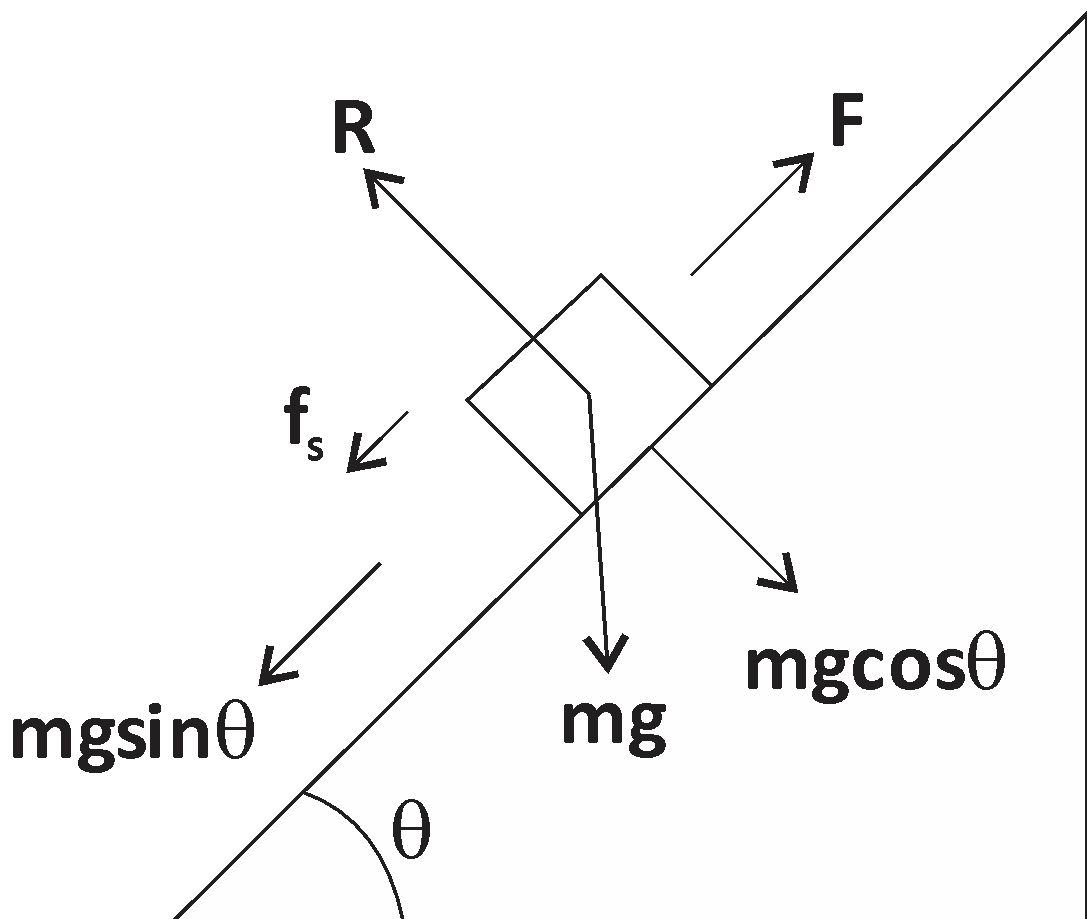
Here, the mass of the body \[ = {\text{ }}m\]
Applied force \[ = {\text{ }}F,\] normal reaction \[ = {\text{ }}R\]
Friction force \[ = {\text{ }}{f_s}\]
Acceleration due to gravity \[ = {\text{ }}g\]
Angle of the inclined plane \[ = \theta \]
Coefficient of friction \[ = \]is
Now, for the body to move up, opposing forces are \[mg\sin \theta \,\,4\,\,{f_s},\] so, \[{F_{up}} = mg\sin \theta + {f_s}\]
\[{F_{up}} = mg\sin \theta + \mu R = mg\sin \theta + \mu mg\cos \theta \]
For preventing the body opposing force is \[mg\sin \theta \] & helping
Force \[{f_s}\], so, \[{F_{down}} = mg\sin \theta - \mu mg\cos \theta \]
Now, given, \[{F_{up}} = 3\,\,{F_{down}}\]
\[ \Rightarrow \left( {mg\sin \theta + \mu mg\cos \theta } \right) = 3\left( {mg\sin \theta - \mu \cos \theta } \right)\]
\[ \Rightarrow 2\sin \theta = 4\mu \,\,\cos \theta \]
\[ \Rightarrow \tan \theta = 2\mu \]
\[\theta = {\tan ^ - }\left( {2\mu } \right)\]
Given, \[\mu = \dfrac{1}{{2\sqrt 3 }}\]
\[\therefore \,\,\,\theta = {\tan ^ - }\left( {\dfrac{1}{{\sqrt 3 }}} \right)\]
\[ = 30^\circ \]
So, option (c) is correct.
Note:
- We to take case while calculating upward 4 downward force
- Fup should be greater than \[{F_{down}}\].
- We have to take care while calculating numerical value.
- We should know friction.
- We should have knowledge of all the forces acting or a body or air inclined plane.
- We need to know the relation between the frictional force \[\left( {fs} \right)\] with normal reaction (R) i.e. \[{f_s} = \mu R\]
Complete step by step Solution:
Here, the mass of the body \[ = {\text{ }}m\]
Applied force \[ = {\text{ }}F,\] normal reaction \[ = {\text{ }}R\]
Friction force \[ = {\text{ }}{f_s}\]
Acceleration due to gravity \[ = {\text{ }}g\]
Angle of the inclined plane \[ = \theta \]
Coefficient of friction \[ = \]is
Now, for the body to move up, opposing forces are \[mg\sin \theta \,\,4\,\,{f_s},\] so, \[{F_{up}} = mg\sin \theta + {f_s}\]
\[{F_{up}} = mg\sin \theta + \mu R = mg\sin \theta + \mu mg\cos \theta \]
For preventing the body opposing force is \[mg\sin \theta \] & helping
Force \[{f_s}\], so, \[{F_{down}} = mg\sin \theta - \mu mg\cos \theta \]
Now, given, \[{F_{up}} = 3\,\,{F_{down}}\]
\[ \Rightarrow \left( {mg\sin \theta + \mu mg\cos \theta } \right) = 3\left( {mg\sin \theta - \mu \cos \theta } \right)\]
\[ \Rightarrow 2\sin \theta = 4\mu \,\,\cos \theta \]
\[ \Rightarrow \tan \theta = 2\mu \]
\[\theta = {\tan ^ - }\left( {2\mu } \right)\]
Given, \[\mu = \dfrac{1}{{2\sqrt 3 }}\]
\[\therefore \,\,\,\theta = {\tan ^ - }\left( {\dfrac{1}{{\sqrt 3 }}} \right)\]
\[ = 30^\circ \]
So, option (c) is correct.
Note:
- We to take case while calculating upward 4 downward force
- Fup should be greater than \[{F_{down}}\].
- We have to take care while calculating numerical value.
Recently Updated Pages
Master Class 11 Computer Science: Engaging Questions & Answers for Success

Master Class 11 Business Studies: Engaging Questions & Answers for Success
Master Class 11 Economics: Engaging Questions & Answers for Success
Master Class 11 English: Engaging Questions & Answers for Success
Master Class 11 Maths: Engaging Questions & Answers for Success
Master Class 11 Biology: Engaging Questions & Answers for Success
Trending doubts
One Metric ton is equal to kg A 10000 B 1000 C 100 class 11 physics CBSE
There are 720 permutations of the digits 1 2 3 4 5 class 11 maths CBSE
Discuss the various forms of bacteria class 11 biology CBSE
Draw a diagram of a plant cell and label at least eight class 11 biology CBSE
State the laws of reflection of light
Explain zero factorial class 11 maths CBSE