




The method developed by Mathew Meselson and Franklin Stahl to separate heavy DNA with ${ N }^{ 14 }$ from DNA, for providing evidence for semi-conservative replication of DNA is
(a) Ion exchange chromatography
(b) Density gradient centrifugation
(c) Buoyant gradient centrifugation
(d) Gel filtration
(e) Isopycnic centrifugation
Answer
 Verified
525.9k+ views
Hint: The process in which various particles are separated by the formation of a number of different layers depending upon their property of sedimentation. It takes place more rapidly in larger particles than in smaller particles.
Complete answer:
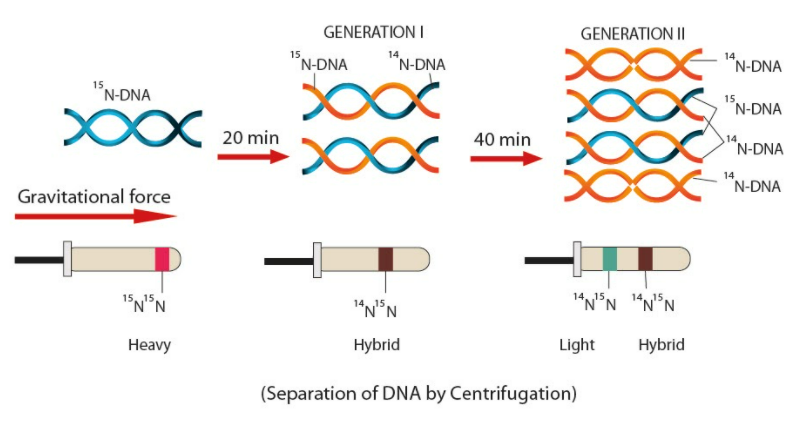
The DNA was all of the transitional thickness after one replication cycle and precluded the moderate replication model, which predicts that both substantial thickness DNA and light thickness DNA will be available. This result demonstrated the semi-conservative mode of replication where the DNA particles will compose of ${ N }^{ 14 }$ DNA strand and other ${ N }^{ 15 }$ DNA strands. It was proved by the method of Density gradient centrifugation, where the particles are separated into different layers based on their density. The heavy particles at the bottom while the lighter particles at the top.
Additional information:
In 1958, Meselson and Stahl performed tests that explored the semiconservative theory of DNA replication by Watson and Crick's. In semiconservative replication, when the twofold abandoned DNA helix is recreated, every one of the two new twofold abandoned DNA helices consists of one strand from the first helix and one recently incorporated. This experiment is also known as "the most lovely investigation in biology". Meselson and Stahl chose nitrogen isotopes as they are present in every nitrogenous base of the DNA and label the parent DNA, this nitrogen helps in recognizing the parent DN and then results in its duplication. The isotope of nitrogen is heavier in nature due to the presence of an extra neutron in its core.
So, the correct answer is ‘Density gradient centrifugation’.
Note:
Watson and Crick proposed a semi-conservative theory, in which they observed that the two strands of DNA molecules got separated during the process of replication and each strand acts as the format for the union of two strands. Modern speculation concludes that the whole DNA molecule will act as a format for the union of a new strand.
Complete answer:
The DNA was all of the transitional thickness after one replication cycle and precluded the moderate replication model, which predicts that both substantial thickness DNA and light thickness DNA will be available. This result demonstrated the semi-conservative mode of replication where the DNA particles will compose of ${ N }^{ 14 }$ DNA strand and other ${ N }^{ 15 }$ DNA strands. It was proved by the method of Density gradient centrifugation, where the particles are separated into different layers based on their density. The heavy particles at the bottom while the lighter particles at the top.
Additional information:
In 1958, Meselson and Stahl performed tests that explored the semiconservative theory of DNA replication by Watson and Crick's. In semiconservative replication, when the twofold abandoned DNA helix is recreated, every one of the two new twofold abandoned DNA helices consists of one strand from the first helix and one recently incorporated. This experiment is also known as "the most lovely investigation in biology". Meselson and Stahl chose nitrogen isotopes as they are present in every nitrogenous base of the DNA and label the parent DNA, this nitrogen helps in recognizing the parent DN and then results in its duplication. The isotope of nitrogen is heavier in nature due to the presence of an extra neutron in its core.
So, the correct answer is ‘Density gradient centrifugation’.
Note:
Watson and Crick proposed a semi-conservative theory, in which they observed that the two strands of DNA molecules got separated during the process of replication and each strand acts as the format for the union of two strands. Modern speculation concludes that the whole DNA molecule will act as a format for the union of a new strand.
Recently Updated Pages
Master Class 12 Social Science: Engaging Questions & Answers for Success

Master Class 12 Physics: Engaging Questions & Answers for Success
Master Class 12 Maths: Engaging Questions & Answers for Success
Master Class 12 Economics: Engaging Questions & Answers for Success
Master Class 12 Chemistry: Engaging Questions & Answers for Success
Master Class 12 Business Studies: Engaging Questions & Answers for Success
Trending doubts
Which are the Top 10 Largest Countries of the World?
Draw a labelled sketch of the human eye class 12 physics CBSE
Explain the structure of megasporangium class 12 biology CBSE
What are the major means of transport Explain each class 12 social science CBSE
How many chromosomes are found in human ovum a 46 b class 12 biology CBSE
The diagram of the section of a maize grain is given class 12 biology CBSE