




The metal refined-electrolytically is:
A. Al
B. Na
C. Cu
D. Fe
Answer
 Verified
598.8k+ views
Hint: Think about the electrolysis process and the components of the process. The solution used, the metal used as anode and cathode and how all three components will react when electricity is passed through the anode and cathode
Step by step answer: Before discussing the answer of the question, let’s discuss the order of reactivity of the metals given in the options. The order of reactivity is
\[Na > Al > Fe > Cu\]
This says that Sodium is most reactive and Copper is least reactive in this series. Now let’s define and discuss electrolysis.
Electrolytic refining is a process of refining a metal by the process of electrolysis. In this process a clean and pure metal is obtained from impure metal. As you can see in the diagram, there are 3 main components which are anode, cathode and a solution. These components will react with each other when electricity is passed through anode and cathode.
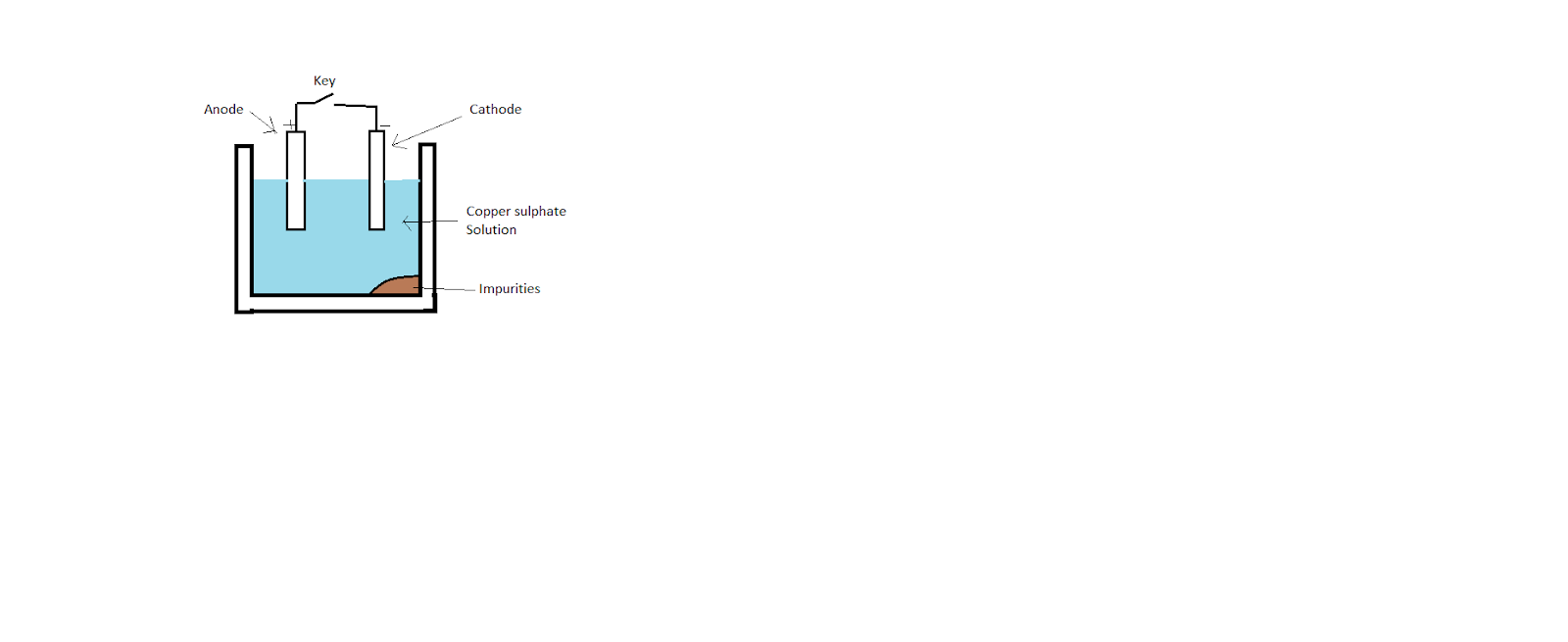
Here the anode is the impure metal rod and the cathode is the pure metal rod and these are called electrodes. The solution is the aqueous solution of the metal (sulphate solution of the metal) which is called the electrolyte. When electricity is passed through the setup, the electrolyte is broken down into positive metal ions and negative sulphate ions ( \(S{O^{4 -}}\) ).
These metal ions move to the negative cathode electrode and get deposited. The anode’s metallic impurities react with sulphate ions in the solution to form metal sulphate in the electrolytic solution and dissolve.
The deposited metal is then separated from the cathode and anode is then replaced with a new block of raw metal rod at regular intervals for electrolytic refining.
This is the process of electrolysis. Now, we need to find out which metal will act perfectly in this process. The answer to this question is copper i.e. option C is the correct answer. Other metals will not react perfectly in this process because other three metals are more reactive and instead of depositing on cathode, the metal ions will recombine with sulphate ions to give back the same compound and therefore there will be no change in the components. Copper is less reactive and therefore will form ions and deposit on cathode.
Therefore, option C is the correct option.
Note: Along with copper, zinc, tin, lead, nickel, silver and gold are also refined electrolytically. Also, these metals meet the cost of refining and therefore refining the best method to get pure forms of these metals.
Step by step answer: Before discussing the answer of the question, let’s discuss the order of reactivity of the metals given in the options. The order of reactivity is
\[Na > Al > Fe > Cu\]
This says that Sodium is most reactive and Copper is least reactive in this series. Now let’s define and discuss electrolysis.
Electrolytic refining is a process of refining a metal by the process of electrolysis. In this process a clean and pure metal is obtained from impure metal. As you can see in the diagram, there are 3 main components which are anode, cathode and a solution. These components will react with each other when electricity is passed through anode and cathode.
Here the anode is the impure metal rod and the cathode is the pure metal rod and these are called electrodes. The solution is the aqueous solution of the metal (sulphate solution of the metal) which is called the electrolyte. When electricity is passed through the setup, the electrolyte is broken down into positive metal ions and negative sulphate ions ( \(S{O^{4 -}}\) ).
These metal ions move to the negative cathode electrode and get deposited. The anode’s metallic impurities react with sulphate ions in the solution to form metal sulphate in the electrolytic solution and dissolve.
The deposited metal is then separated from the cathode and anode is then replaced with a new block of raw metal rod at regular intervals for electrolytic refining.
This is the process of electrolysis. Now, we need to find out which metal will act perfectly in this process. The answer to this question is copper i.e. option C is the correct answer. Other metals will not react perfectly in this process because other three metals are more reactive and instead of depositing on cathode, the metal ions will recombine with sulphate ions to give back the same compound and therefore there will be no change in the components. Copper is less reactive and therefore will form ions and deposit on cathode.
Therefore, option C is the correct option.
Note: Along with copper, zinc, tin, lead, nickel, silver and gold are also refined electrolytically. Also, these metals meet the cost of refining and therefore refining the best method to get pure forms of these metals.
Recently Updated Pages
Master Class 11 Social Science: Engaging Questions & Answers for Success

Master Class 11 Physics: Engaging Questions & Answers for Success
Master Class 11 Maths: Engaging Questions & Answers for Success
Master Class 11 Economics: Engaging Questions & Answers for Success
Master Class 11 Computer Science: Engaging Questions & Answers for Success
Master Class 11 Chemistry: Engaging Questions & Answers for Success
Trending doubts
One Metric ton is equal to kg A 10000 B 1000 C 100 class 11 physics CBSE
There are 720 permutations of the digits 1 2 3 4 5 class 11 maths CBSE
1 Quintal is equal to a 110 kg b 10 kg c 100kg d 1000 class 11 physics CBSE
State and prove Bernoullis theorem class 11 physics CBSE
Difference Between Prokaryotic Cells and Eukaryotic Cells
Which among the following are examples of coming together class 11 social science CBSE