




The medium through which the sound travels the fastest is empty space. This statement is:
A. True
B. False
C. Ambiguous
D. Data insufficient
Answer
 Verified
629.7k+ views
Hint: Sound waves are longitudinal waves. When the direction of propagation of the wave is in the same direction as the displacement of the medium, the waves are longitudinal.
Complete step by step answer:
Sound waves are longitudinal in nature. Longitudinal wave is defined as the wave for which the direction of displacement of the particles of the medium is that same as the direction of propagation. Some of the examples are sound waves, ripples in water etc.
Sound in the form of energy travels from the source to the destination. The particle at the source does not reach the destination itself. But a particle transfers the energy to the next particle by displacing through a small amount. See the illustration to understand how this works.
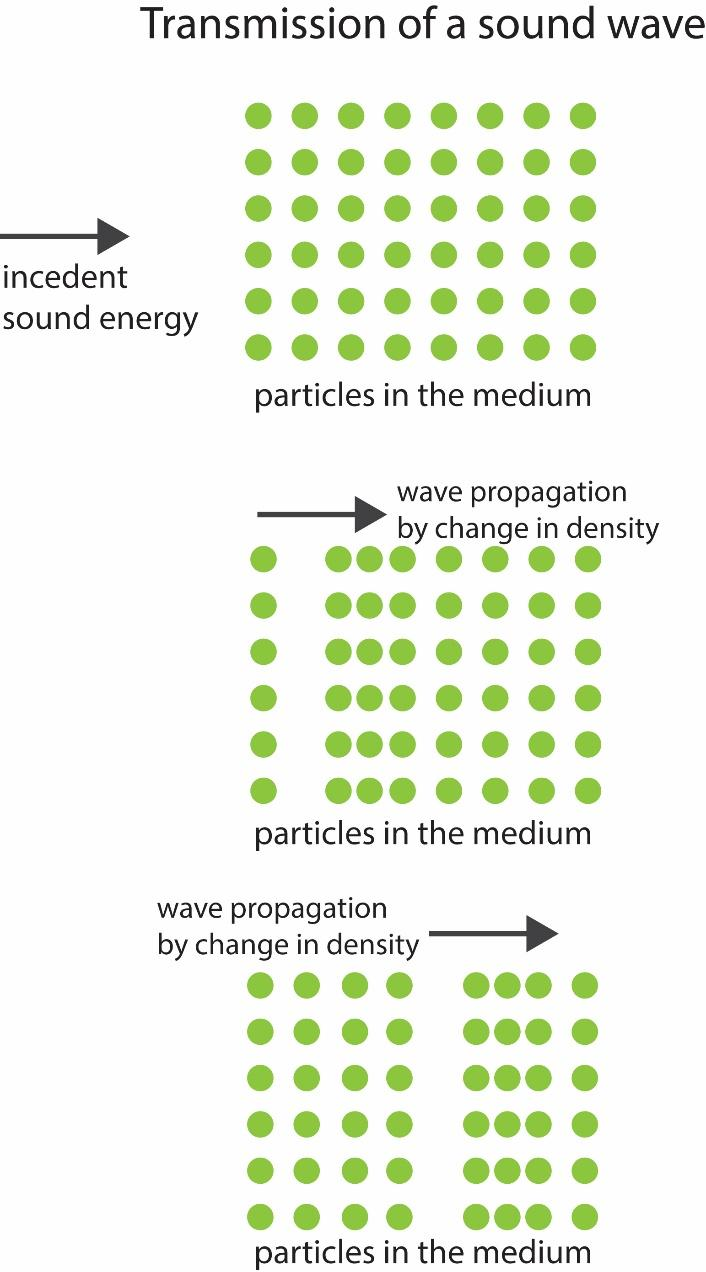
One way to explain the role of material density is to understand the following. With increasing the number of particles in any material, the particle will have to displace less in order to transfer its energy. That is the energy transfer will be faster. Which essentially means that sound travels faster in a denser medium.
The speed of sound through a solid material is greater than through liquid state and the least in the gaseous state. Because the density of the medium decreases in the same order.
Now, for empty space, no particle would be present, and a medium is crucial for a longitudinal wave like sound to propagate.
Therefore, option B. is correct.
Note: In outer space, sound can not propagate. This is due to the reason that it is empty space and the speed of sound there is zero.
Complete step by step answer:
Sound waves are longitudinal in nature. Longitudinal wave is defined as the wave for which the direction of displacement of the particles of the medium is that same as the direction of propagation. Some of the examples are sound waves, ripples in water etc.
Sound in the form of energy travels from the source to the destination. The particle at the source does not reach the destination itself. But a particle transfers the energy to the next particle by displacing through a small amount. See the illustration to understand how this works.
One way to explain the role of material density is to understand the following. With increasing the number of particles in any material, the particle will have to displace less in order to transfer its energy. That is the energy transfer will be faster. Which essentially means that sound travels faster in a denser medium.
The speed of sound through a solid material is greater than through liquid state and the least in the gaseous state. Because the density of the medium decreases in the same order.
Now, for empty space, no particle would be present, and a medium is crucial for a longitudinal wave like sound to propagate.
Therefore, option B. is correct.
Note: In outer space, sound can not propagate. This is due to the reason that it is empty space and the speed of sound there is zero.
Recently Updated Pages
Master Class 11 Social Science: Engaging Questions & Answers for Success

Master Class 11 English: Engaging Questions & Answers for Success
Master Class 11 Maths: Engaging Questions & Answers for Success
Master Class 11 Chemistry: Engaging Questions & Answers for Success
Master Class 11 Biology: Engaging Questions & Answers for Success
Master Class 11 Physics: Engaging Questions & Answers for Success
Trending doubts
One Metric ton is equal to kg A 10000 B 1000 C 100 class 11 physics CBSE
Difference Between Prokaryotic Cells and Eukaryotic Cells
Draw a diagram of a plant cell and label at least eight class 11 biology CBSE
Two of the body parts which do not appear in MRI are class 11 biology CBSE
Which gas is abundant in air class 11 chemistry CBSE
10 examples of friction in our daily life