




The measures of two angles of a parallelogram are in the ratio 3:2. Find the measure of each of the angles of the parallelogram.
Answer
 Verified
641.7k+ views
Hint: Assume that the measure of one of the adjacent angles is x, and the measure of the adjacent other angle is y. Use the property that opposite angles of a parallelogram are equal and the sum of angles of a quadrilateral is \[360{}^\circ \]. Also, use the fact that the ratio of two adjacent angles is 3:2. Hence form two linear equations in two variables and solve the system to find the values of x and y. Hence find the measures of angles of the triangle.
Complete step-by-step answer:
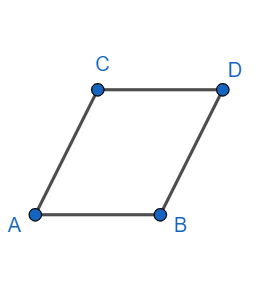
Given: ABCD is a parallelogram. $\angle \text{A:}\angle \text{B::3:2}$
To determine: $\angle \text{A,}\angle \text{B,}\angle \text{C}$ and $\angle \text{D}$
Let $\angle \text{A=}x{}^\circ $ and $\angle \text{B=}y{}^\circ $
Since opposite angles of a parallelogram are equal, we have
$\angle \text{D=}x{}^\circ $ and $\angle \text{C=}y{}^\circ $.
Now we know that the sum of angles of a quadrilateral is equal to \[360{}^\circ \].
Using, we get
\[\begin{align}
& \angle \text{A+}\angle \text{B+}\angle \text{C+}\angle \text{D=360}{}^\circ \\
& \Rightarrow x+y+y+x=360 \\
& \Rightarrow 2x+2y=360 \\
& \Rightarrow x+y=180\text{ (i)} \\
\end{align}\]
Also, we have $\angle \text{A:}\angle \text{B::3:2}$
Hence, $\dfrac{x}{y}=\dfrac{3}{2}$
Cross multiplying, we get
$2x=3y$
Dividing both sides by 2, we get
$x=\dfrac{3y}{2}\text{ (ii)}$
Substituting the value of x from equation (ii) in equation (i), we get
$\begin{align}
& \dfrac{3y}{2}+y=180 \\
& \Rightarrow \dfrac{5y}{2}=180 \\
\end{align}$
Multiplying both sides by $\dfrac{2}{5}$, we get
$\begin{align}
& \dfrac{5y}{2}\times \dfrac{2}{5}=180\times \dfrac{2}{5} \\
& \Rightarrow y=72{}^\circ \\
\end{align}$
Substituting the value of y in equation (ii), we get
$x=\dfrac{3}{2}\times 72=108{}^\circ $
Hence the angles of the parallelogram are
$72{}^\circ ,108{}^\circ ,72{}^\circ $ and $108{}^\circ $.
Note: The opposite angles of a parallelogram are equal
Proof:
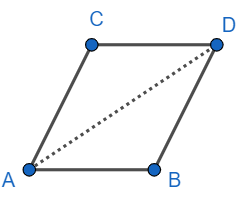
Consider a parallelogram ABCD as shown above. Join AD.
Since CD||AB, we have
$\angle \text{CDA=}\angle \text{DAB (i)}$
Also since DB||AC, we have
$\angle \text{BDA=}\angle \text{DAC (ii)}$
Adding equation (i) and equation (ii), we get
\[\begin{align}
& \angle \text{CDA+}\angle \text{BDA=}\angle \text{DAB+}\angle \text{DAC } \\
& \angle \text{CDB=}\angle \text{CAB } \\
\end{align}\]
Similarly, $\angle \text{ACD=}\angle \text{ABD}$
Hence proved.
Complete step-by-step answer:
Given: ABCD is a parallelogram. $\angle \text{A:}\angle \text{B::3:2}$
To determine: $\angle \text{A,}\angle \text{B,}\angle \text{C}$ and $\angle \text{D}$
Let $\angle \text{A=}x{}^\circ $ and $\angle \text{B=}y{}^\circ $
Since opposite angles of a parallelogram are equal, we have
$\angle \text{D=}x{}^\circ $ and $\angle \text{C=}y{}^\circ $.
Now we know that the sum of angles of a quadrilateral is equal to \[360{}^\circ \].
Using, we get
\[\begin{align}
& \angle \text{A+}\angle \text{B+}\angle \text{C+}\angle \text{D=360}{}^\circ \\
& \Rightarrow x+y+y+x=360 \\
& \Rightarrow 2x+2y=360 \\
& \Rightarrow x+y=180\text{ (i)} \\
\end{align}\]
Also, we have $\angle \text{A:}\angle \text{B::3:2}$
Hence, $\dfrac{x}{y}=\dfrac{3}{2}$
Cross multiplying, we get
$2x=3y$
Dividing both sides by 2, we get
$x=\dfrac{3y}{2}\text{ (ii)}$
Substituting the value of x from equation (ii) in equation (i), we get
$\begin{align}
& \dfrac{3y}{2}+y=180 \\
& \Rightarrow \dfrac{5y}{2}=180 \\
\end{align}$
Multiplying both sides by $\dfrac{2}{5}$, we get
$\begin{align}
& \dfrac{5y}{2}\times \dfrac{2}{5}=180\times \dfrac{2}{5} \\
& \Rightarrow y=72{}^\circ \\
\end{align}$
Substituting the value of y in equation (ii), we get
$x=\dfrac{3}{2}\times 72=108{}^\circ $
Hence the angles of the parallelogram are
$72{}^\circ ,108{}^\circ ,72{}^\circ $ and $108{}^\circ $.
Note: The opposite angles of a parallelogram are equal
Proof:
Consider a parallelogram ABCD as shown above. Join AD.
Since CD||AB, we have
$\angle \text{CDA=}\angle \text{DAB (i)}$
Also since DB||AC, we have
$\angle \text{BDA=}\angle \text{DAC (ii)}$
Adding equation (i) and equation (ii), we get
\[\begin{align}
& \angle \text{CDA+}\angle \text{BDA=}\angle \text{DAB+}\angle \text{DAC } \\
& \angle \text{CDB=}\angle \text{CAB } \\
\end{align}\]
Similarly, $\angle \text{ACD=}\angle \text{ABD}$
Hence proved.
Recently Updated Pages
Master Class 11 Social Science: Engaging Questions & Answers for Success

Master Class 11 English: Engaging Questions & Answers for Success
Master Class 11 Maths: Engaging Questions & Answers for Success
Master Class 11 Chemistry: Engaging Questions & Answers for Success
Master Class 11 Biology: Engaging Questions & Answers for Success
Master Class 11 Physics: Engaging Questions & Answers for Success
Trending doubts
Differentiate between an exothermic and an endothermic class 11 chemistry CBSE
One Metric ton is equal to kg A 10000 B 1000 C 100 class 11 physics CBSE
Difference Between Prokaryotic Cells and Eukaryotic Cells
There are 720 permutations of the digits 1 2 3 4 5 class 11 maths CBSE
Draw a diagram of a plant cell and label at least eight class 11 biology CBSE
Which chemical is known as king of chemicals A H 2 class 11 chemistry CBSE