




The measure of two consecutive angles in a parallelogram are in the ratio $4:11$. What is the measure of the four angles of the parallelogram?
Answer
 Verified
513.6k+ views
Hint:We know that the sum of two adjacent angles in a parallelogram is ${180^ \circ }$. So, with the help of this property, we can find these two angles as the ratio of these two angles is given in the question. We also know that opposite sides of a parallelogram are parallel. So, with the help of this property, we can find other two angles also.
Complete step by step answer:
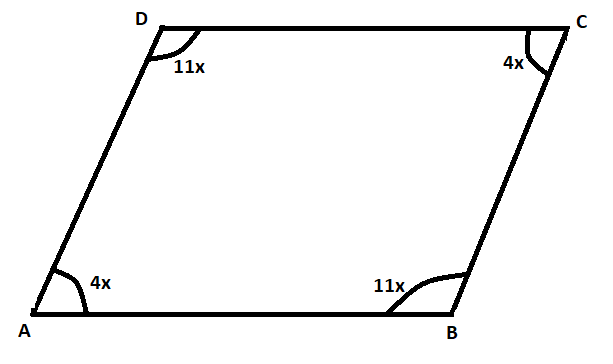
In the above question, it is given that we have a parallelogram in which the ratio of its consecutive angles is given as $4:11$.
Let the value of $\angle A$ is $4x$.
Therefore, the value of $\angle B$ will be $11x$.
We know that the sum of consecutive angles in a parallelogram is $180$ degrees.
Therefore,
$ \Rightarrow 4x + 11x = 180$
$ \Rightarrow 15x = 180$
On cross-multiplication, we get
$ \Rightarrow x = \dfrac{{180}}{{15}}$
On division, we get
$ \Rightarrow x = 12$
Now, $\angle A = 4x = 4 \times 12 = 48$
$\angle B = 11x = 11 \times 12 = 132$
Also, we know that opposite sides and opposite angles in a parallelogram are equal.
hence, $\angle A = \angle C\,\,and\,\,\angle B = \angle D$
Therefore, $\angle C = {48^ \circ }\,and\,\,\angle D = {132^ \circ }$
Note:We can also do this question by adding all the angles and putting their sum up to $360$ degrees. The properties of a parallelogram are as follows: The opposite sides are parallel and congruent. The opposite angles are congruent. The consecutive angles are supplementary. If any of the angles is a right angle, then all the other angles will be the right angle. The two diagonals bisect each other.
Complete step by step answer:
In the above question, it is given that we have a parallelogram in which the ratio of its consecutive angles is given as $4:11$.
Let the value of $\angle A$ is $4x$.
Therefore, the value of $\angle B$ will be $11x$.
We know that the sum of consecutive angles in a parallelogram is $180$ degrees.
Therefore,
$ \Rightarrow 4x + 11x = 180$
$ \Rightarrow 15x = 180$
On cross-multiplication, we get
$ \Rightarrow x = \dfrac{{180}}{{15}}$
On division, we get
$ \Rightarrow x = 12$
Now, $\angle A = 4x = 4 \times 12 = 48$
$\angle B = 11x = 11 \times 12 = 132$
Also, we know that opposite sides and opposite angles in a parallelogram are equal.
hence, $\angle A = \angle C\,\,and\,\,\angle B = \angle D$
Therefore, $\angle C = {48^ \circ }\,and\,\,\angle D = {132^ \circ }$
Note:We can also do this question by adding all the angles and putting their sum up to $360$ degrees. The properties of a parallelogram are as follows: The opposite sides are parallel and congruent. The opposite angles are congruent. The consecutive angles are supplementary. If any of the angles is a right angle, then all the other angles will be the right angle. The two diagonals bisect each other.
Recently Updated Pages
Master Class 10 Computer Science: Engaging Questions & Answers for Success

Master Class 10 General Knowledge: Engaging Questions & Answers for Success
Master Class 10 English: Engaging Questions & Answers for Success
Master Class 10 Social Science: Engaging Questions & Answers for Success
Master Class 10 Maths: Engaging Questions & Answers for Success
Master Class 10 Science: Engaging Questions & Answers for Success
Trending doubts
Explain the Treaty of Vienna of 1815 class 10 social science CBSE
Who Won 36 Oscar Awards? Record Holder Revealed
What is the median of the first 10 natural numbers class 10 maths CBSE
Why is it 530 pm in india when it is 1200 afternoon class 10 social science CBSE
Select the word that is correctly spelled a Twelveth class 10 english CBSE
Why is there a time difference of about 5 hours between class 10 social science CBSE