




The measure of angle between the line $\overrightarrow{r}=\left( 2,-3,1 \right)+k\left( 2,2,1 \right)$; $k\in R$ and the plane $2x-2y+z+7=0$ is
(A) ${{\cos }^{-1}}\dfrac{1}{9}$
(B) ${{\tan }^{-1}}\dfrac{1}{4\sqrt{5}}$
(C) ${{\sin }^{-1}}\dfrac{1}{3}$
(D) $\dfrac{\pi }{2}$
Answer
 Verified
635.1k+ views
Hint:We start solving this problem by first finding the direction ratios of line and then finding the angle between the given line and plane using the formula, angle between the line having direction ratios $\left( l,m,n \right)$ and the plane $ax+by+cz+d=0$ is,
$\theta ={{\sin }^{-1}}\left( \left| \dfrac{al+bm+cn}{\left( \sqrt{{{a}^{2}}+{{b}^{2}}+{{c}^{2}}} \right)\times \left( \sqrt{{{l}^{2}}+{{m}^{2}}+{{n}^{2}}} \right)} \right| \right)$. Then we check if the options have this value as answer or not and then we use the formula ${{\sin }^{2}}\theta +{{\cos }^{2}}\theta =1$ to find the value of $\cos \theta $ and find the angle in terms of inverse of cosine. Then we use the formula, $\tan \theta =\dfrac{\sin \theta }{\cos \theta }$ and find its value using the obtained values of $\sin \theta $ and $\cos \theta $. Then we find the angle in terms of inverse of tangent function.
Complete step by step answer:
We are given that the equation of line is $\overrightarrow{r}=\left( 2,-3,1 \right)+k\left( 2,2,1 \right)$.
The equation of the plane we are given is $2x-2y+z+7=0$.
We need to find the angle between the given line and the plane. Let us assume that the angle between them is $\theta $.
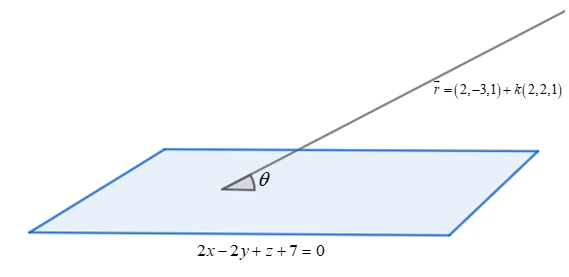
Now let us consider the given line $\overrightarrow{r}=\left( 2,-3,1 \right)+k\left( 2,2,1 \right)$.
From the given equation of the line, we can say that the given line is parallel to the line with direction ratios (2, 2, 1).
So, the direction ratios of the given line are (2, 2, 1).
Now let us consider the equation of the plane $2x-2y+z+7=0$
Now let us consider the formula, angle between the line having direction ratios $\left( l,m,n \right)$ and the plane $ax+by+cz+d=0$ is,
$\theta ={{\sin }^{-1}}\left( \left| \dfrac{al+bm+cn}{\left( \sqrt{{{a}^{2}}+{{b}^{2}}+{{c}^{2}}} \right)\times \left( \sqrt{{{l}^{2}}+{{m}^{2}}+{{n}^{2}}} \right)} \right| \right)$
Using this formula and applying it to the given line and plane we get,
$\begin{align}
& \Rightarrow \theta ={{\sin }^{-1}}\left( \left| \dfrac{2\left( 2 \right)+\left( -2 \right)\left( 2 \right)+1\left( 1 \right)}{\left( \sqrt{{{2}^{2}}+{{\left( -2 \right)}^{2}}+{{1}^{2}}} \right)\times \left( \sqrt{{{2}^{2}}+{{2}^{2}}+{{1}^{2}}} \right)} \right| \right) \\
& \Rightarrow \theta ={{\sin }^{-1}}\left( \left| \dfrac{4-4+1}{\left( \sqrt{4+4+1} \right)\times \left( \sqrt{4+4+1} \right)} \right| \right) \\
& \Rightarrow \theta ={{\sin }^{-1}}\left( \left| \dfrac{1}{\sqrt{9}\times \sqrt{9}} \right| \right) \\
& \Rightarrow \theta ={{\sin }^{-1}}\left( \left| \dfrac{1}{9} \right| \right) \\
& \Rightarrow \theta ={{\sin }^{-1}}\left( \dfrac{1}{9} \right) \\
\end{align}$
So, we get the angle between the line and the plane as $\theta ={{\sin }^{-1}}\left( \dfrac{1}{9} \right)$.
As we don’t have an answer of such type in the options let us convert into the inverse of cosine and tan and verify with the options.
We can write it as $\sin \theta =\dfrac{1}{9}$.
Now let us consider the formula, ${{\sin }^{2}}\theta +{{\cos }^{2}}\theta =1$.
Using it we can find the value of $\cos \theta $ as,
$\begin{align}
& \Rightarrow {{\left( \dfrac{1}{9} \right)}^{2}}+{{\cos }^{2}}\theta =1 \\
& \Rightarrow \dfrac{1}{81}+{{\cos }^{2}}\theta =1 \\
& \Rightarrow {{\cos }^{2}}\theta =1-\dfrac{1}{81} \\
\end{align}$
$\begin{align}
& \Rightarrow {{\cos }^{2}}\theta =\dfrac{80}{81} \\
& \Rightarrow \cos \theta =\dfrac{\sqrt{80}}{9} \\
& \Rightarrow \cos \theta =\dfrac{4\sqrt{5}}{9} \\
\end{align}$
Then we can write $\theta $ in terms of cosine inverse as,
$\theta ={{\cos }^{-1}}\dfrac{4\sqrt{5}}{9}$
Now let us consider the formula,
$\tan \theta =\dfrac{\sin \theta }{\cos \theta }$
Substituting the values of $\sin \theta $ and $\cos \theta $ obtained above we get the value of $\tan \theta $ as,
$\begin{align}
& \Rightarrow \tan \theta =\dfrac{\dfrac{1}{9}}{\dfrac{4\sqrt{5}}{9}} \\
& \Rightarrow \tan \theta =\dfrac{1}{4\sqrt{5}} \\
\end{align}$
Then we can write $\theta $ in terms of inverse of tangent as,
$\Rightarrow \theta ={{\tan }^{-1}}\dfrac{1}{4\sqrt{5}}$
Hence answer is Option B.
Note:
The common mistake that one makes in this question is one might consider the formula for the angle between the line having direction ratios $\left( l,m,n \right)$ and the plane $ax+by+cz+d=0$ is,
$\theta ={{\cos }^{-1}}\left( \left| \dfrac{al+bm+cn}{\left( \sqrt{{{a}^{2}}+{{b}^{2}}+{{c}^{2}}} \right)\times \left( \sqrt{{{l}^{2}}+{{m}^{2}}+{{n}^{2}}} \right)} \right| \right)$
Then they will get the answer as Option A. But this formula is for the angle between two lines not for the angle between a line and a plane.
$\theta ={{\sin }^{-1}}\left( \left| \dfrac{al+bm+cn}{\left( \sqrt{{{a}^{2}}+{{b}^{2}}+{{c}^{2}}} \right)\times \left( \sqrt{{{l}^{2}}+{{m}^{2}}+{{n}^{2}}} \right)} \right| \right)$. Then we check if the options have this value as answer or not and then we use the formula ${{\sin }^{2}}\theta +{{\cos }^{2}}\theta =1$ to find the value of $\cos \theta $ and find the angle in terms of inverse of cosine. Then we use the formula, $\tan \theta =\dfrac{\sin \theta }{\cos \theta }$ and find its value using the obtained values of $\sin \theta $ and $\cos \theta $. Then we find the angle in terms of inverse of tangent function.
Complete step by step answer:
We are given that the equation of line is $\overrightarrow{r}=\left( 2,-3,1 \right)+k\left( 2,2,1 \right)$.
The equation of the plane we are given is $2x-2y+z+7=0$.
We need to find the angle between the given line and the plane. Let us assume that the angle between them is $\theta $.
Now let us consider the given line $\overrightarrow{r}=\left( 2,-3,1 \right)+k\left( 2,2,1 \right)$.
From the given equation of the line, we can say that the given line is parallel to the line with direction ratios (2, 2, 1).
So, the direction ratios of the given line are (2, 2, 1).
Now let us consider the equation of the plane $2x-2y+z+7=0$
Now let us consider the formula, angle between the line having direction ratios $\left( l,m,n \right)$ and the plane $ax+by+cz+d=0$ is,
$\theta ={{\sin }^{-1}}\left( \left| \dfrac{al+bm+cn}{\left( \sqrt{{{a}^{2}}+{{b}^{2}}+{{c}^{2}}} \right)\times \left( \sqrt{{{l}^{2}}+{{m}^{2}}+{{n}^{2}}} \right)} \right| \right)$
Using this formula and applying it to the given line and plane we get,
$\begin{align}
& \Rightarrow \theta ={{\sin }^{-1}}\left( \left| \dfrac{2\left( 2 \right)+\left( -2 \right)\left( 2 \right)+1\left( 1 \right)}{\left( \sqrt{{{2}^{2}}+{{\left( -2 \right)}^{2}}+{{1}^{2}}} \right)\times \left( \sqrt{{{2}^{2}}+{{2}^{2}}+{{1}^{2}}} \right)} \right| \right) \\
& \Rightarrow \theta ={{\sin }^{-1}}\left( \left| \dfrac{4-4+1}{\left( \sqrt{4+4+1} \right)\times \left( \sqrt{4+4+1} \right)} \right| \right) \\
& \Rightarrow \theta ={{\sin }^{-1}}\left( \left| \dfrac{1}{\sqrt{9}\times \sqrt{9}} \right| \right) \\
& \Rightarrow \theta ={{\sin }^{-1}}\left( \left| \dfrac{1}{9} \right| \right) \\
& \Rightarrow \theta ={{\sin }^{-1}}\left( \dfrac{1}{9} \right) \\
\end{align}$
So, we get the angle between the line and the plane as $\theta ={{\sin }^{-1}}\left( \dfrac{1}{9} \right)$.
As we don’t have an answer of such type in the options let us convert into the inverse of cosine and tan and verify with the options.
We can write it as $\sin \theta =\dfrac{1}{9}$.
Now let us consider the formula, ${{\sin }^{2}}\theta +{{\cos }^{2}}\theta =1$.
Using it we can find the value of $\cos \theta $ as,
$\begin{align}
& \Rightarrow {{\left( \dfrac{1}{9} \right)}^{2}}+{{\cos }^{2}}\theta =1 \\
& \Rightarrow \dfrac{1}{81}+{{\cos }^{2}}\theta =1 \\
& \Rightarrow {{\cos }^{2}}\theta =1-\dfrac{1}{81} \\
\end{align}$
$\begin{align}
& \Rightarrow {{\cos }^{2}}\theta =\dfrac{80}{81} \\
& \Rightarrow \cos \theta =\dfrac{\sqrt{80}}{9} \\
& \Rightarrow \cos \theta =\dfrac{4\sqrt{5}}{9} \\
\end{align}$
Then we can write $\theta $ in terms of cosine inverse as,
$\theta ={{\cos }^{-1}}\dfrac{4\sqrt{5}}{9}$
Now let us consider the formula,
$\tan \theta =\dfrac{\sin \theta }{\cos \theta }$
Substituting the values of $\sin \theta $ and $\cos \theta $ obtained above we get the value of $\tan \theta $ as,
$\begin{align}
& \Rightarrow \tan \theta =\dfrac{\dfrac{1}{9}}{\dfrac{4\sqrt{5}}{9}} \\
& \Rightarrow \tan \theta =\dfrac{1}{4\sqrt{5}} \\
\end{align}$
Then we can write $\theta $ in terms of inverse of tangent as,
$\Rightarrow \theta ={{\tan }^{-1}}\dfrac{1}{4\sqrt{5}}$
Hence answer is Option B.
Note:
The common mistake that one makes in this question is one might consider the formula for the angle between the line having direction ratios $\left( l,m,n \right)$ and the plane $ax+by+cz+d=0$ is,
$\theta ={{\cos }^{-1}}\left( \left| \dfrac{al+bm+cn}{\left( \sqrt{{{a}^{2}}+{{b}^{2}}+{{c}^{2}}} \right)\times \left( \sqrt{{{l}^{2}}+{{m}^{2}}+{{n}^{2}}} \right)} \right| \right)$
Then they will get the answer as Option A. But this formula is for the angle between two lines not for the angle between a line and a plane.
Recently Updated Pages
Basicity of sulphurous acid and sulphuric acid are

Master Class 10 Computer Science: Engaging Questions & Answers for Success
Master Class 10 Social Science: Engaging Questions & Answers for Success
Master Class 10 Science: Engaging Questions & Answers for Success
Class 10 Question and Answer - Your Ultimate Solutions Guide
Master Class 10 Maths: Engaging Questions & Answers for Success
Trending doubts
What is the Total Duration of Football Match?
Explain the Treaty of Vienna of 1815 class 10 social science CBSE
In football, which nation is called "La Roja"?
Why is there a time difference of about 5 hours between class 10 social science CBSE
10 examples of evaporation in daily life with explanations
What is the full form of POSCO class 10 social science CBSE