




The maximum value of g is
A. At the poles
B. At the top of the Mount Everest
C. At the equator
D. Below the sea level
Answer
 Verified
624.9k+ views
Hint: Here, the effect of centrifugal acceleration will act on. It’s an acceleration that acts outwards from Earth’s surface. It has different values at different longitudes. It usually tries to reduce the gravitational acceleration.
Formula used: $g \prime= g-mR\omega^2.\cos^2\theta$
Complete step-by-step solution:
One has to know the effective value of the acceleration due to gravity at different longitudes. Now, let $\theta$ be the longitude of some place on Earth. Try to imagine a circular plane perpendicular to the axis of Earth along this place. The radius of this circular plane is $R.\cos\theta$. Here R is the radius of Earth and $\theta$ is the longitudinal angle.
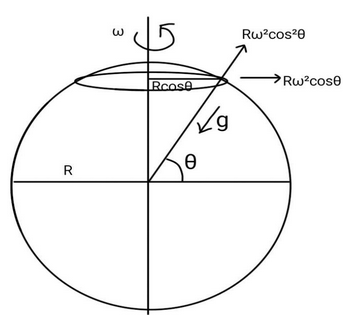
So, the centrifugal acceleration in this place of Earth is given by,
$a_c=R.\cos\theta .\omega^2 $
Here, $\omega$ is the angular velocity of Earth.
Now, component of this acceleration along the direction of g is given by,
$a_c.\cos\theta=R.\omega^2.\cos^2\theta $
This acceleration acts opposite to the acceleration due to gravity. Hence the effective value of g is given by,
$g \prime= g-mR\omega^2.\cos^2\theta$
Now, at the equator, the longitude is zero. So $g \prime$ is very low. But at the poles, $\theta=90^\circ$. So, $g \prime$ is the maximum.
Again, while considering heights, value of g decreases with height as well as with the depth. So, only option A is the correct answer.
Additional information: If a body rotates with angular velocity $\omega$ in a orbit of radius r, its centrifugal acceleration is given by,
$r. \omega^2=\dfrac{v^2}{r}$
Here, v is the linear velocity of the body.
Note: A few things to keep in mind are...
1. While trying to remember the formula, don’t replace cosine with sine. Then you will get the wrong answer.
2. Remember that, centrifugal acceleration always works in the outward direction.
3. Angular velocity of Earth is constant on all the places of Earth.
Formula used: $g \prime= g-mR\omega^2.\cos^2\theta$
Complete step-by-step solution:
One has to know the effective value of the acceleration due to gravity at different longitudes. Now, let $\theta$ be the longitude of some place on Earth. Try to imagine a circular plane perpendicular to the axis of Earth along this place. The radius of this circular plane is $R.\cos\theta$. Here R is the radius of Earth and $\theta$ is the longitudinal angle.
So, the centrifugal acceleration in this place of Earth is given by,
$a_c=R.\cos\theta .\omega^2 $
Here, $\omega$ is the angular velocity of Earth.
Now, component of this acceleration along the direction of g is given by,
$a_c.\cos\theta=R.\omega^2.\cos^2\theta $
This acceleration acts opposite to the acceleration due to gravity. Hence the effective value of g is given by,
$g \prime= g-mR\omega^2.\cos^2\theta$
Now, at the equator, the longitude is zero. So $g \prime$ is very low. But at the poles, $\theta=90^\circ$. So, $g \prime$ is the maximum.
Again, while considering heights, value of g decreases with height as well as with the depth. So, only option A is the correct answer.
Additional information: If a body rotates with angular velocity $\omega$ in a orbit of radius r, its centrifugal acceleration is given by,
$r. \omega^2=\dfrac{v^2}{r}$
Here, v is the linear velocity of the body.
Note: A few things to keep in mind are...
1. While trying to remember the formula, don’t replace cosine with sine. Then you will get the wrong answer.
2. Remember that, centrifugal acceleration always works in the outward direction.
3. Angular velocity of Earth is constant on all the places of Earth.
Recently Updated Pages
Master Class 11 Social Science: Engaging Questions & Answers for Success

Master Class 11 English: Engaging Questions & Answers for Success
Master Class 11 Maths: Engaging Questions & Answers for Success
Master Class 11 Chemistry: Engaging Questions & Answers for Success
Master Class 11 Biology: Engaging Questions & Answers for Success
Master Class 11 Physics: Engaging Questions & Answers for Success
Trending doubts
Differentiate between an exothermic and an endothermic class 11 chemistry CBSE
One Metric ton is equal to kg A 10000 B 1000 C 100 class 11 physics CBSE
Difference Between Prokaryotic Cells and Eukaryotic Cells
There are 720 permutations of the digits 1 2 3 4 5 class 11 maths CBSE
Draw a diagram of a plant cell and label at least eight class 11 biology CBSE
Which chemical is known as king of chemicals A H 2 class 11 chemistry CBSE