




The maximum range of bullet fires from a toy pistol mounted on a car at rest is \[{R_ \circ } = 40m\].What will be the acute angle of inclination of the pistol for maximum range when the car is moving in the direction of firing with uniform velocity \[v = 20\dfrac{m}{s}\], on a horizontal surface? \[\left( {g = 10\dfrac{m}{{{s^2}}}} \right)\]
(A) \[{30^ \circ }\]
(B) \[{60^ \circ }\]
(C) \[{75^ \circ }\]
(D) \[{45^ \circ }\]
Answer
 Verified
598.2k+ views
Hint: In this question, we need to determine the acute angle of inclination of the pistol for maximum range such that the car is moving in the direction of firing with uniform velocity. For this, we will use the equations of the projectile motions which is the special case of the linear motions.
Complete step by step answer:
Maximum range of bullet fired \[{R_ \circ } = 40m\]
uniform velocity of the car \[v = 20\dfrac{m}{s}\]
We know the range of a projection of a particle is given by the formula
\[ \Rightarrow R = \dfrac{{{u^2}}}{g}\ operator\,name {Sin} 2\theta \]
Where the range of a projection of a particle will be maximum if angle of projection is maximum
i.e. \[\theta = {90^ \circ }\], hence the formula for maximum projection becomes
\[{R_{\max }} = \dfrac{{{u^2}}}{g} - - (i)\]
Now since the maximum projection of bullet is given so the velocity of toy pistol
\[
{R_{\max }} = \dfrac{{{u^2}}}{g} \\
\Rightarrow 40 = \dfrac{{{u^2}}}{{10}} \\
\Rightarrow{u^2} = 400 \\
\Rightarrow u = 20\dfrac{m}{s} - - (ii) \\
\]
Now it is said that the car stats moving in the direction of firing with uniform velocity \[v = 20\dfrac{m}{s}\]
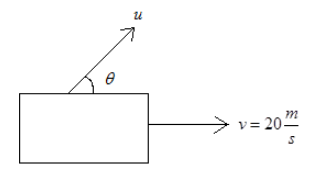
Now since the car is moving in x direction and the bullet is also fired in x direction so the total speed becomes
\[u_{_x}^1 = 20 + u\cos \theta - - (iii)\]
\Rightarrow\[{u_y} = u\sin \theta - - (iv)\]
Now we know the maximum range of projection is given as
\[R = \dfrac{{2 \cdot {u_x} \cdot {u_y}}}{g} - - (v)\]
Hence by substituting the values from equation (iii) and (iv), we get
\[R = \dfrac{{2 \cdot \left( {20 + u\cos \theta } \right) \cdot \left( {u\sin \theta } \right)}}{g} - - (vi)\]
Now to maximize the range of projection we can write \[\dfrac{{dR}}{{d\theta }} = 0\]
Hence for maximum range differentiate equation (v) w.r.t. \[\theta \], hence we get
\[
\dfrac{{d\left( {\dfrac{{2\left( {20u\sin \theta + {u^2}\sin \theta \cos \theta } \right)}}{g}} \right)}}{{d\theta }} = 0 \\
\Rightarrow\dfrac{2}{g}\dfrac{{d\left( {20u\sin \theta + {u^2}\sin \theta \cos \theta } \right)}}{{d\theta }} = 0 \\
\Rightarrow\dfrac{2}{g}\left\{ {20\dfrac{d}{{d\theta }}\left( {u\sin \theta } \right) + \dfrac{d}{{d\theta }}\left( {{u^2}\sin \theta \cos \theta } \right)} \right\} = 0 \\
\]
Hence by differentiating we get
\[
\dfrac{2}{g}\left\{ {20\dfrac{d}{{d\theta }}\left( {u\sin \theta } \right) + \dfrac{d}{{d\theta }}\left( {{u^2}\sin \theta \cos \theta } \right)} \right\} = 0 \\
\Rightarrow\dfrac{2}{g}\left\{ {20\left( {u\cos \theta } \right) + {u^2}\dfrac{d}{{d\theta }}\left( {\sin \theta \cos \theta } \right)} \right\} = 0 \\
\]
Now by applying uv rule we can further differentiate the equation as
\[20\left( {u\cos \theta } \right) + {u^2}\left( {{{\cos }^2}\theta - {{\sin }^2}\theta } \right) = 0\]
Now since \[{\sin ^2}\theta + {\cos ^2}\theta = 1\], hence we can further write the equation as
\[20\cos \theta + u\left( {2{{\cos }^2}\theta - 1} \right) = 0\]
This can be written as
\[20\cos \theta + 2u{\cos ^2}\theta - u = 0\]
Now since \[u = 20\dfrac{m}{s}\] from equation (ii), hence we can write
\[
\cos \theta + 2{\cos ^2}\theta - 1 = 0 \\
\]
This is equal to \[2{\cos ^2}\theta + \cos \theta - 1 = 0\]
Hence we get the equation in quadratic form where \[\cos \theta = {60^ \circ },{270^ \circ }\].
Hence acute angle of inclination of the pistol for maximum range when the car is moving in the direction of firing \[{60^ \circ }\]. So,option B is correct.
Note: Sometimes vectors are not aligned on the x-axis or the y-axes and so, they increase the confusion while solving the questions. Always try to simplify the vectors along the x-axis (horizontal) and the y-axis (vertical) and then, do the algebraic operations on the same.
Complete step by step answer:
Maximum range of bullet fired \[{R_ \circ } = 40m\]
uniform velocity of the car \[v = 20\dfrac{m}{s}\]
We know the range of a projection of a particle is given by the formula
\[ \Rightarrow R = \dfrac{{{u^2}}}{g}\ operator\,name {Sin} 2\theta \]
Where the range of a projection of a particle will be maximum if angle of projection is maximum
i.e. \[\theta = {90^ \circ }\], hence the formula for maximum projection becomes
\[{R_{\max }} = \dfrac{{{u^2}}}{g} - - (i)\]
Now since the maximum projection of bullet is given so the velocity of toy pistol
\[
{R_{\max }} = \dfrac{{{u^2}}}{g} \\
\Rightarrow 40 = \dfrac{{{u^2}}}{{10}} \\
\Rightarrow{u^2} = 400 \\
\Rightarrow u = 20\dfrac{m}{s} - - (ii) \\
\]
Now it is said that the car stats moving in the direction of firing with uniform velocity \[v = 20\dfrac{m}{s}\]
Now since the car is moving in x direction and the bullet is also fired in x direction so the total speed becomes
\[u_{_x}^1 = 20 + u\cos \theta - - (iii)\]
\Rightarrow\[{u_y} = u\sin \theta - - (iv)\]
Now we know the maximum range of projection is given as
\[R = \dfrac{{2 \cdot {u_x} \cdot {u_y}}}{g} - - (v)\]
Hence by substituting the values from equation (iii) and (iv), we get
\[R = \dfrac{{2 \cdot \left( {20 + u\cos \theta } \right) \cdot \left( {u\sin \theta } \right)}}{g} - - (vi)\]
Now to maximize the range of projection we can write \[\dfrac{{dR}}{{d\theta }} = 0\]
Hence for maximum range differentiate equation (v) w.r.t. \[\theta \], hence we get
\[
\dfrac{{d\left( {\dfrac{{2\left( {20u\sin \theta + {u^2}\sin \theta \cos \theta } \right)}}{g}} \right)}}{{d\theta }} = 0 \\
\Rightarrow\dfrac{2}{g}\dfrac{{d\left( {20u\sin \theta + {u^2}\sin \theta \cos \theta } \right)}}{{d\theta }} = 0 \\
\Rightarrow\dfrac{2}{g}\left\{ {20\dfrac{d}{{d\theta }}\left( {u\sin \theta } \right) + \dfrac{d}{{d\theta }}\left( {{u^2}\sin \theta \cos \theta } \right)} \right\} = 0 \\
\]
Hence by differentiating we get
\[
\dfrac{2}{g}\left\{ {20\dfrac{d}{{d\theta }}\left( {u\sin \theta } \right) + \dfrac{d}{{d\theta }}\left( {{u^2}\sin \theta \cos \theta } \right)} \right\} = 0 \\
\Rightarrow\dfrac{2}{g}\left\{ {20\left( {u\cos \theta } \right) + {u^2}\dfrac{d}{{d\theta }}\left( {\sin \theta \cos \theta } \right)} \right\} = 0 \\
\]
Now by applying uv rule we can further differentiate the equation as
\[20\left( {u\cos \theta } \right) + {u^2}\left( {{{\cos }^2}\theta - {{\sin }^2}\theta } \right) = 0\]
Now since \[{\sin ^2}\theta + {\cos ^2}\theta = 1\], hence we can further write the equation as
\[20\cos \theta + u\left( {2{{\cos }^2}\theta - 1} \right) = 0\]
This can be written as
\[20\cos \theta + 2u{\cos ^2}\theta - u = 0\]
Now since \[u = 20\dfrac{m}{s}\] from equation (ii), hence we can write
\[
\cos \theta + 2{\cos ^2}\theta - 1 = 0 \\
\]
This is equal to \[2{\cos ^2}\theta + \cos \theta - 1 = 0\]
Hence we get the equation in quadratic form where \[\cos \theta = {60^ \circ },{270^ \circ }\].
Hence acute angle of inclination of the pistol for maximum range when the car is moving in the direction of firing \[{60^ \circ }\]. So,option B is correct.
Note: Sometimes vectors are not aligned on the x-axis or the y-axes and so, they increase the confusion while solving the questions. Always try to simplify the vectors along the x-axis (horizontal) and the y-axis (vertical) and then, do the algebraic operations on the same.
Recently Updated Pages
Master Class 11 Social Science: Engaging Questions & Answers for Success

Master Class 11 Chemistry: Engaging Questions & Answers for Success
Master Class 12 Business Studies: Engaging Questions & Answers for Success
Master Class 12 Chemistry: Engaging Questions & Answers for Success
Master Class 12 Biology: Engaging Questions & Answers for Success
Class 12 Question and Answer - Your Ultimate Solutions Guide
Trending doubts
One Metric ton is equal to kg A 10000 B 1000 C 100 class 11 physics CBSE
Difference Between Prokaryotic Cells and Eukaryotic Cells
Two of the body parts which do not appear in MRI are class 11 biology CBSE
Explain zero factorial class 11 maths CBSE
10 examples of friction in our daily life
Name the Largest and the Smallest Cell in the Human Body ?