




The maximum range of a rifle bullet on the horizontal ground is 6Km. Find its maximum range on an inclined of ${30^0}$
$
(a){\text{ 5}} \\
(b){\text{ 6}} \\
(c){\text{ 4}} \\
(d){\text{ 7}} \\
$
Answer
 Verified
645k+ views
- Hint: In this question use the concept that maximum range refers to the distance travelled by the bullet after eventually it comes to the rest, so use the direct relation between the range, initial velocity and the slope of inclination that is $R = \dfrac{{{u^2}}}{{g\left( {1 + \sin \theta } \right)}}$. This will help approaching the problem.
Complete step-by-step solution -
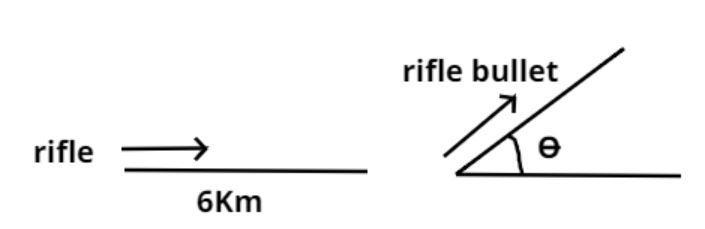
It is given that the maximum range of a rifle bullet on the horizontal ground is 6Km as shown in the figure.
Therefore, R = 6Km
Let u be the initial velocity of the bullet.
Bullet final velocity becomes zero after covering 6Km distance.
Therefore, v = 0m/s.
The maximum range covered by the bullet is given by,
$R = \dfrac{{{u^2}}}{{g\left( {1 + \sin \theta } \right)}}$
In horizontal ground the angle $\theta $ becomes zero, so sin 0 = 0, therefore,
$ \Rightarrow 6 = \dfrac{{{u^2}}}{{g\left( {1 + \sin 0} \right)}} = \dfrac{{{u^2}}}{g}$.............. (1)
Now when the bullet is fired on an inclined of ${30^0}$as shown in the figure, so the maximum range covered by the bullet is given as,
${R_{\max }} = \dfrac{{{u^2}}}{{g\left( {1 + \sin \theta } \right)}}$.................. (2)
Where, u = initial velocity of the bullet, g = acceleration due to gravity and, $\theta $ = angle of inclination.
Now substitute the value from equation (1) in equation (2) we have,
$ \Rightarrow {R_{\max }} = \dfrac{6}{{1 + \sin {{30}^o}}}$
Now simplify this using $\sin {30^o} = \dfrac{1}{2}$ we have,
$ \Rightarrow {R_{\max }} = \dfrac{6}{{1 + \dfrac{1}{2}}} = \dfrac{6}{{\dfrac{3}{2}}} = \dfrac{{6 \times 2}}{3} = 4$Km.
So the maximum range of a rifle bullet on an incline of 30 degree is 4 Km.
So this is the required answer.
Hence option (C) is the correct answer.
Note – It is advised to remember this direct formula that is $R = \dfrac{{{u^2}}}{{g\left( {1 + \sin \theta } \right)}}$ as it helps saving a lot of time. The trick here was to find out the relationship between initial velocity u and g as it has to be substituted into the mainstream formula and thus the maximum range on the flat ground is being taken into consideration.
Complete step-by-step solution -
It is given that the maximum range of a rifle bullet on the horizontal ground is 6Km as shown in the figure.
Therefore, R = 6Km
Let u be the initial velocity of the bullet.
Bullet final velocity becomes zero after covering 6Km distance.
Therefore, v = 0m/s.
The maximum range covered by the bullet is given by,
$R = \dfrac{{{u^2}}}{{g\left( {1 + \sin \theta } \right)}}$
In horizontal ground the angle $\theta $ becomes zero, so sin 0 = 0, therefore,
$ \Rightarrow 6 = \dfrac{{{u^2}}}{{g\left( {1 + \sin 0} \right)}} = \dfrac{{{u^2}}}{g}$.............. (1)
Now when the bullet is fired on an inclined of ${30^0}$as shown in the figure, so the maximum range covered by the bullet is given as,
${R_{\max }} = \dfrac{{{u^2}}}{{g\left( {1 + \sin \theta } \right)}}$.................. (2)
Where, u = initial velocity of the bullet, g = acceleration due to gravity and, $\theta $ = angle of inclination.
Now substitute the value from equation (1) in equation (2) we have,
$ \Rightarrow {R_{\max }} = \dfrac{6}{{1 + \sin {{30}^o}}}$
Now simplify this using $\sin {30^o} = \dfrac{1}{2}$ we have,
$ \Rightarrow {R_{\max }} = \dfrac{6}{{1 + \dfrac{1}{2}}} = \dfrac{6}{{\dfrac{3}{2}}} = \dfrac{{6 \times 2}}{3} = 4$Km.
So the maximum range of a rifle bullet on an incline of 30 degree is 4 Km.
So this is the required answer.
Hence option (C) is the correct answer.
Note – It is advised to remember this direct formula that is $R = \dfrac{{{u^2}}}{{g\left( {1 + \sin \theta } \right)}}$ as it helps saving a lot of time. The trick here was to find out the relationship between initial velocity u and g as it has to be substituted into the mainstream formula and thus the maximum range on the flat ground is being taken into consideration.
Recently Updated Pages
Master Class 11 English: Engaging Questions & Answers for Success

Master Class 11 Social Science: Engaging Questions & Answers for Success
Master Class 11 Maths: Engaging Questions & Answers for Success
Master Class 11 Biology: Engaging Questions & Answers for Success
Master Class 11 Physics: Engaging Questions & Answers for Success
Master Class 11 Chemistry: Engaging Questions & Answers for Success
Trending doubts
One Metric ton is equal to kg A 10000 B 1000 C 100 class 11 physics CBSE
Difference Between Prokaryotic Cells and Eukaryotic Cells
Find the value of the expression given below sin 30circ class 11 maths CBSE
Difference between physical and chemical change class 11 chemistry CBSE
Two of the body parts which do not appear in MRI are class 11 biology CBSE
Draw a diagram of a plant cell and label at least eight class 11 biology CBSE