




The maximum number of sets obtainable from A and B by applying union and difference operations is
A) 5
B) 6
C) 7
D) 8
Answer
 Verified
621.6k+ views
Hint:
To calculate maximum numbers of sets obtainable from A and B by applying union and different operations. We draw Vann’s diagram of set A and set B, In the Vann diagram firstly we consider a universal set ‘U’ which is represented by a rectangle, and then we considered its two subsets A and B, With the help of these diagrams, we can calculate the number of sets from by union and intersection of A and B.
Complete step by step solution:
The Venn diagram is given
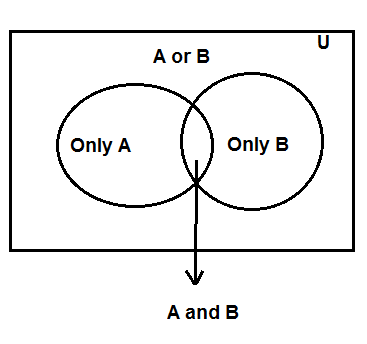
This is the Venn diagram of A and B. There are mainly three areas in the diagram.
Firstly, $ A - B $ represents the set in which there are the elements of A but not B.
Secondly $ A \cup B $ .
It is called A union B. AUB represents the set in which there are all elements of A together with elements of B. In $ A \cup B $ , there are no repeated elements.
Third is $ B - A $
$ B - A $ represents the set in which there are the elements of set A bit not set B.
Any other set obtained from these two areas either contains or does not contain each area. Therefore, there are a maximum number of $ {2^3} = 2 \times 2 \times 2 = 8 $ possible sets.
These possible sets are A, B, $ A - B $ , $ B - A $ , $ A \cap B $ , others are AUB, A-A and $ (A - B) \cap (B - A) $
Here, A-A is the empty set. The empty set is those sets that do not contain any elements.
Also $ A \cup B $ = $ (A \cap B) \cup (A - B) \cup (B - A) $
So, the total number of sets obtained from the union, and the difference between A and B is 8.
So, option D is correct.
Note:
Here A $ \cap $ B is called A intersection B. Intersection of two sets A and B is the setting in which there are common elements of A and B.
AUB is called the union of A and B. Union of two sets A and B is the setting in which there are the elements of A together with elements of B.
Universal set:- If all the sets under consideration are the sub-set of a fixed set then this fixed set is called a universal set.
To calculate maximum numbers of sets obtainable from A and B by applying union and different operations. We draw Vann’s diagram of set A and set B, In the Vann diagram firstly we consider a universal set ‘U’ which is represented by a rectangle, and then we considered its two subsets A and B, With the help of these diagrams, we can calculate the number of sets from by union and intersection of A and B.
Complete step by step solution:
The Venn diagram is given
This is the Venn diagram of A and B. There are mainly three areas in the diagram.
Firstly, $ A - B $ represents the set in which there are the elements of A but not B.
Secondly $ A \cup B $ .
It is called A union B. AUB represents the set in which there are all elements of A together with elements of B. In $ A \cup B $ , there are no repeated elements.
Third is $ B - A $
$ B - A $ represents the set in which there are the elements of set A bit not set B.
Any other set obtained from these two areas either contains or does not contain each area. Therefore, there are a maximum number of $ {2^3} = 2 \times 2 \times 2 = 8 $ possible sets.
These possible sets are A, B, $ A - B $ , $ B - A $ , $ A \cap B $ , others are AUB, A-A and $ (A - B) \cap (B - A) $
Here, A-A is the empty set. The empty set is those sets that do not contain any elements.
Also $ A \cup B $ = $ (A \cap B) \cup (A - B) \cup (B - A) $
So, the total number of sets obtained from the union, and the difference between A and B is 8.
So, option D is correct.
Note:
Here A $ \cap $ B is called A intersection B. Intersection of two sets A and B is the setting in which there are common elements of A and B.
AUB is called the union of A and B. Union of two sets A and B is the setting in which there are the elements of A together with elements of B.
Universal set:- If all the sets under consideration are the sub-set of a fixed set then this fixed set is called a universal set.
Recently Updated Pages
Basicity of sulphurous acid and sulphuric acid are

Master Class 11 English: Engaging Questions & Answers for Success
Master Class 11 Physics: Engaging Questions & Answers for Success
Master Class 11 Computer Science: Engaging Questions & Answers for Success
Master Class 11 Chemistry: Engaging Questions & Answers for Success
Master Class 11 Social Science: Engaging Questions & Answers for Success
Trending doubts
Difference Between Prokaryotic Cells and Eukaryotic Cells
Two of the body parts which do not appear in MRI are class 11 biology CBSE
One Metric ton is equal to kg A 10000 B 1000 C 100 class 11 physics CBSE
10 examples of friction in our daily life
Draw a diagram of nephron and explain its structur class 11 biology CBSE
What will happen if the mucus is not secreted by the class 11 biology CBSE