




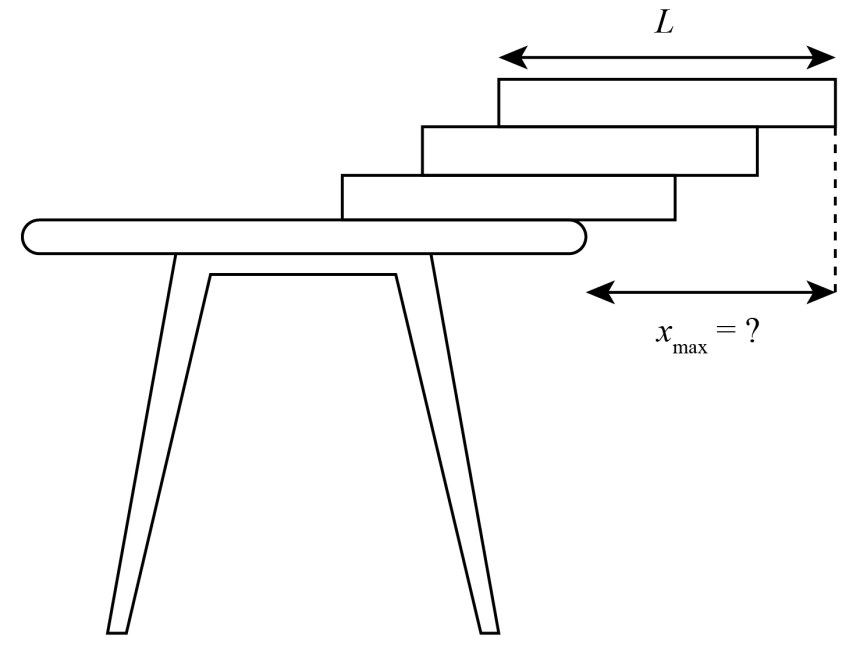
The maximum length that three playing cards can protrude on a table edge?
(A). $\dfrac{L}{{10}}$
(B). $\dfrac{{3L}}{4}$
(C). $\dfrac{{3L}}{{12}}$
(D). $L$
Answer
 Verified
576k+ views
Hint: The physical principle here is to balance the torque (or moments) on the two sides of the table’s edge. The torque on each side is the product of the mass on that side and the distance from its center of mass to the edge.
Complete step by step answer:
Let the mass of each card be $m$. We can first analyze the top two cards. Then the force applied by the top card on the underneath is ${F_1}$ , which will be equal to $mg$, where $g$ is the acceleration due to gravity. When two forces balance one another with no offset, there is no torque, or moment, twisting the block. It is stable. It’s possible to slide the block towards the edge of the table, and provide the centre of mass to remain over the table, then the block is stable. If the centre of mass moves beyond the edge of the table there is no way its weight can be reacted without a moment and the block will topple off the end.For the cards not to topple, the net torque should be equal to zero. Thus, we have,
${F_1}{y_1} = mg\left( {\dfrac{L}{2} - x} \right)$
Torque by contact force at the taken values from zero to $mg\left( {L - x} \right)$ depends on $y$. And hence we have, ${F_1}{y_1} = 0$. So this further implies that,
$
0 = mg\left( {\dfrac{L}{2} - x} \right)\\
\Rightarrow {x_1} = \dfrac{L}{2}
$
Now we can consider three card systems. Here the force will be ${F_2} = 2mg$. For rotational equilibrium,
$
mg{x_2} + 2mg{y_2} = mg\left( {\dfrac{L}{2} - {x_2}} \right)\\
\Rightarrow 2mg{y_2} = mg\left( {\dfrac{L}{2} - 2{x_2}} \right)\\
\Rightarrow {x_2} = \dfrac{L}{4}
$
Similarly we can obtain the relation, for ${x_3}$ as,
${x_3} = \dfrac{L}{6}$
Therefore the total is,
${x_1} + {x_2} + {x_3} = \dfrac{L}{2} + \dfrac{L}{4} + \dfrac{L}{6} = \dfrac{{11L}}{{12}}$
So, the correct answer is “Option B”.
Note:
The moment of the combined centre of mass of the entire loops of cards, around the lower right corner is equal to the sum of the moments of the individual cards. Since the moment of the top card passes directly through this chosen origin, it is zero.
Complete step by step answer:
Let the mass of each card be $m$. We can first analyze the top two cards. Then the force applied by the top card on the underneath is ${F_1}$ , which will be equal to $mg$, where $g$ is the acceleration due to gravity. When two forces balance one another with no offset, there is no torque, or moment, twisting the block. It is stable. It’s possible to slide the block towards the edge of the table, and provide the centre of mass to remain over the table, then the block is stable. If the centre of mass moves beyond the edge of the table there is no way its weight can be reacted without a moment and the block will topple off the end.For the cards not to topple, the net torque should be equal to zero. Thus, we have,
${F_1}{y_1} = mg\left( {\dfrac{L}{2} - x} \right)$
Torque by contact force at the taken values from zero to $mg\left( {L - x} \right)$ depends on $y$. And hence we have, ${F_1}{y_1} = 0$. So this further implies that,
$
0 = mg\left( {\dfrac{L}{2} - x} \right)\\
\Rightarrow {x_1} = \dfrac{L}{2}
$
Now we can consider three card systems. Here the force will be ${F_2} = 2mg$. For rotational equilibrium,
$
mg{x_2} + 2mg{y_2} = mg\left( {\dfrac{L}{2} - {x_2}} \right)\\
\Rightarrow 2mg{y_2} = mg\left( {\dfrac{L}{2} - 2{x_2}} \right)\\
\Rightarrow {x_2} = \dfrac{L}{4}
$
Similarly we can obtain the relation, for ${x_3}$ as,
${x_3} = \dfrac{L}{6}$
Therefore the total is,
${x_1} + {x_2} + {x_3} = \dfrac{L}{2} + \dfrac{L}{4} + \dfrac{L}{6} = \dfrac{{11L}}{{12}}$
So, the correct answer is “Option B”.
Note:
The moment of the combined centre of mass of the entire loops of cards, around the lower right corner is equal to the sum of the moments of the individual cards. Since the moment of the top card passes directly through this chosen origin, it is zero.
Recently Updated Pages
Master Class 11 Business Studies: Engaging Questions & Answers for Success

Master Class 11 Economics: Engaging Questions & Answers for Success
Master Class 11 Computer Science: Engaging Questions & Answers for Success
Master Class 11 English: Engaging Questions & Answers for Success
Master Class 11 Maths: Engaging Questions & Answers for Success
Master Class 11 Biology: Engaging Questions & Answers for Success
Trending doubts
One Metric ton is equal to kg A 10000 B 1000 C 100 class 11 physics CBSE
Discuss the various forms of bacteria class 11 biology CBSE
Draw a diagram of a plant cell and label at least eight class 11 biology CBSE
State the laws of reflection of light
Explain zero factorial class 11 maths CBSE
10 examples of friction in our daily life