




The masses and radii of earth and moon are${M_1}$, ${R_1}$ and${M_2}$, ${R_2}$ respectively. Their centres are at a distance $d$ apart. The minimum speed with which a particle of mass $m$ should be protected from a point midway between the two centres so as to escape to infinity is:
(A) $\sqrt {\dfrac{{G\left( {{M_1} + {M_2}} \right)}}{d}} $
(B) $\sqrt {\dfrac{{2G\left( {{M_1} + {M_2}} \right)}}{d}} $
(C) $\sqrt {\dfrac{{4G\left( {{M_1} + {M_2}} \right)}}{d}} $
(D) \[\sqrt {\dfrac{{G{M_1} + {M_2}}}{d}} \]
Answer
 Verified
626.4k+ views
Hint In order to find the escape velocity, we will at first find the potential difference between the potential energies of the two bodies. After this, applying the principle of conservation of mechanical energy and equating it with the kinetic energy, we can find the escape velocity.
Complete Step-By-Step Solution:
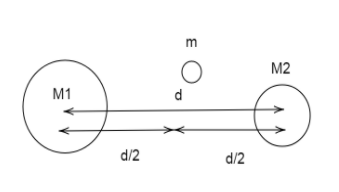
Thus, the mass $m$ is placed at the centre having distance $d/2$on both sides.
Thus, the potential energy difference can be written as:
$p = \dfrac{{G{m_1}{m_2}}}{R}$
Where:
$p = $Potential energy
${m_1} = $ Mass of first object
${m_2} = $ Mass of second object
$R = $ Distance between the objects
Now, using this we can write:
Change in potential energy considering the above diagram as:
$\Delta p = - \dfrac{{G{M_2}{m_{}}}}{{d/2}} - \dfrac{{G{M_1}{m_{}}}}{{d/2}}$
This is the total initial energy of the system.
Now, applying conservation of mechanical energy, we know:
Total potential energy is converted to kinetic energy.
The principle states that:
Energy is not created nor destroyed but is converted from one form to another.
Hence, this conversion of energy occurs from potential to kinetic energy.
Hence we can write:
$ - \dfrac{{G{M_2}{m_{}}}}{{d/2}} - \dfrac{{G{M_1}{m_{}}}}{{d/2}} = \dfrac{1}{2}m{v^2}$
Where:
${m_{}} = $ Mass of the object
${v_{}} = $ Escape velocity of the object
Escape velocity is defined as the velocity at which the objects sum of gravitational potential energy and kinetic energy results to zero.
On solving the equation, we get:
${v^2} = \dfrac{{4G}}{d}\left( {{M_1} + {M_2}} \right)$
Thus, we get:
$v = \sqrt {\dfrac{{4G}}{d}\left( {{M_1} + {M_2}} \right)} $
This is the correct answer. Therefore, option (C ) is correct.
Note: Kinetic energy of a body is the energy possessed by the body due to virtue its motion. Therefore, when we considered the escape velocity we took the equation for kinetic energy. On the other hand, potential energy is defined as the energy possessed by an object at rest.
Complete Step-By-Step Solution:
Thus, the mass $m$ is placed at the centre having distance $d/2$on both sides.
Thus, the potential energy difference can be written as:
$p = \dfrac{{G{m_1}{m_2}}}{R}$
Where:
$p = $Potential energy
${m_1} = $ Mass of first object
${m_2} = $ Mass of second object
$R = $ Distance between the objects
Now, using this we can write:
Change in potential energy considering the above diagram as:
$\Delta p = - \dfrac{{G{M_2}{m_{}}}}{{d/2}} - \dfrac{{G{M_1}{m_{}}}}{{d/2}}$
This is the total initial energy of the system.
Now, applying conservation of mechanical energy, we know:
Total potential energy is converted to kinetic energy.
The principle states that:
Energy is not created nor destroyed but is converted from one form to another.
Hence, this conversion of energy occurs from potential to kinetic energy.
Hence we can write:
$ - \dfrac{{G{M_2}{m_{}}}}{{d/2}} - \dfrac{{G{M_1}{m_{}}}}{{d/2}} = \dfrac{1}{2}m{v^2}$
Where:
${m_{}} = $ Mass of the object
${v_{}} = $ Escape velocity of the object
Escape velocity is defined as the velocity at which the objects sum of gravitational potential energy and kinetic energy results to zero.
On solving the equation, we get:
${v^2} = \dfrac{{4G}}{d}\left( {{M_1} + {M_2}} \right)$
Thus, we get:
$v = \sqrt {\dfrac{{4G}}{d}\left( {{M_1} + {M_2}} \right)} $
This is the correct answer. Therefore, option (C ) is correct.
Note: Kinetic energy of a body is the energy possessed by the body due to virtue its motion. Therefore, when we considered the escape velocity we took the equation for kinetic energy. On the other hand, potential energy is defined as the energy possessed by an object at rest.
Recently Updated Pages
Which will be the least stable resonating structure class 11 chemistry CBSE

How many 5 digit telephone numbers can be construc-class-11-maths-CBSE
How do you find the angle of the resultant vector class 11 physics CBSE
Draw labelled diagram of the following i Gram seed class 11 biology CBSE
1 Quintal is equal to a 110 kg b 10 kg c 100kg d 1000 class 11 physics CBSE
What is the need and importance of classification class 11 biology CBSE
Trending doubts
Find the value of the expression given below sin 30circ class 11 maths CBSE
One Metric ton is equal to kg A 10000 B 1000 C 100 class 11 physics CBSE
10 examples of friction in our daily life
Draw a diagram of a plant cell and label at least eight class 11 biology CBSE
Difference between physical and chemical change class 11 chemistry CBSE
Proton was discovered by A Thomson B Rutherford C Chadwick class 11 chemistry CBSE