




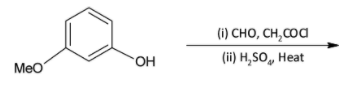
The major product of the given reaction is:
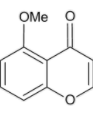
A.
B.
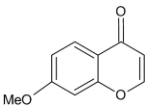
C.
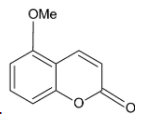
D.
Answer
 Verified
615.9k+ views
Hint:
To answer this question, you must be familiar with reactions of various oxygen containing organic compounds. Acid chlorides are much more reactive than aldehydes, ketones and carboxylic acids.
Complete step by step solution:
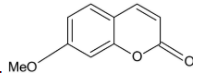
We know that acid chlorides are more reactive than aldehydes and thus the acid chloride group will be the one reacting with the phenolic hydroxyl group. The acid chloride and hydroxyl group undergoes an esterification reaction.
We are familiar with the fact that methoxy group is an ortho para directing group. Thus, we can say that the para position (to methoxy group) of the phenyl ring is activated and susceptible to nucleophilic attack.
On treatment with concentrated sulphuric acid, a water molecule is lost and the molecule undergoes cyclisation. A six membered cyclic ring is formed.
We can write the reaction as,

Thus, the correct option is D.
Note:
Acid halides are derived from carboxylic acids by replacing the hydroxyl group in the acid by a halide. A unique property of an acid halide is its inability to form hydrogen bonds with other compounds. This absence of hydrogen bonds affects their boiling and melting point. In comparison, it can be clearly seen that the melting and boiling points of acid halides are significantly lower than those of carboxylic acids.
Acid halides are extremely reactive compounds. Each of their reactions involves the replacement of the halide group by another functional group, that might be the reacting nucleophile. All reactions of acyl halides are characterized by production of steamy acidic fumes of hydrogen halides in the first step.
To answer this question, you must be familiar with reactions of various oxygen containing organic compounds. Acid chlorides are much more reactive than aldehydes, ketones and carboxylic acids.
Complete step by step solution:
We know that acid chlorides are more reactive than aldehydes and thus the acid chloride group will be the one reacting with the phenolic hydroxyl group. The acid chloride and hydroxyl group undergoes an esterification reaction.
We are familiar with the fact that methoxy group is an ortho para directing group. Thus, we can say that the para position (to methoxy group) of the phenyl ring is activated and susceptible to nucleophilic attack.
On treatment with concentrated sulphuric acid, a water molecule is lost and the molecule undergoes cyclisation. A six membered cyclic ring is formed.
We can write the reaction as,
Thus, the correct option is D.
Note:
Acid halides are derived from carboxylic acids by replacing the hydroxyl group in the acid by a halide. A unique property of an acid halide is its inability to form hydrogen bonds with other compounds. This absence of hydrogen bonds affects their boiling and melting point. In comparison, it can be clearly seen that the melting and boiling points of acid halides are significantly lower than those of carboxylic acids.
Acid halides are extremely reactive compounds. Each of their reactions involves the replacement of the halide group by another functional group, that might be the reacting nucleophile. All reactions of acyl halides are characterized by production of steamy acidic fumes of hydrogen halides in the first step.
Recently Updated Pages
If x a + bt + ct2 where x is in meters and t is in class 11 physics CBSE

A car covers the first half distance between two places class 11 physics CBSE
The resultant of two vectors overrightarrow P and overrightarrow class 11 physics CBSE
Find the value of cos 135 class 11 maths CBSE
A mass M is held in place by an applied force F and class 11 physics CBSE
A solution of glucose in water is labelled as 10 dfracwv class 11 chemistry CBSE
Trending doubts
Find the value of the expression given below sin 30circ class 11 maths CBSE
One Metric ton is equal to kg A 10000 B 1000 C 100 class 11 physics CBSE
Draw a diagram of nephron and explain its structur class 11 biology CBSE
10 examples of friction in our daily life
Proton was discovered by A Thomson B Rutherford C Chadwick class 11 chemistry CBSE
Bond order ofO2 O2+ O2 and O22 is in order A O2 langle class 11 chemistry CBSE