




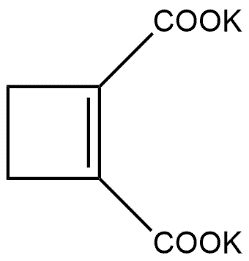
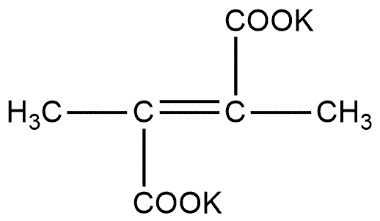
What would be the major product for the given electrolysis reaction.
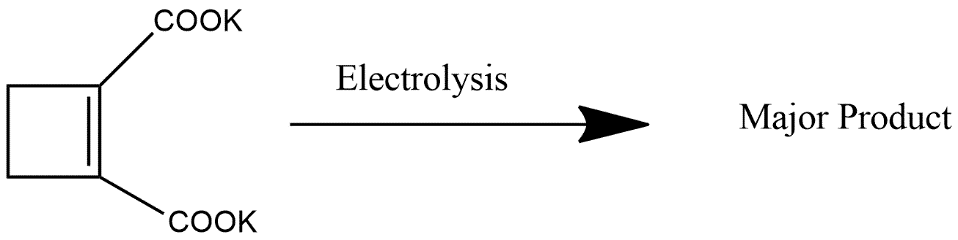
(1)
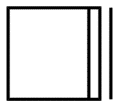
(2)
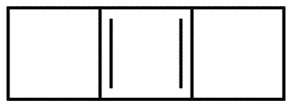
(3)
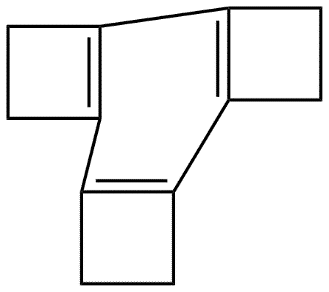
(4) None
Answer
 Verified
618k+ views
Hint: Butene generally contains a chain of 4 carbon atoms having an alkene group when it undergoes an electrolysis process then this type of reactions are known as Kolbe reactions which is also called Kolbe Schmitt Reaction. It is generally an additional reaction.
Complete Step by step solution: Kolbe electrolysis is generally an electrochemical decarboxylation of the salts of carboxylic acid which produces radicals. This reaction is also called as decarboxylative dimerization because it undergoes radical reaction mechanisms. This reaction is used in the synthesis of symmetrical dimers. In the given reaction COOK are given as carboxylic acid salts which undergo through the process of dimerization and it generally follows two step mechanism which is described as:
First of all we know that
Can also be written as
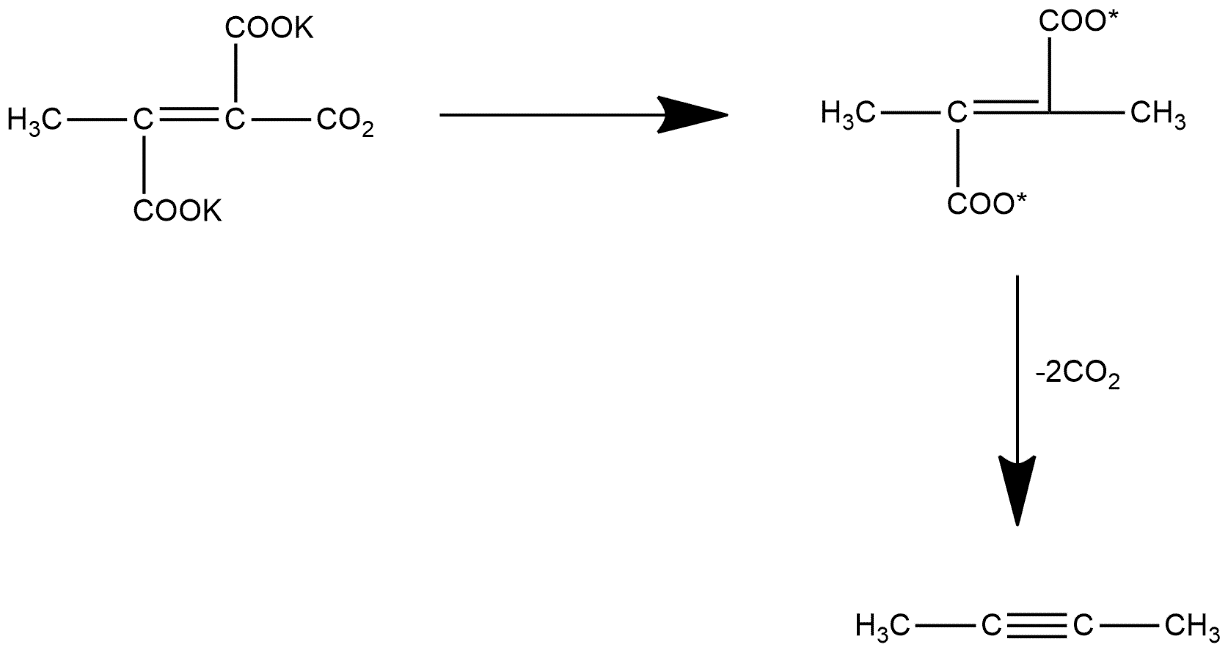
In first step in undergoes through the process of electrolysis and forms radicals as shown below:

But these are not so stable so it readily losses carbon dioxide atoms and from alkyne group which can be represented as:
Product formed is 2-butyne which can also be represented as:
Hence we can say that option 1 is the correct answer.
Note: Radical substitution reaction is a type of reaction which occurs by a free radical mechanism which results in the substitution of one or more of the atoms or groups present in the substrate by different atoms or groups. In the initiation step of radical chain reaction firstly free radical is produced and in terminating step two radicals react together in some way so that the chain can no longer be propagated.
Complete Step by step solution: Kolbe electrolysis is generally an electrochemical decarboxylation of the salts of carboxylic acid which produces radicals. This reaction is also called as decarboxylative dimerization because it undergoes radical reaction mechanisms. This reaction is used in the synthesis of symmetrical dimers. In the given reaction COOK are given as carboxylic acid salts which undergo through the process of dimerization and it generally follows two step mechanism which is described as:
First of all we know that
Can also be written as
In first step in undergoes through the process of electrolysis and forms radicals as shown below:
But these are not so stable so it readily losses carbon dioxide atoms and from alkyne group which can be represented as:
Product formed is 2-butyne which can also be represented as:
Hence we can say that option 1 is the correct answer.
Note: Radical substitution reaction is a type of reaction which occurs by a free radical mechanism which results in the substitution of one or more of the atoms or groups present in the substrate by different atoms or groups. In the initiation step of radical chain reaction firstly free radical is produced and in terminating step two radicals react together in some way so that the chain can no longer be propagated.
Recently Updated Pages
Basicity of sulphurous acid and sulphuric acid are

Master Class 11 English: Engaging Questions & Answers for Success
Master Class 11 Physics: Engaging Questions & Answers for Success
Master Class 11 Computer Science: Engaging Questions & Answers for Success
Master Class 11 Chemistry: Engaging Questions & Answers for Success
Master Class 11 Social Science: Engaging Questions & Answers for Success
Trending doubts
Difference Between Prokaryotic Cells and Eukaryotic Cells
Two of the body parts which do not appear in MRI are class 11 biology CBSE
One Metric ton is equal to kg A 10000 B 1000 C 100 class 11 physics CBSE
10 examples of friction in our daily life
Draw a diagram of nephron and explain its structur class 11 biology CBSE
What will happen if the mucus is not secreted by the class 11 biology CBSE