




The main difference between Gram-positive and Gram-negative bacteria is
Answer
 Verified
623.7k+ views
Hint: Bacteria is a group of minute, unicellular, microscopic organisms, which have been classified as prokaryotes, due to the absence of a true nucleus. The gram-negative and gram-positive bacteria are classified based on the ability to hold gram stain when the staining dyes are applied.
Complete step by step answer:
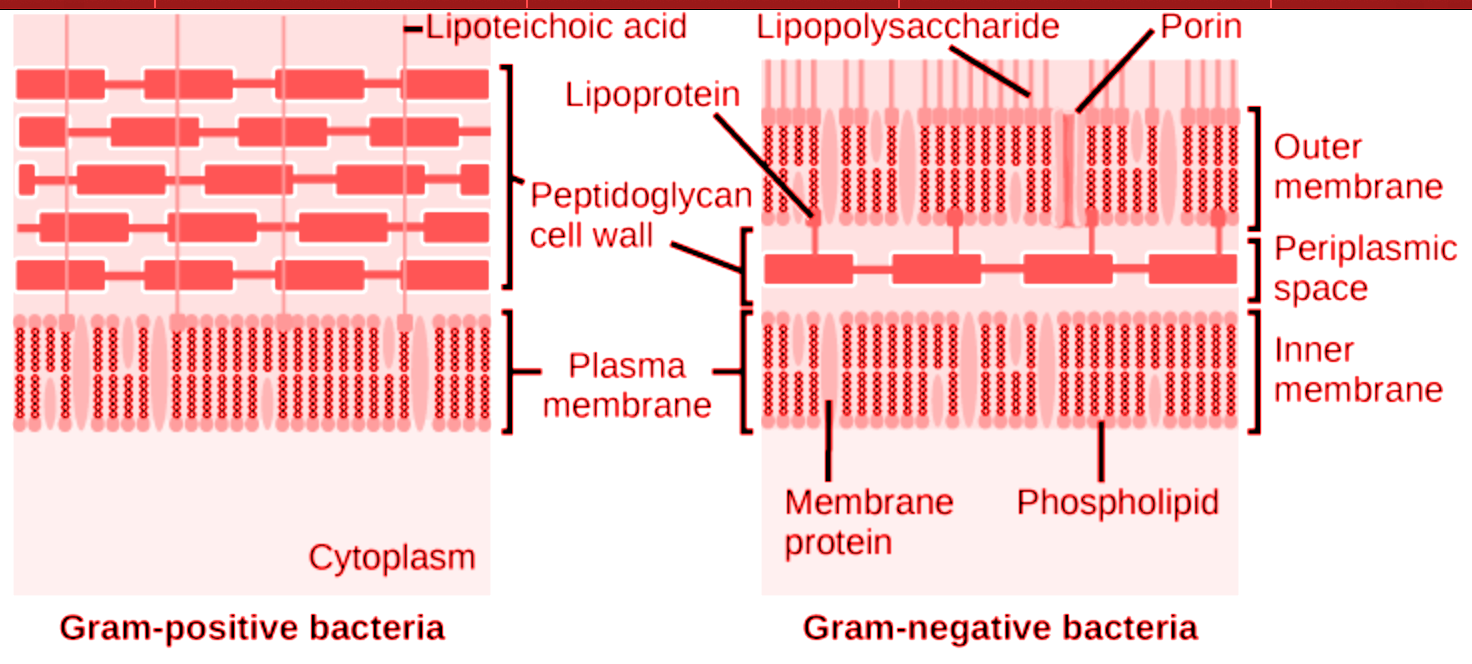
The following are the differences between gram-positive and gram-negative bacteria:
Note:
- The gram-positive bacteria retain the crystal violet color even after they are washed with acetone or alcohol and appear as purple- colored when examined under the microscope after gram staining.
- The gram-negative bacteria do not retain the stain color even after they are washed with acetone or alcohol and appear as pink- coloured when examined under the microscope after gram staining.
- This gram staining technique was proposed by Christian Gram to distinguish the two types of bacteria based on the difference in their cell wall structures.
Complete step by step answer:
The following are the differences between gram-positive and gram-negative bacteria:
| Gram-positive bacteria | Gram-negative bacteria |
| The cell wall is single- layered. | The cell wall is double layered. |
| The thickness of the cell wall lies between 20- 80 nanometers. | The thickness of the cell wall lies between 8- 10 nanometers. |
| A thick peptidoglycan layer is present. | A thin peptidoglycan layer is present. |
| They contain teichoic acid. | They Lack teichoic acid |
| Porins are absent. | Porins are present |
| A more prominent mesosome is present | A Less prominent mesosome is present. |
| The flagella have two rings in the basal body. | The flagella have four rings in the basal body. |
| Has very low lipid content. | Has lipid content of 20- 30% |
| Lipopolysaccharides are absent. | Lipopolysaccharides are present. |
| Produced exotoxins | Can produce exotoxins or endotoxins. |
| More susceptible to antibiotics. | More resistant to antibiotics. |
| Can form cocci or spores. | Cannot form cocci or spores. |
| Example- Staphylococcus, Streptococcus, etc. | Example- Escherichia, Salmonella, etc. |
Note:
- The gram-positive bacteria retain the crystal violet color even after they are washed with acetone or alcohol and appear as purple- colored when examined under the microscope after gram staining.
- The gram-negative bacteria do not retain the stain color even after they are washed with acetone or alcohol and appear as pink- coloured when examined under the microscope after gram staining.
- This gram staining technique was proposed by Christian Gram to distinguish the two types of bacteria based on the difference in their cell wall structures.
Recently Updated Pages
Master Class 11 English: Engaging Questions & Answers for Success

Master Class 11 Social Science: Engaging Questions & Answers for Success
Master Class 11 Maths: Engaging Questions & Answers for Success
Master Class 11 Biology: Engaging Questions & Answers for Success
Master Class 11 Physics: Engaging Questions & Answers for Success
Master Class 11 Chemistry: Engaging Questions & Answers for Success
Trending doubts
One Metric ton is equal to kg A 10000 B 1000 C 100 class 11 physics CBSE
Difference Between Prokaryotic Cells and Eukaryotic Cells
Two of the body parts which do not appear in MRI are class 11 biology CBSE
Find the value of the expression given below sin 30circ class 11 maths CBSE
Draw a diagram of a plant cell and label at least eight class 11 biology CBSE
10 examples of friction in our daily life