




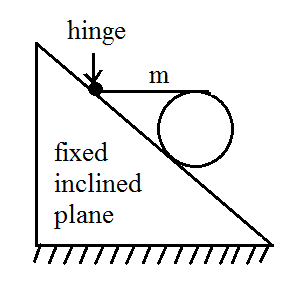
The magnitude of normal reaction exerted by the inclined plane on the cylinder is:
A. 50 N
B. 75 N
C. 100 N
D. cannot be calculated with given information
Answer
 Verified
591.3k+ views
Hint: The calculation of the torque due to the elements is to be carried out first to know the normal and the other forces acting on the elements. In the case of inclined planes, the frictional forces play an important role.
Complete step by step answer:
From given, we have the data,
The mass of uniform rod = m
FBD of the rod is,
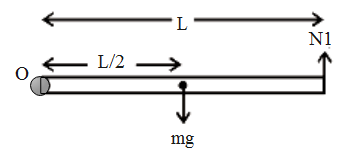
The centre of the mass (weight) force acts in a downward direction, at a length of \[{L}/{2}\;\]given by, mg
The normal force acts in the upward direction, given by, \[{{N}_{1}}\].
FBD of the cylinder is,
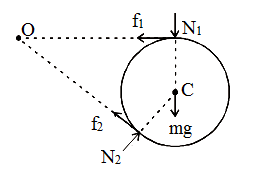
Similarly, in the case of a cylinder,
Let ‘O’ represent the hinge point.
The centre of the mass force acts in a downward direction, given by, mg.
The normal force acts in the downward direction, given by, \[{{N}_{1}}\].
The normal from the plane acts towards the centre C of the cylinder, given by, \[{{N}_{2}}\].
The frictional force between the cylinder and the rod acts towards the rod and is given by, \[{{f}_{1}}\].
The frictional force between the cylinder and the inclined plane acts upwards along the inclined plane towards the inclined plane and is given by, \[{{f}_{2}}\].
Thus the frictional forces acting are \[{{f}_{1}},{{f}_{2}}\].
The net torque on the rod at the hinge ‘O’ is,
Normal force along the whole length of the rod = Mass force along the half length of the rod
\[\begin{align}
& {{N}_{1}}\times L=mg\times \dfrac{L}{2} \\
& \Rightarrow {{N}_{1}}=\dfrac{mg}{2} \\
\end{align}\] …… (1)
The torque equation for the cylinder about the centre C is,
\[\begin{align}
& {{f}_{1}}\times R={{f}_{2}}\times R \\
& \Rightarrow {{f}_{1}}={{f}_{2}} \\
\end{align}\]
The torque equation for the cylinder about O is,
\[{{N}_{1}}\times L+mg\times L={{N}_{2}}\times L\]
Substitute the value of equation (1) in the above equation.
\[\dfrac{mg}{2}\times L+mg\times L={{N}_{2}}\times L\]
Simplify the equation to find the value of the normal force.
\[{{N}_{2}}=\dfrac{3mg}{2}\]
The gravitational constant, \[g=10m/{{s}^{2}}\]
Considering the mass of the cylinder to be, m = 5kg
We get,
\[\begin{align}
& {{N}_{2}}=\dfrac{3mg}{2} \\
& \Rightarrow {{N}_{2}}=\dfrac{3\times 5\times 10}{2} \\
& \Rightarrow {{N}_{2}}=75N \\
\end{align}\]
As the magnitude of normal reaction exerted by the inclined plane on the cylinder is 75 N, option (B) is correct.
Note:
The things to be on your finger-tips for further information on solving these types of problems are: The torque on the rod due to the inclined plane is different from the torque on the cylinder due to the inclined. Thus, while calculating such problems, the terms given should be considered properly.
Complete step by step answer:
From given, we have the data,
The mass of uniform rod = m
FBD of the rod is,
The centre of the mass (weight) force acts in a downward direction, at a length of \[{L}/{2}\;\]given by, mg
The normal force acts in the upward direction, given by, \[{{N}_{1}}\].
FBD of the cylinder is,
Similarly, in the case of a cylinder,
Let ‘O’ represent the hinge point.
The centre of the mass force acts in a downward direction, given by, mg.
The normal force acts in the downward direction, given by, \[{{N}_{1}}\].
The normal from the plane acts towards the centre C of the cylinder, given by, \[{{N}_{2}}\].
The frictional force between the cylinder and the rod acts towards the rod and is given by, \[{{f}_{1}}\].
The frictional force between the cylinder and the inclined plane acts upwards along the inclined plane towards the inclined plane and is given by, \[{{f}_{2}}\].
Thus the frictional forces acting are \[{{f}_{1}},{{f}_{2}}\].
The net torque on the rod at the hinge ‘O’ is,
Normal force along the whole length of the rod = Mass force along the half length of the rod
\[\begin{align}
& {{N}_{1}}\times L=mg\times \dfrac{L}{2} \\
& \Rightarrow {{N}_{1}}=\dfrac{mg}{2} \\
\end{align}\] …… (1)
The torque equation for the cylinder about the centre C is,
\[\begin{align}
& {{f}_{1}}\times R={{f}_{2}}\times R \\
& \Rightarrow {{f}_{1}}={{f}_{2}} \\
\end{align}\]
The torque equation for the cylinder about O is,
\[{{N}_{1}}\times L+mg\times L={{N}_{2}}\times L\]
Substitute the value of equation (1) in the above equation.
\[\dfrac{mg}{2}\times L+mg\times L={{N}_{2}}\times L\]
Simplify the equation to find the value of the normal force.
\[{{N}_{2}}=\dfrac{3mg}{2}\]
The gravitational constant, \[g=10m/{{s}^{2}}\]
Considering the mass of the cylinder to be, m = 5kg
We get,
\[\begin{align}
& {{N}_{2}}=\dfrac{3mg}{2} \\
& \Rightarrow {{N}_{2}}=\dfrac{3\times 5\times 10}{2} \\
& \Rightarrow {{N}_{2}}=75N \\
\end{align}\]
As the magnitude of normal reaction exerted by the inclined plane on the cylinder is 75 N, option (B) is correct.
Note:
The things to be on your finger-tips for further information on solving these types of problems are: The torque on the rod due to the inclined plane is different from the torque on the cylinder due to the inclined. Thus, while calculating such problems, the terms given should be considered properly.
Recently Updated Pages
Basicity of sulphurous acid and sulphuric acid are

Master Class 11 Business Studies: Engaging Questions & Answers for Success
Master Class 11 Computer Science: Engaging Questions & Answers for Success
Master Class 11 Economics: Engaging Questions & Answers for Success
Master Class 11 Social Science: Engaging Questions & Answers for Success
Master Class 11 English: Engaging Questions & Answers for Success
Trending doubts
One Metric ton is equal to kg A 10000 B 1000 C 100 class 11 physics CBSE
The largest wind power cluster is located in the state class 11 social science CBSE
Explain zero factorial class 11 maths CBSE
State and prove Bernoullis theorem class 11 physics CBSE
Which among the following are examples of coming together class 11 social science CBSE
Can anyone list 10 advantages and disadvantages of friction