




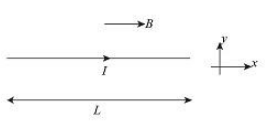
The magnitude and direction of force on current carrying wire is
(1) $BIL\left( { - \hat j} \right)$
(2) $BIL\left( {\hat j} \right)$
(3) $BIL\left( { - \hat i} \right)$
(4) Zero
Answer
 Verified
586.8k+ views
Hint: Use the concept that the magnitude of the force on current-carrying wire depends on the magnetic field lines, length of the wire, and the current flowing in the wire. We can determine the direction of the force with the help of Fleming's left-hand rule.
Complete step by step answer:
Suppose we placed a current-carrying wire of length L in the magnetic field, then magnetic force acts on the wire, and the magnitude of the magnetic force depends on the position of the current-carrying wire if the wire is placed in such a way that the magnetic field lines and wire are perpendicular to each other then in this condition. In that case, the magnitude of the force is highest.
But if we placed the current-carrying wire at some angle with respect to the magnetic field lines, then the force's magnitude varies and depends on the angle at which the wire is placed. If the angle's value is more, then the force's magnitude becomes more, and if the angle is small, the magnitude of the force becomes small. If we place the current-carrying wire parallel to the direction of magnetic field lines, then the magnitude of the force becomes zero. In the given figure, it is visible that the magnetic field lines are parallel to the wire, so the force's magnitude will become zero.Therefore, the force's magnitude and direction on the current-carrying wire is zero, and option (4) is correct.
Note:When the magnetic field lines are parallel to the current-carrying wire, we can not use the Fleming left-hand rule to determine the direction of the force because when the magnitude of the force becomes zero, then no force is present on the wire.
Complete step by step answer:
Suppose we placed a current-carrying wire of length L in the magnetic field, then magnetic force acts on the wire, and the magnitude of the magnetic force depends on the position of the current-carrying wire if the wire is placed in such a way that the magnetic field lines and wire are perpendicular to each other then in this condition. In that case, the magnitude of the force is highest.
But if we placed the current-carrying wire at some angle with respect to the magnetic field lines, then the force's magnitude varies and depends on the angle at which the wire is placed. If the angle's value is more, then the force's magnitude becomes more, and if the angle is small, the magnitude of the force becomes small. If we place the current-carrying wire parallel to the direction of magnetic field lines, then the magnitude of the force becomes zero. In the given figure, it is visible that the magnetic field lines are parallel to the wire, so the force's magnitude will become zero.Therefore, the force's magnitude and direction on the current-carrying wire is zero, and option (4) is correct.
Note:When the magnetic field lines are parallel to the current-carrying wire, we can not use the Fleming left-hand rule to determine the direction of the force because when the magnitude of the force becomes zero, then no force is present on the wire.
Recently Updated Pages
Master Class 12 Economics: Engaging Questions & Answers for Success

Master Class 12 Physics: Engaging Questions & Answers for Success
Master Class 12 English: Engaging Questions & Answers for Success
Master Class 12 Social Science: Engaging Questions & Answers for Success
Master Class 12 Maths: Engaging Questions & Answers for Success
Master Class 12 Business Studies: Engaging Questions & Answers for Success
Trending doubts
Which are the Top 10 Largest Countries of the World?
What are the major means of transport Explain each class 12 social science CBSE
Draw a labelled sketch of the human eye class 12 physics CBSE
Differentiate between insitu conservation and exsitu class 12 biology CBSE
Draw a neat and well labeled diagram of TS of ovary class 12 biology CBSE
Give 10 examples of unisexual and bisexual flowers