




The magnetic field inside a solenoid is:
(A) Infinite
(B) Zero
(C) Uniform
(D) Non-uniform
Answer
 Verified
618k+ views
Hint
Study the formation of magnetic fields due to a current carrying element. Try to understand the concept of ampere’s circuital law as an alternative to Biot-Savart law and try applying the right hand thumb rule to find the magnetic field from the direction of current flow.
Complete step by step solution
Solenoid can be defined as an electromagnet which is formed by tightly packed of a long wire in the form of a helix. Since the coil is tightly packed each turn can be regarded as a circular loop.
If the solenoid is carrying a current there will be a magnetic field. The direction of the magnetic field can be given by the right-hand thumb rule. Right hand thumb rule can be defined as if we curl up our fingers around a circular wire in the direction of the magnetic field. The magnetic field will form a closed loop. Inside a solenoid the magnetic field lines will be straight lines and the field will be strong. Outside the solenoid the magnetic field will be weak and the field lines will curl up to form closed loops.
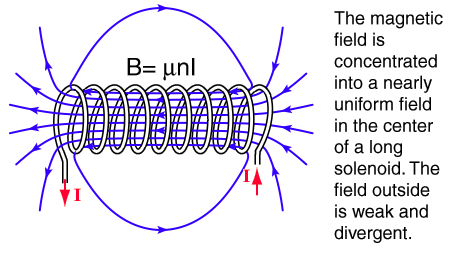
Hence, the magnetic field inside a solenoid will be uniform.
The correct option is (C).
Additional information
The magnetic field can be given by Ampere’s circuital law. It will be
$B = \mathop \mu \nolimits_ \circ nI$
$B$ is the magnetic field.
$\mathop \mu \nolimits_ \circ $ is the permeability of the free space,
$n$ is the number of turns,
$I$ is the current flowing through the solenoid.
Note
The right-hand thumb rule can be applied directly in different situations. If the current is flowing through a straight wire the magnetic field can be given as when we point our thumb in the direction of the current flow the direction of the magnetic field will be given by direction of the curled fingers.
Study the formation of magnetic fields due to a current carrying element. Try to understand the concept of ampere’s circuital law as an alternative to Biot-Savart law and try applying the right hand thumb rule to find the magnetic field from the direction of current flow.
Complete step by step solution
Solenoid can be defined as an electromagnet which is formed by tightly packed of a long wire in the form of a helix. Since the coil is tightly packed each turn can be regarded as a circular loop.
If the solenoid is carrying a current there will be a magnetic field. The direction of the magnetic field can be given by the right-hand thumb rule. Right hand thumb rule can be defined as if we curl up our fingers around a circular wire in the direction of the magnetic field. The magnetic field will form a closed loop. Inside a solenoid the magnetic field lines will be straight lines and the field will be strong. Outside the solenoid the magnetic field will be weak and the field lines will curl up to form closed loops.
Hence, the magnetic field inside a solenoid will be uniform.
The correct option is (C).
Additional information
The magnetic field can be given by Ampere’s circuital law. It will be
$B = \mathop \mu \nolimits_ \circ nI$
$B$ is the magnetic field.
$\mathop \mu \nolimits_ \circ $ is the permeability of the free space,
$n$ is the number of turns,
$I$ is the current flowing through the solenoid.
Note
The right-hand thumb rule can be applied directly in different situations. If the current is flowing through a straight wire the magnetic field can be given as when we point our thumb in the direction of the current flow the direction of the magnetic field will be given by direction of the curled fingers.
Recently Updated Pages
Master Class 12 Business Studies: Engaging Questions & Answers for Success

Master Class 12 Chemistry: Engaging Questions & Answers for Success
Master Class 12 Biology: Engaging Questions & Answers for Success
Class 12 Question and Answer - Your Ultimate Solutions Guide
Master Class 11 English: Engaging Questions & Answers for Success
Master Class 11 Social Science: Engaging Questions & Answers for Success
Trending doubts
Which are the Top 10 Largest Countries of the World?
Draw a labelled sketch of the human eye class 12 physics CBSE
The end of compass needle which points towards north class 12 physics CBSE
Differentiate between homogeneous and heterogeneous class 12 chemistry CBSE
Why is the cell called the structural and functional class 12 biology CBSE
When was the first election held in India a 194748 class 12 sst CBSE