




The locus of the midpoints of chords of the circle \[{x^2} + {y^2} = 1\]which subtends a right angle at the origin is
A.\[{x^2} + {y^2} = \dfrac{1}{4}\]
B.\[{x^2} + {y^2} = \dfrac{1}{2}\]
C.\[xy = 0\]
D.\[{x^2} - {y^2} = 0\]
Answer
 Verified
602.1k+ views
Hint: In this question equation of the circle is given, and the coordinate of center and vertex is also given, so we will find the radius of the circle by comparing it with the length of the cord, and then the chord equation is found.
Complete step-by-step answer:
Given the center of the circle, C is at \[(0,0)\]
R is the radius of the circle
Equation of the circle \[{x^2} + {y^2} = 1\]
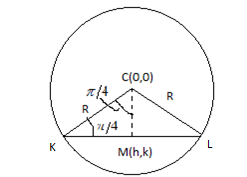
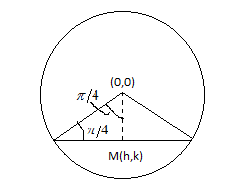
In the figure, we can see line CM is perpendicular to the KL; hence we apply the right-angled property in\[\Delta CKM\]; therefore, the length of line CM will be
\[CM = R\sin \dfrac{\pi }{4} = \dfrac{R}{{\sqrt 2 }} - - (i)\] [Since\[\sin \dfrac{\pi }{4} = \dfrac{1}{{\sqrt 2 }}\]]
By squaring both sides of the equation (i), we can further write
\[
{\left( {CM} \right)^2} = {\left( {\dfrac{R}{{\sqrt 2 }}} \right)^2} \\
{\Rightarrow \left( {CM} \right)^2} = \dfrac{{{R^2}}}{2} - - (ii) \\
\]
Now apply the distance formula in the line CM whose vertices are given as (0, 0) and (h, k), respectively
\[
{\left( {CM} \right)^2} = {\left( {h - 0} \right)^2} + {\left( {k - 0} \right)^2} \\
\Rightarrow { \left( {CM} \right)^2} = {h^2} + {k^2} - - (iii) \\
\]
Where \[{\left( {CM} \right)^2} = \dfrac{{{R^2}}}{2}\] from equation (ii)
Hence by comparing equation (ii) and (iii), we can write
\[{h^2} + {k^2} = \dfrac{{{R^2}}}{2} - - (iv)\]
Since the equation of the circle is given hence by replacing h, k by x, y and radius R with 1 in equation (iv), we get the equation as
\[
{x^2} + {y^2} = \dfrac{{{1^2}}}{2} \\
\Rightarrow {x^2} + {y^2} = \dfrac{1}{2} \\
\]
Hence the locus of the midpoints \[{x^2} + {y^2} = \dfrac{1}{2}\]
Option (B) is correct.
Note: A chord of a circle is the straight line drawn between the ends point of the circle, where the diameter is the longest chord passing through the center, joining both endpoints at the circumference.
Complete step-by-step answer:
Given the center of the circle, C is at \[(0,0)\]
R is the radius of the circle
Equation of the circle \[{x^2} + {y^2} = 1\]
In the figure, we can see line CM is perpendicular to the KL; hence we apply the right-angled property in\[\Delta CKM\]; therefore, the length of line CM will be
\[CM = R\sin \dfrac{\pi }{4} = \dfrac{R}{{\sqrt 2 }} - - (i)\] [Since\[\sin \dfrac{\pi }{4} = \dfrac{1}{{\sqrt 2 }}\]]
By squaring both sides of the equation (i), we can further write
\[
{\left( {CM} \right)^2} = {\left( {\dfrac{R}{{\sqrt 2 }}} \right)^2} \\
{\Rightarrow \left( {CM} \right)^2} = \dfrac{{{R^2}}}{2} - - (ii) \\
\]
Now apply the distance formula in the line CM whose vertices are given as (0, 0) and (h, k), respectively
\[
{\left( {CM} \right)^2} = {\left( {h - 0} \right)^2} + {\left( {k - 0} \right)^2} \\
\Rightarrow { \left( {CM} \right)^2} = {h^2} + {k^2} - - (iii) \\
\]
Where \[{\left( {CM} \right)^2} = \dfrac{{{R^2}}}{2}\] from equation (ii)
Hence by comparing equation (ii) and (iii), we can write
\[{h^2} + {k^2} = \dfrac{{{R^2}}}{2} - - (iv)\]
Since the equation of the circle is given hence by replacing h, k by x, y and radius R with 1 in equation (iv), we get the equation as
\[
{x^2} + {y^2} = \dfrac{{{1^2}}}{2} \\
\Rightarrow {x^2} + {y^2} = \dfrac{1}{2} \\
\]
Hence the locus of the midpoints \[{x^2} + {y^2} = \dfrac{1}{2}\]
Option (B) is correct.
Note: A chord of a circle is the straight line drawn between the ends point of the circle, where the diameter is the longest chord passing through the center, joining both endpoints at the circumference.
Recently Updated Pages
Three beakers labelled as A B and C each containing 25 mL of water were taken A small amount of NaOH anhydrous CuSO4 and NaCl were added to the beakers A B and C respectively It was observed that there was an increase in the temperature of the solutions contained in beakers A and B whereas in case of beaker C the temperature of the solution falls Which one of the following statements isarecorrect i In beakers A and B exothermic process has occurred ii In beakers A and B endothermic process has occurred iii In beaker C exothermic process has occurred iv In beaker C endothermic process has occurred

Master Class 11 Social Science: Engaging Questions & Answers for Success
Master Class 11 Physics: Engaging Questions & Answers for Success
Master Class 11 Maths: Engaging Questions & Answers for Success
Master Class 11 Economics: Engaging Questions & Answers for Success
Master Class 11 Computer Science: Engaging Questions & Answers for Success
Three beakers labelled as A B and C each containing 25 mL of water were taken A small amount of NaOH anhydrous CuSO4 and NaCl were added to the beakers A B and C respectively It was observed that there was an increase in the temperature of the solutions contained in beakers A and B whereas in case of beaker C the temperature of the solution falls Which one of the following statements isarecorrect i In beakers A and B exothermic process has occurred ii In beakers A and B endothermic process has occurred iii In beaker C exothermic process has occurred iv In beaker C endothermic process has occurred
Master Class 11 Social Science: Engaging Questions & Answers for Success
Master Class 11 Physics: Engaging Questions & Answers for Success
Trending doubts
There are 720 permutations of the digits 1 2 3 4 5 class 11 maths CBSE
State and prove Bernoullis theorem class 11 physics CBSE
1 Quintal is equal to a 110 kg b 10 kg c 100kg d 1000 class 11 physics CBSE
Discuss the various forms of bacteria class 11 biology CBSE
10 examples of friction in our daily life
1 ton equals to A 100 kg B 1000 kg C 10 kg D 10000 class 11 physics CBSE