




The locus of the midpoint of the chord of the circle ${{x}^{2}}+{{y}^{2}}-2x-2y-2=0$ which makes an angle of $120{}^\circ $ at the centre is –
(a) ${{x}^{2}}+{{y}^{2}}-2x-2y+1=0$
(b) ${{x}^{2}}+{{y}^{2}}+x+y-1=0$
(c) ${{x}^{2}}+{{y}^{2}}-2x-2y-1=0$
(d) None of these
Answer
 Verified
616.8k+ views
Hint: This question involves mid-point theorem, parametric points of circle and concept of locus. First of all, we assume a chord in the form of parametric points and then by mid-point theorem, get the midpoint of the chord. Let us assume mid-point as and solve for the equation in terms of $h$ and $k$ and then replace $h$ with $x$ and $k$ with$y$.
We will use following properties and formula –
(i) If $\alpha $ is the angle between two lines of slope ${{m}_{1}}$ and${{m}_{2}}$, then
$\tan \alpha =\dfrac{{{m}_{1}}-{{m}_{2}}}{1+{{m}_{1}}{{m}_{2}}}$
(ii) Mid-point Theorem: If $M$ is midpoint of line segment$AB$, where $A$ is $\left( {{x}_{1}},{{y}_{1}} \right)$ and $B$ is$\left( {{x}_{2}},{{y}_{2}} \right)$, and let $M$ be $\left( x,y \right)$. Then
$x=\dfrac{{{x}_{1}}+{{x}_{2}}}{2}$ and$y=\dfrac{{{y}_{1}}+{{y}_{2}}}{2}$.
Complete step-by-step answer:
Now, we have been given that the equation of circle is ${{x}^{2}}+{{y}^{2}}-2x-2y-2=0$
$\Rightarrow \left( {{x}^{2}}-2x+1 \right)+\left( {{y}^{2}}-2y+1 \right)-2-2=0$
$\Rightarrow {{\left( x-1 \right)}^{2}}+{{\left( y-1 \right)}^{2}}=4$ … (i)
$\Rightarrow {{\left( x-1 \right)}^{2}}+{{\left( y-1 \right)}^{2}}={{2}^{2}}$
So, the centre is $\left( 1,1 \right)$ and radius is $2$.
Thus, the circle can be represented as –
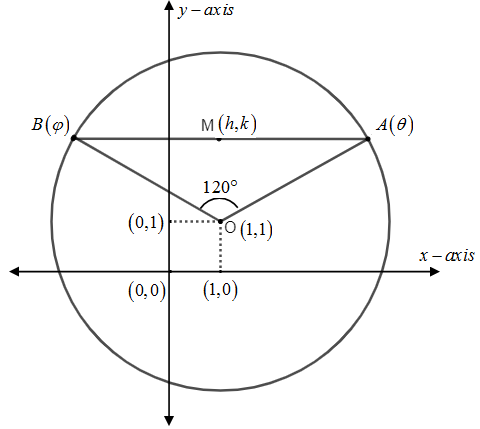
As we know that if the equation of a circle is${{\left( x-\alpha \right)}^{2}}+{{\left( y-\beta \right)}^{2}}={{r}^{2}}$, then parametric point $P$ is assumed as $P\left( \theta \right)$.
${{x}_{1}}=\left( \alpha +r\cos \theta \right)$ and${{y}_{1}}=\left( \beta +r\sin \theta \right)$
Let us assume $AB$in the parametric form of points $A\left( \theta \right)$ and$B\left( \varphi \right)$. So, $A$ is $\left( 1+2\cos \theta ,1+2\sin \theta \right)$ and $B$ is$\left( 1+2\cos \varphi ,1+2\sin \varphi \right)$.
As we know that, slope of line joining two points $\left( {{x}_{1}},{{y}_{1}} \right)$ and$\left( {{x}_{2}},{{y}_{2}} \right)$ $=\dfrac{\left( {{y}_{2}}-{{y}_{1}} \right)}{\left( {{x}_{2}}-{{x}_{1}} \right)}$.
So, slope of line $OA$ joining points $O\left( 0,0 \right)$ and $A\left( 1+2\cos \theta ,1+2\sin \theta \right)$ \[=\dfrac{\left( 1+2\sin \theta \right)-1}{\left( 1+2\cos \theta \right)-1}\]
$\Rightarrow {{m}_{OA}}=\tan \theta $
And, slope of line $OB$ joining $O\left( 0,0 \right)$ and $B\left( 1+2\cos \varphi ,1+2\sin \varphi \right)$ $=\dfrac{\left( 1+2\sin \varphi \right)-1}{\left( 1+2\cos \varphi \right)-1}$
$\Rightarrow {{m}_{OB}}=\tan \varphi $
As we know that, if $\alpha $ is the angle between two lines of slope ${{m}_{1}}$ and${{m}_{2}}$, then
$\tan \alpha =\dfrac{{{m}_{1}}-{{m}_{2}}}{1+{{m}_{1}}{{m}_{2}}}$ .
Now according to the question, angle between line $OA$ and $OB$ is
$\tan \left( 120{}^\circ \right)=\dfrac{{{m}_{OA}}-{{m}_{OB}}}{1+{{m}_{OA}}.{{m}_{OB}}}$
$\Rightarrow \tan \left( 120{}^\circ \right)=\dfrac{\tan \theta -\tan \varphi }{1+\tan \theta .\tan \varphi }$
$\Rightarrow \tan \left( 120{}^\circ \right)=\tan \left( \theta -\varphi \right)$
$\Rightarrow 120{}^\circ =\left( \theta -\varphi \right)$ … (iii)
Now, as we know that, if $M\left( x,y \right)$ is midpoint of line segment$AB$, where $A$ is $\left( {{x}_{1}},{{y}_{1}} \right)$ and $B$ is$\left( {{x}_{2}},{{y}_{2}} \right)$, then
$x=\dfrac{{{x}_{1}}+{{x}_{2}}}{2}$ and$y=\dfrac{{{y}_{1}}+{{y}_{2}}}{2}$.
Let midpoint of the chord $AB$ is $M\left( h,k \right)$ and $A$ is $\left( 1+2\cos \theta ,1+2\sin \theta \right)$ and $B$ is$\left( 1+2\cos \varphi ,1+2\sin \varphi \right)$.
$h=\dfrac{\left( 1+2\cos \theta \right)+\left( 1+2\cos \varphi \right)}{2}$
\[\Rightarrow 2h=2+2\left( \cos \theta +\cos \varphi \right)\]
\[\Rightarrow h-1=\cos \theta +\cos \varphi \]
\[\Rightarrow {{\left( h-1 \right)}^{2}}={{\left( \cos \theta +\cos \varphi \right)}^{2}}\] … (iii)
And, $k=\dfrac{\left( 1+2\sin \theta \right)+\left( 1+2\sin \varphi \right)}{2}$
\[\Rightarrow 2k=2+2\left( \sin \theta +\sin \varphi \right)\]
\[\Rightarrow k-1=\sin \theta +\sin \varphi \]
\[\Rightarrow {{\left( k-1 \right)}^{2}}={{\left( \sin \theta +\sin \varphi \right)}^{2}}\] … (iv)
By adding equation (iii) and (iv), we get
\[\Rightarrow {{\left( h-1 \right)}^{2}}+{{\left( k-1 \right)}^{2}}={{\cos }^{2}}\theta +{{\cos }^{2}}\varphi +2\cos \theta \cos \varphi +{{\sin }^{2}}\theta +{{\sin }^{2}}\varphi +2\sin \theta \sin \varphi \]
\[\because {{\cos }^{2}}\theta +{{\sin }^{2}}\theta =1\] and $\cos {{\theta }_{1}}.\cos {{\theta }_{2}}+\sin {{\theta }_{1}}.\sin {{\theta }_{2}}=\cos \left( {{\theta }_{1}}-{{\theta }_{2}} \right)$
\[\Rightarrow {{\left( h-1 \right)}^{2}}+{{\left( k-1 \right)}^{2}}=2+2\cos \left( \theta -\varphi \right)\]
As we know from equation (iii), $\left( \theta -\varphi \right)=120{}^\circ $ , so we have
\[\Rightarrow {{\left( h-1 \right)}^{2}}+{{\left( k-1 \right)}^{2}}=2+2\cos \left( 120{}^\circ \right)\]
\[\Rightarrow {{\left( h-1 \right)}^{2}}+{{\left( k-1 \right)}^{2}}=2+2\left( \dfrac{-1}{2} \right)\]
\[\Rightarrow {{\left( h-1 \right)}^{2}}+{{\left( k-1 \right)}^{2}}=1\]
Now by replacing $h\to x$ and$k\to y$, we have
\[\Rightarrow {{\left( x-1 \right)}^{2}}+{{\left( y-1 \right)}^{2}}=1\]
\[\Rightarrow {{x}^{2}}-2x+1+{{y}^{2}}-2y+1=1\]
\[\Rightarrow {{x}^{2}}+{{y}^{2}}-2x-2y+1=0\]
So, the locus of the midpoint of the chord is \[{{x}^{2}}+{{y}^{2}}-2x-2y+1=0\].
So, the correct answer is “Option A”.
Note: (i) In this question, students should take care of the angle between two lines formula,
$\tan \alpha =\dfrac{{{m}_{1}}-{{m}_{2}}}{1+{{m}_{1}}{{m}_{2}}}$
Don’t interchange the two signs; else it will make the whole question wrong.
(ii) Students should take care of calculation mistakes. In options, there is only change in signs. So, take care of signs properly.
We will use following properties and formula –
(i) If $\alpha $ is the angle between two lines of slope ${{m}_{1}}$ and${{m}_{2}}$, then
$\tan \alpha =\dfrac{{{m}_{1}}-{{m}_{2}}}{1+{{m}_{1}}{{m}_{2}}}$
(ii) Mid-point Theorem: If $M$ is midpoint of line segment$AB$, where $A$ is $\left( {{x}_{1}},{{y}_{1}} \right)$ and $B$ is$\left( {{x}_{2}},{{y}_{2}} \right)$, and let $M$ be $\left( x,y \right)$. Then
$x=\dfrac{{{x}_{1}}+{{x}_{2}}}{2}$ and$y=\dfrac{{{y}_{1}}+{{y}_{2}}}{2}$.
Complete step-by-step answer:
Now, we have been given that the equation of circle is ${{x}^{2}}+{{y}^{2}}-2x-2y-2=0$
$\Rightarrow \left( {{x}^{2}}-2x+1 \right)+\left( {{y}^{2}}-2y+1 \right)-2-2=0$
$\Rightarrow {{\left( x-1 \right)}^{2}}+{{\left( y-1 \right)}^{2}}=4$ … (i)
$\Rightarrow {{\left( x-1 \right)}^{2}}+{{\left( y-1 \right)}^{2}}={{2}^{2}}$
So, the centre is $\left( 1,1 \right)$ and radius is $2$.
Thus, the circle can be represented as –
As we know that if the equation of a circle is${{\left( x-\alpha \right)}^{2}}+{{\left( y-\beta \right)}^{2}}={{r}^{2}}$, then parametric point $P$ is assumed as $P\left( \theta \right)$.
${{x}_{1}}=\left( \alpha +r\cos \theta \right)$ and${{y}_{1}}=\left( \beta +r\sin \theta \right)$
Let us assume $AB$in the parametric form of points $A\left( \theta \right)$ and$B\left( \varphi \right)$. So, $A$ is $\left( 1+2\cos \theta ,1+2\sin \theta \right)$ and $B$ is$\left( 1+2\cos \varphi ,1+2\sin \varphi \right)$.
As we know that, slope of line joining two points $\left( {{x}_{1}},{{y}_{1}} \right)$ and$\left( {{x}_{2}},{{y}_{2}} \right)$ $=\dfrac{\left( {{y}_{2}}-{{y}_{1}} \right)}{\left( {{x}_{2}}-{{x}_{1}} \right)}$.
So, slope of line $OA$ joining points $O\left( 0,0 \right)$ and $A\left( 1+2\cos \theta ,1+2\sin \theta \right)$ \[=\dfrac{\left( 1+2\sin \theta \right)-1}{\left( 1+2\cos \theta \right)-1}\]
$\Rightarrow {{m}_{OA}}=\tan \theta $
And, slope of line $OB$ joining $O\left( 0,0 \right)$ and $B\left( 1+2\cos \varphi ,1+2\sin \varphi \right)$ $=\dfrac{\left( 1+2\sin \varphi \right)-1}{\left( 1+2\cos \varphi \right)-1}$
$\Rightarrow {{m}_{OB}}=\tan \varphi $
As we know that, if $\alpha $ is the angle between two lines of slope ${{m}_{1}}$ and${{m}_{2}}$, then
$\tan \alpha =\dfrac{{{m}_{1}}-{{m}_{2}}}{1+{{m}_{1}}{{m}_{2}}}$ .
Now according to the question, angle between line $OA$ and $OB$ is
$\tan \left( 120{}^\circ \right)=\dfrac{{{m}_{OA}}-{{m}_{OB}}}{1+{{m}_{OA}}.{{m}_{OB}}}$
$\Rightarrow \tan \left( 120{}^\circ \right)=\dfrac{\tan \theta -\tan \varphi }{1+\tan \theta .\tan \varphi }$
$\Rightarrow \tan \left( 120{}^\circ \right)=\tan \left( \theta -\varphi \right)$
$\Rightarrow 120{}^\circ =\left( \theta -\varphi \right)$ … (iii)
Now, as we know that, if $M\left( x,y \right)$ is midpoint of line segment$AB$, where $A$ is $\left( {{x}_{1}},{{y}_{1}} \right)$ and $B$ is$\left( {{x}_{2}},{{y}_{2}} \right)$, then
$x=\dfrac{{{x}_{1}}+{{x}_{2}}}{2}$ and$y=\dfrac{{{y}_{1}}+{{y}_{2}}}{2}$.
Let midpoint of the chord $AB$ is $M\left( h,k \right)$ and $A$ is $\left( 1+2\cos \theta ,1+2\sin \theta \right)$ and $B$ is$\left( 1+2\cos \varphi ,1+2\sin \varphi \right)$.
$h=\dfrac{\left( 1+2\cos \theta \right)+\left( 1+2\cos \varphi \right)}{2}$
\[\Rightarrow 2h=2+2\left( \cos \theta +\cos \varphi \right)\]
\[\Rightarrow h-1=\cos \theta +\cos \varphi \]
\[\Rightarrow {{\left( h-1 \right)}^{2}}={{\left( \cos \theta +\cos \varphi \right)}^{2}}\] … (iii)
And, $k=\dfrac{\left( 1+2\sin \theta \right)+\left( 1+2\sin \varphi \right)}{2}$
\[\Rightarrow 2k=2+2\left( \sin \theta +\sin \varphi \right)\]
\[\Rightarrow k-1=\sin \theta +\sin \varphi \]
\[\Rightarrow {{\left( k-1 \right)}^{2}}={{\left( \sin \theta +\sin \varphi \right)}^{2}}\] … (iv)
By adding equation (iii) and (iv), we get
\[\Rightarrow {{\left( h-1 \right)}^{2}}+{{\left( k-1 \right)}^{2}}={{\cos }^{2}}\theta +{{\cos }^{2}}\varphi +2\cos \theta \cos \varphi +{{\sin }^{2}}\theta +{{\sin }^{2}}\varphi +2\sin \theta \sin \varphi \]
\[\because {{\cos }^{2}}\theta +{{\sin }^{2}}\theta =1\] and $\cos {{\theta }_{1}}.\cos {{\theta }_{2}}+\sin {{\theta }_{1}}.\sin {{\theta }_{2}}=\cos \left( {{\theta }_{1}}-{{\theta }_{2}} \right)$
\[\Rightarrow {{\left( h-1 \right)}^{2}}+{{\left( k-1 \right)}^{2}}=2+2\cos \left( \theta -\varphi \right)\]
As we know from equation (iii), $\left( \theta -\varphi \right)=120{}^\circ $ , so we have
\[\Rightarrow {{\left( h-1 \right)}^{2}}+{{\left( k-1 \right)}^{2}}=2+2\cos \left( 120{}^\circ \right)\]
\[\Rightarrow {{\left( h-1 \right)}^{2}}+{{\left( k-1 \right)}^{2}}=2+2\left( \dfrac{-1}{2} \right)\]
\[\Rightarrow {{\left( h-1 \right)}^{2}}+{{\left( k-1 \right)}^{2}}=1\]
Now by replacing $h\to x$ and$k\to y$, we have
\[\Rightarrow {{\left( x-1 \right)}^{2}}+{{\left( y-1 \right)}^{2}}=1\]
\[\Rightarrow {{x}^{2}}-2x+1+{{y}^{2}}-2y+1=1\]
\[\Rightarrow {{x}^{2}}+{{y}^{2}}-2x-2y+1=0\]
So, the locus of the midpoint of the chord is \[{{x}^{2}}+{{y}^{2}}-2x-2y+1=0\].
So, the correct answer is “Option A”.
Note: (i) In this question, students should take care of the angle between two lines formula,
$\tan \alpha =\dfrac{{{m}_{1}}-{{m}_{2}}}{1+{{m}_{1}}{{m}_{2}}}$
Don’t interchange the two signs; else it will make the whole question wrong.
(ii) Students should take care of calculation mistakes. In options, there is only change in signs. So, take care of signs properly.
Recently Updated Pages
Master Class 12 Economics: Engaging Questions & Answers for Success

Master Class 12 English: Engaging Questions & Answers for Success
Master Class 12 Social Science: Engaging Questions & Answers for Success
Master Class 12 Maths: Engaging Questions & Answers for Success
Master Class 12 Physics: Engaging Questions & Answers for Success
Master Class 11 Social Science: Engaging Questions & Answers for Success
Trending doubts
One Metric ton is equal to kg A 10000 B 1000 C 100 class 11 physics CBSE
Difference Between Prokaryotic Cells and Eukaryotic Cells
Two of the body parts which do not appear in MRI are class 11 biology CBSE
1 ton equals to A 100 kg B 1000 kg C 10 kg D 10000 class 11 physics CBSE
Draw a diagram of nephron and explain its structur class 11 biology CBSE
10 examples of friction in our daily life