




The location of the villi is:
(a)Large intestine
(b)Small intestine
(c)Stomach
(d)None of the above
Answer
 Verified
616.2k+ views
Hint: In the gastrointestinal tract, villi is present in an organ where much of the final absorption of nutrients and minerals from food occurs. To assist with digestion, it absorbs bile and pancreatic juice through the pancreatic duct.
Complete answer:
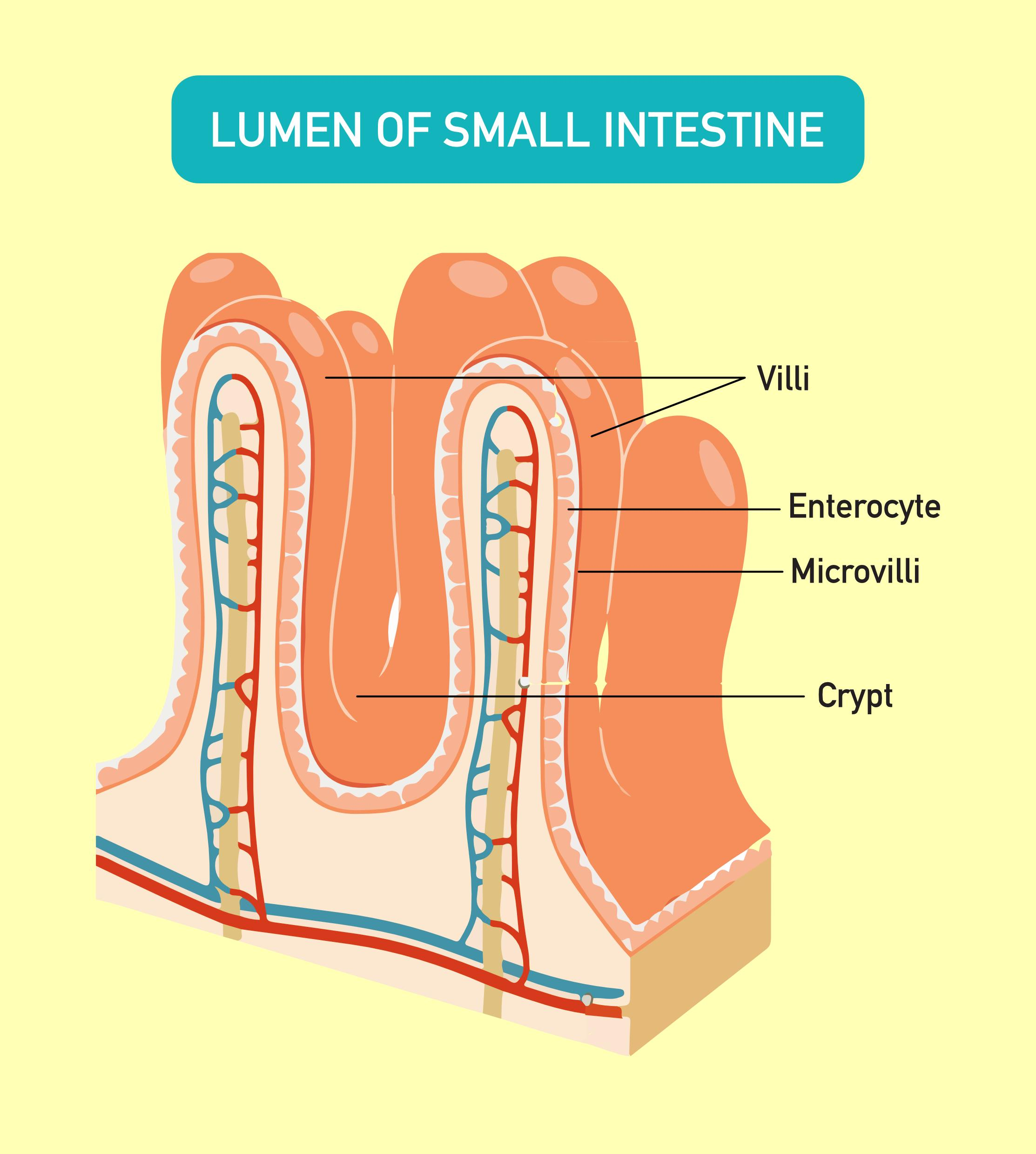
Villi are tiny finger-like projections that are found in the small intestinal walls. Their function is to increase the area of the surface in order to optimize digested food absorption. The number of villi varies from 10 to 40 per square meter of tissue and is usually 0.5 to 1 mm long.
The protein molecules are absorbed by these projections and help to transfer the proteins to all cells and tissues.
Within these villi, several blood vessels are present, helping to absorb digested food and bring it to the bloodstream. Later, the ingested food is distributed to each and every cell of the body from the bloodstream. It is called assimilation.
Additional Information: Every villus has a muscle strand that allows contracting and expanding the villi. This is so that the contents are continuously traveling in the lumen of the small intestine and the concentration gradient is preserved for successful absorption.
A mucosal epithelium is protected by the villi, which consists primarily of various cell types, enterocytes, goblet cells, enteroendocrine cells, and paneth cells and stem cells at the base of the villi (also called a crypt). Substances including water and electrolytes are absorbed by enterocytes. Some cells, such as goblet cells, secrete mucus into the bowel cavity and hormones are secreted by enteroendocrine cells. The cells of Paneth secrete antimicrobial peptides.
So, the correct answer is, ‘Small intestine’.
Note: Millions of tiny finger-like projections called villi are in the small intestine. For more effective food absorption, these villi improve the surface region.
There are thousands of finger-like outgrowths on the internal walls of the small intestine. These are called (singular villus) villi.
Each villus is composed of arteries, veins, a complex capillary system, and lacteal, a lymphatic vessel. The lacteal absorbs and transports fatty acids and glycerol away from the villus. In the villi, the capillaries have several functions, carrying the absorbed nutrients such as proteins and carbohydrates away from the villi, but also delivering oxygen to the microvilli so that cell respiration can be performed.
Complete answer:
Villi are tiny finger-like projections that are found in the small intestinal walls. Their function is to increase the area of the surface in order to optimize digested food absorption. The number of villi varies from 10 to 40 per square meter of tissue and is usually 0.5 to 1 mm long.
The protein molecules are absorbed by these projections and help to transfer the proteins to all cells and tissues.
Within these villi, several blood vessels are present, helping to absorb digested food and bring it to the bloodstream. Later, the ingested food is distributed to each and every cell of the body from the bloodstream. It is called assimilation.
Additional Information: Every villus has a muscle strand that allows contracting and expanding the villi. This is so that the contents are continuously traveling in the lumen of the small intestine and the concentration gradient is preserved for successful absorption.
A mucosal epithelium is protected by the villi, which consists primarily of various cell types, enterocytes, goblet cells, enteroendocrine cells, and paneth cells and stem cells at the base of the villi (also called a crypt). Substances including water and electrolytes are absorbed by enterocytes. Some cells, such as goblet cells, secrete mucus into the bowel cavity and hormones are secreted by enteroendocrine cells. The cells of Paneth secrete antimicrobial peptides.
So, the correct answer is, ‘Small intestine’.
Note: Millions of tiny finger-like projections called villi are in the small intestine. For more effective food absorption, these villi improve the surface region.
There are thousands of finger-like outgrowths on the internal walls of the small intestine. These are called (singular villus) villi.
Each villus is composed of arteries, veins, a complex capillary system, and lacteal, a lymphatic vessel. The lacteal absorbs and transports fatty acids and glycerol away from the villus. In the villi, the capillaries have several functions, carrying the absorbed nutrients such as proteins and carbohydrates away from the villi, but also delivering oxygen to the microvilli so that cell respiration can be performed.
Recently Updated Pages
Master Class 11 English: Engaging Questions & Answers for Success

Master Class 11 Social Science: Engaging Questions & Answers for Success
Master Class 11 Maths: Engaging Questions & Answers for Success
Master Class 11 Biology: Engaging Questions & Answers for Success
Master Class 11 Physics: Engaging Questions & Answers for Success
Master Class 11 Chemistry: Engaging Questions & Answers for Success
Trending doubts
One Metric ton is equal to kg A 10000 B 1000 C 100 class 11 physics CBSE
Difference Between Prokaryotic Cells and Eukaryotic Cells
Find the value of the expression given below sin 30circ class 11 maths CBSE
Difference between physical and chemical change class 11 chemistry CBSE
Two of the body parts which do not appear in MRI are class 11 biology CBSE
Draw a diagram of a plant cell and label at least eight class 11 biology CBSE