




The line $\lambda x+\mu y=1$ is a normal to the circle $2x^{2}+2y^{2}-5x+6y-1=0$ if
A) $5\lambda -6\mu =4$
B) $4+5\mu =6\lambda$
C) $4+6\mu =5\lambda$
D) None of these
Answer
 Verified
611.1k+ views
Hint: In this question it is given that we have to find the relation between $\lambda$ and $\mu$ for which the line $\lambda x+\mu y=1$ is a normal to the circle $2x^{2}+2y^{2}-5x+6y-1=0$. To find the solution we have to put any point (a,b) which lies on the line $\lambda x+\mu y=1$. So to understand it better we have to draw the diagram.
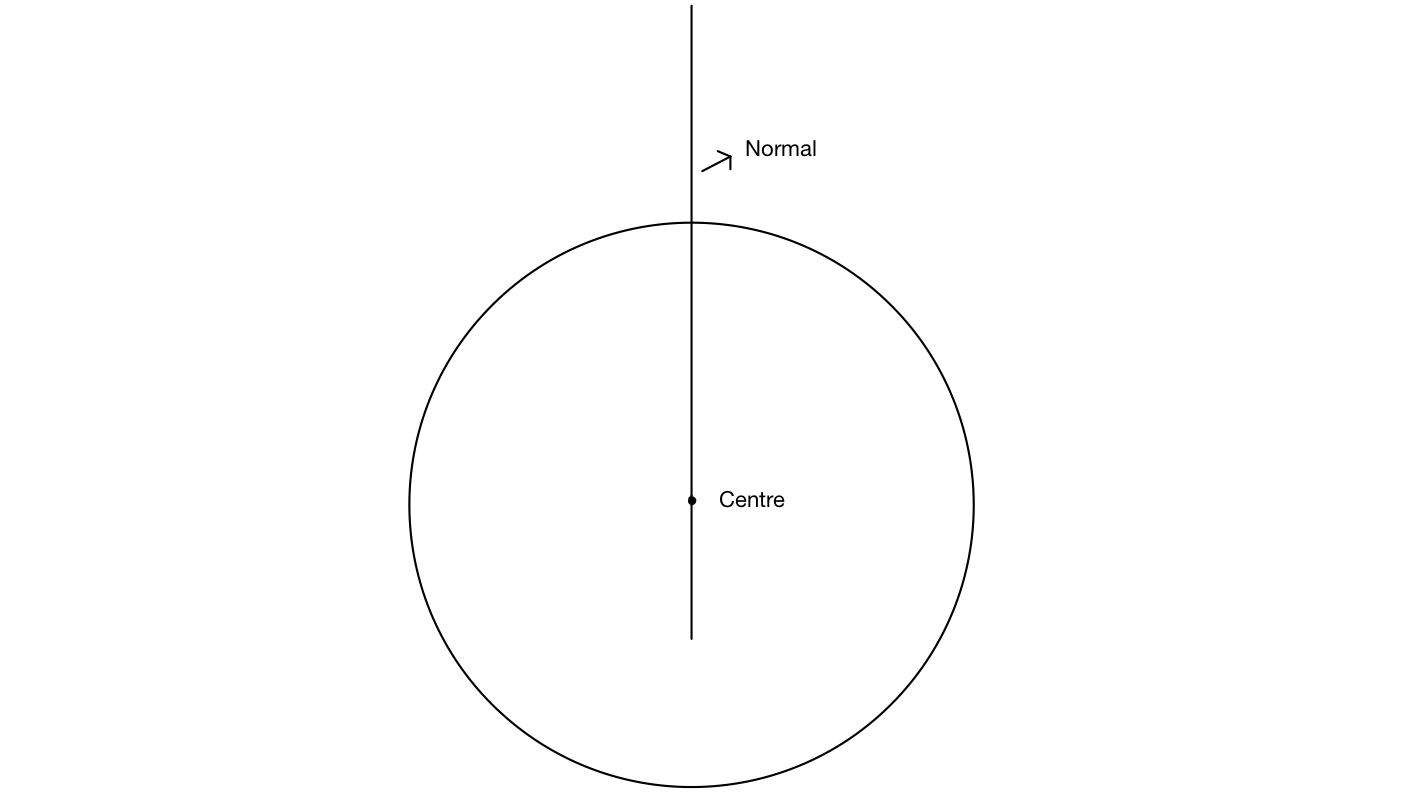
So we can see that the normal of a circle always passes through the centre, that implies, we have to put the coordinate of this circle in order to get the relation.
Complete step-by-step solution:
So before moving into solution we have to know that if any equation of circle is in the form of $x^{2}+y^{2}+2gx+2fy+c=0$.......(1)
Then the coordinate of the centre is (-g,-f).
Now, the given equation of circle, $2x^{2}+2y^{2}-5x+6y-1=0$. Which can be written as $$x^{2}+y^{2}-\dfrac{5}{2} x+3y-\dfrac{1}{2} =0$$.
Now if we compare the above equation with equation (1), then we get, $$g=-\dfrac{5}{4}$$ and $$f=\dfrac{3}{2}$$.
So we can write the centre of the circle (-g,-f)=$$\left( \dfrac{5}{4} ,-\dfrac{3}{2} \right) $$.
Now, since the normal line $\lambda x+\mu y=1$ passing through the centre $$\left( \dfrac{5}{4} ,-\dfrac{3}{2} \right) $$, then the centre must Satisfy the above equation,
$$\therefore \ \lambda \times \dfrac{5}{4} +\mu \times \left( -\dfrac{3}{2} \right) =1$$
$$\Rightarrow \dfrac{5\lambda }{4} -\dfrac{3\mu }{2} =1$$
Now multiplying both side by 4,
$\Rightarrow 5\lambda -6\mu =4$
$\Rightarrow 4+6\mu =5\lambda$
Which is our required solution.
So the correct option is option C.
Note: To solve this type of question you have to remember that any normal line of a circle always passes through the centre of the circle and also we can call this normal line as diameter line.
So we can see that the normal of a circle always passes through the centre, that implies, we have to put the coordinate of this circle in order to get the relation.
Complete step-by-step solution:
So before moving into solution we have to know that if any equation of circle is in the form of $x^{2}+y^{2}+2gx+2fy+c=0$.......(1)
Then the coordinate of the centre is (-g,-f).
Now, the given equation of circle, $2x^{2}+2y^{2}-5x+6y-1=0$. Which can be written as $$x^{2}+y^{2}-\dfrac{5}{2} x+3y-\dfrac{1}{2} =0$$.
Now if we compare the above equation with equation (1), then we get, $$g=-\dfrac{5}{4}$$ and $$f=\dfrac{3}{2}$$.
So we can write the centre of the circle (-g,-f)=$$\left( \dfrac{5}{4} ,-\dfrac{3}{2} \right) $$.
Now, since the normal line $\lambda x+\mu y=1$ passing through the centre $$\left( \dfrac{5}{4} ,-\dfrac{3}{2} \right) $$, then the centre must Satisfy the above equation,
$$\therefore \ \lambda \times \dfrac{5}{4} +\mu \times \left( -\dfrac{3}{2} \right) =1$$
$$\Rightarrow \dfrac{5\lambda }{4} -\dfrac{3\mu }{2} =1$$
Now multiplying both side by 4,
$\Rightarrow 5\lambda -6\mu =4$
$\Rightarrow 4+6\mu =5\lambda$
Which is our required solution.
So the correct option is option C.
Note: To solve this type of question you have to remember that any normal line of a circle always passes through the centre of the circle and also we can call this normal line as diameter line.
Recently Updated Pages
Master Class 11 Computer Science: Engaging Questions & Answers for Success

Master Class 11 Business Studies: Engaging Questions & Answers for Success
Master Class 11 Economics: Engaging Questions & Answers for Success
Master Class 11 English: Engaging Questions & Answers for Success
Master Class 11 Maths: Engaging Questions & Answers for Success
Master Class 11 Biology: Engaging Questions & Answers for Success
Trending doubts
One Metric ton is equal to kg A 10000 B 1000 C 100 class 11 physics CBSE
There are 720 permutations of the digits 1 2 3 4 5 class 11 maths CBSE
Discuss the various forms of bacteria class 11 biology CBSE
Draw a diagram of a plant cell and label at least eight class 11 biology CBSE
State the laws of reflection of light
Explain zero factorial class 11 maths CBSE