




The line \[3x + 4y - k = 0\] is tangent to the circle \[{x^2} + {y^2} = 16\]. What are the possible values of \[k\]?
Answer
 Verified
491.1k+ views
Hint: We will find the centre and radius of the given circle \[{x^2} + {y^2} = 16\]. As we know, the point where the line and the circle intersect is perpendicular to the radius. Therefore, we will use the formula to find the distance of a point from a line. we will find the distance of the centre of the circle from the given line \[3x + 4y - k = 0\] and we will equate the distance to the radius. On simplification we will find the result.
Complete step by step answer:
For any general circle \[{x^2} + {y^2} + 2gx + 2fy + c = 0\], the coordinate of centre is \[( - g, - f)\] and radius is \[\sqrt {{g^2} + {f^2} - c} \].
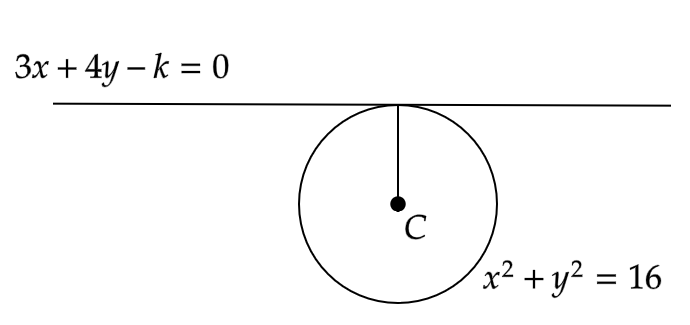
Given circle is \[{x^2} + {y^2} = 16\]. For this, \[g = 0\] and \[f = 0\]. Therefore, centre is \[C(0,0)\] and radius is \[\sqrt {{{\left( 0 \right)}^2} + {{(0)}^2} - \left( { - 16} \right)} \] i.e., \[4\].
As we know, the point where the line and the circle intersect is perpendicular to the radius.
The perpendicular distance between the line and the centre of the circle is equal to the radius.
The perpendicular distance (\[d\]) of a point \[({x_1},{y_1})\] from a line \[ax + by + c = 0\] is given by \[d = \left| {\dfrac{{a{x_1} + b{y_1} + c}}{{\sqrt {{a^2} + {b^2}} }}} \right|\].
In this question, we have \[d\] as radius of the circle, \[({x_1},{y_1})\] is centre of the circle \[(0,0)\] and the line is \[3x + 4y - k = 0\]. Putting all these values we get
\[ \Rightarrow 4 = \left| {\dfrac{{3 \times \left( 0 \right) + 4 \times \left( 0 \right) - k}}{{\sqrt {{{\left( 3 \right)}^2} + {{\left( 4 \right)}^2}} }}} \right|\]
On simplification, we get
\[ \Rightarrow 4 = \left| {\dfrac{{ - k}}{{\sqrt {9 + 16} }}} \right|\]
On further simplification, we get
\[ \Rightarrow 4 = \left| {\dfrac{{ - k}}{{\sqrt {25} }}} \right|\]
\[ \Rightarrow 4 = \left| {\dfrac{{ - k}}{5}} \right|\]
Using the definition of modulus function i.e., \[\left| a \right| = \pm a\], we get
\[ \Rightarrow \dfrac{{ - k}}{5} = \pm 4\]
\[ \Rightarrow \dfrac{{ - k}}{5} = 4\] or \[\dfrac{{ - k}}{5} = - 4\]
On cross multiplication, we get
\[ \Rightarrow - k = 20\] or \[ - k = - 20\]
On simplification, we get
\[ \Rightarrow k = - 20\] or \[k = 20\]
Therefore, the possible values of \[k\] is \[20\] or \[ - 20\].
Note:
A tangent intersects the circle exactly in one single point and can never cross the circle or enter it. The point where a tangent touches the circle is known as the point of tangency. Also, from one external point only two tangents can be drawn to a circle that have equal tangent segments.
Complete step by step answer:
For any general circle \[{x^2} + {y^2} + 2gx + 2fy + c = 0\], the coordinate of centre is \[( - g, - f)\] and radius is \[\sqrt {{g^2} + {f^2} - c} \].
Given circle is \[{x^2} + {y^2} = 16\]. For this, \[g = 0\] and \[f = 0\]. Therefore, centre is \[C(0,0)\] and radius is \[\sqrt {{{\left( 0 \right)}^2} + {{(0)}^2} - \left( { - 16} \right)} \] i.e., \[4\].
As we know, the point where the line and the circle intersect is perpendicular to the radius.
The perpendicular distance between the line and the centre of the circle is equal to the radius.
The perpendicular distance (\[d\]) of a point \[({x_1},{y_1})\] from a line \[ax + by + c = 0\] is given by \[d = \left| {\dfrac{{a{x_1} + b{y_1} + c}}{{\sqrt {{a^2} + {b^2}} }}} \right|\].
In this question, we have \[d\] as radius of the circle, \[({x_1},{y_1})\] is centre of the circle \[(0,0)\] and the line is \[3x + 4y - k = 0\]. Putting all these values we get
\[ \Rightarrow 4 = \left| {\dfrac{{3 \times \left( 0 \right) + 4 \times \left( 0 \right) - k}}{{\sqrt {{{\left( 3 \right)}^2} + {{\left( 4 \right)}^2}} }}} \right|\]
On simplification, we get
\[ \Rightarrow 4 = \left| {\dfrac{{ - k}}{{\sqrt {9 + 16} }}} \right|\]
On further simplification, we get
\[ \Rightarrow 4 = \left| {\dfrac{{ - k}}{{\sqrt {25} }}} \right|\]
\[ \Rightarrow 4 = \left| {\dfrac{{ - k}}{5}} \right|\]
Using the definition of modulus function i.e., \[\left| a \right| = \pm a\], we get
\[ \Rightarrow \dfrac{{ - k}}{5} = \pm 4\]
\[ \Rightarrow \dfrac{{ - k}}{5} = 4\] or \[\dfrac{{ - k}}{5} = - 4\]
On cross multiplication, we get
\[ \Rightarrow - k = 20\] or \[ - k = - 20\]
On simplification, we get
\[ \Rightarrow k = - 20\] or \[k = 20\]
Therefore, the possible values of \[k\] is \[20\] or \[ - 20\].
Note:
A tangent intersects the circle exactly in one single point and can never cross the circle or enter it. The point where a tangent touches the circle is known as the point of tangency. Also, from one external point only two tangents can be drawn to a circle that have equal tangent segments.
Recently Updated Pages
Master Class 11 Computer Science: Engaging Questions & Answers for Success

Master Class 11 Business Studies: Engaging Questions & Answers for Success
Master Class 11 Economics: Engaging Questions & Answers for Success
Master Class 11 English: Engaging Questions & Answers for Success
Master Class 11 Maths: Engaging Questions & Answers for Success
Master Class 11 Biology: Engaging Questions & Answers for Success
Trending doubts
One Metric ton is equal to kg A 10000 B 1000 C 100 class 11 physics CBSE
There are 720 permutations of the digits 1 2 3 4 5 class 11 maths CBSE
Discuss the various forms of bacteria class 11 biology CBSE
Draw a diagram of a plant cell and label at least eight class 11 biology CBSE
State the laws of reflection of light
Explain zero factorial class 11 maths CBSE