




The limiting force of friction is:
A.)The value of frictional force which stops the movement of the body
B.)The value of frictional force which cannot exceed under a situation
C.)A frictional force acting when a body is just about to move
D.)A frictional force acting on a body when it is in motion
Answer
 Verified
645.6k+ views
Hint: Recall the concept of static friction i.e., If two systems are in contact and stationary relative to one another, then the friction between them is called static friction.
Complete step by step answer:
When one body makes an attempt to slide over another body, an opposing force called the force of friction arises as a reaction to the applied force, and acts in the opposite direction.
Limiting friction is the maximum friction that can be generated between two static surfaces in contact with each other.
For two dry surfaces, the limiting friction is a product of the normal reaction force and the coefficient of limiting friction.
Once a force applied to the two surfaces exceeds the limiting friction, motion will occur.
Hence, the correct option is C, i.e., A frictional force acting when a body is just about to move.
Additional Information:
Static friction is the type of friction that exists when two objects touch each other at rest. It has a limiting value called limiting friction, which is equal to the least force required to move the body from rest. When the external force F is increased, a stage comes when the body is just to start motion. At this stage, the force of friction is at the maximum, and is known as limiting friction.
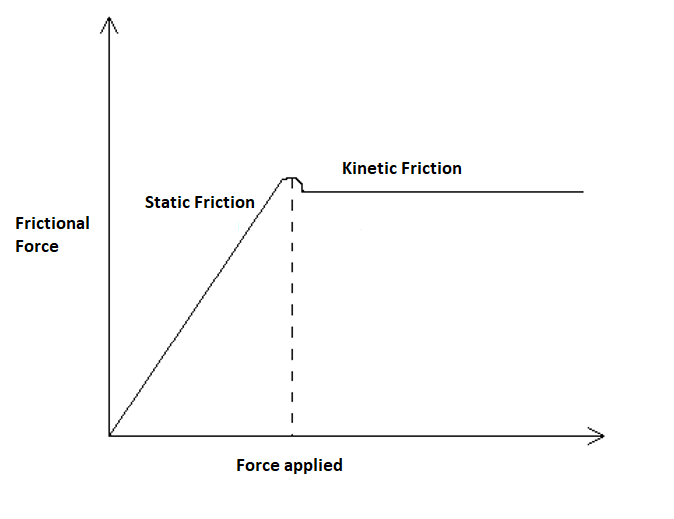
It is found experimentally that limiting frictional force, \[{{f}_{s}}={{\mu }_{s}}Mg\]
Where, \[{{\mu }_{s}}\] is the coefficient of static friction. It is the dimensionless constant but depends on the nature of the surface in contact.
Note: Students should understand the types of friction i.e., static friction and kinetic friction. Students should keep in mind that the limiting friction is the maximum friction that can be generated between two static surfaces.
Complete step by step answer:
When one body makes an attempt to slide over another body, an opposing force called the force of friction arises as a reaction to the applied force, and acts in the opposite direction.
Limiting friction is the maximum friction that can be generated between two static surfaces in contact with each other.
For two dry surfaces, the limiting friction is a product of the normal reaction force and the coefficient of limiting friction.
Once a force applied to the two surfaces exceeds the limiting friction, motion will occur.
Hence, the correct option is C, i.e., A frictional force acting when a body is just about to move.
Additional Information:
Static friction is the type of friction that exists when two objects touch each other at rest. It has a limiting value called limiting friction, which is equal to the least force required to move the body from rest. When the external force F is increased, a stage comes when the body is just to start motion. At this stage, the force of friction is at the maximum, and is known as limiting friction.
It is found experimentally that limiting frictional force, \[{{f}_{s}}={{\mu }_{s}}Mg\]
Where, \[{{\mu }_{s}}\] is the coefficient of static friction. It is the dimensionless constant but depends on the nature of the surface in contact.
Note: Students should understand the types of friction i.e., static friction and kinetic friction. Students should keep in mind that the limiting friction is the maximum friction that can be generated between two static surfaces.
Recently Updated Pages
Master Class 11 English: Engaging Questions & Answers for Success

Master Class 11 Social Science: Engaging Questions & Answers for Success
Master Class 11 Maths: Engaging Questions & Answers for Success
Master Class 11 Biology: Engaging Questions & Answers for Success
Master Class 11 Physics: Engaging Questions & Answers for Success
Master Class 11 Chemistry: Engaging Questions & Answers for Success
Trending doubts
One Metric ton is equal to kg A 10000 B 1000 C 100 class 11 physics CBSE
Difference Between Prokaryotic Cells and Eukaryotic Cells
Find the value of the expression given below sin 30circ class 11 maths CBSE
Two of the body parts which do not appear in MRI are class 11 biology CBSE
Draw a diagram of a plant cell and label at least eight class 11 biology CBSE
10 examples of friction in our daily life