




The lever for which the mechanical advantage is less than ${\text{ }}1{\text{ }}$ has:
A) Fulcrum at midpoint between load and effort
B) Load between effort and fulcrum
C) Effort between fulcrum and load
D) Load and effort acting at the same point
Answer
 Verified
613.5k+ views
Hint: The measure of force amplification is obtained by using a tool, a machine, or any mechanical device. The best example of mechanical advantage is a level. A movable bar that pivots on a fulcrum positioned across a fixed point is called a lever. The increase or decrease in force without considering friction is given by mechanical advantage.
Complete step by step solution:
The lever pivots on the fulcrum. It operates by applying forces at different distances from the fulcrum.
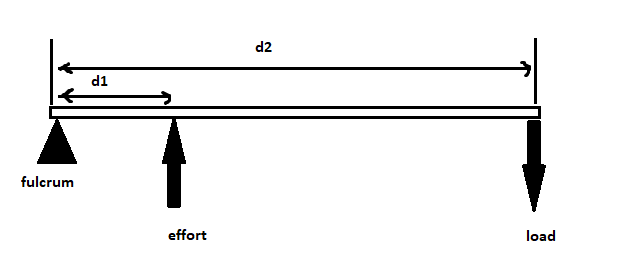
In this case, we consider the distance mechanical advantage. Distance mechanical advantage is given by the ratio of the distance moved by the load to the distance moved by the effort. If we take the distance moved by the load to be the output distance and the load moved by the effort to be the input distance, then the mechanical advantage is given by,
${\text{mechanical advantage = }}\dfrac{{{\text{output distance}}}}{{{\text{input distance}}}} = \dfrac{{{\text{load distance}}}}{{{\text{effort distance}}}}$
The mechanical advantage of less than one means that the effort distance is greater than the load distance.
Therefore, the meaning of mechanical advantage less than one is that the effort lies between the load and the fulcrum.
The answer is Option (C): Effort between fulcrum and load.
Note: In mechanical advantage, the distance direction is not considered. The distance will not be changed by friction. The mechanical advantage will be greater than one, the effort will move farther than the load. When mechanical advantage is less than one, the effort moves less than the load. In a first-class lever, the fulcrum is between the effort and lever. In a second class lever, the load is between the fulcrum and effort. In a third-class lever, the effort is between the load and fulcrum.
Complete step by step solution:
The lever pivots on the fulcrum. It operates by applying forces at different distances from the fulcrum.
In this case, we consider the distance mechanical advantage. Distance mechanical advantage is given by the ratio of the distance moved by the load to the distance moved by the effort. If we take the distance moved by the load to be the output distance and the load moved by the effort to be the input distance, then the mechanical advantage is given by,
${\text{mechanical advantage = }}\dfrac{{{\text{output distance}}}}{{{\text{input distance}}}} = \dfrac{{{\text{load distance}}}}{{{\text{effort distance}}}}$
The mechanical advantage of less than one means that the effort distance is greater than the load distance.
Therefore, the meaning of mechanical advantage less than one is that the effort lies between the load and the fulcrum.
The answer is Option (C): Effort between fulcrum and load.
Note: In mechanical advantage, the distance direction is not considered. The distance will not be changed by friction. The mechanical advantage will be greater than one, the effort will move farther than the load. When mechanical advantage is less than one, the effort moves less than the load. In a first-class lever, the fulcrum is between the effort and lever. In a second class lever, the load is between the fulcrum and effort. In a third-class lever, the effort is between the load and fulcrum.
Recently Updated Pages
Master Class 11 English: Engaging Questions & Answers for Success

Master Class 11 Social Science: Engaging Questions & Answers for Success
Master Class 11 Maths: Engaging Questions & Answers for Success
Master Class 11 Biology: Engaging Questions & Answers for Success
Master Class 11 Physics: Engaging Questions & Answers for Success
Master Class 11 Chemistry: Engaging Questions & Answers for Success
Trending doubts
Explain the Treaty of Vienna of 1815 class 10 social science CBSE
What is the full form of POSCO class 10 social science CBSE
Define Potential, Developed, Stock and Reserved resources
The diagonals of a rhombus are 10cm and 24cm Find the class 10 maths CBSE
Fill the blanks with proper collective nouns 1 A of class 10 english CBSE
What planets have no moons Which one has only one moon class 10 physics CBSE