




The lengths of two parallel chords of a circle are 6 cm and 8 cm. The smaller chord is at a distance of 4 cm from the center, then the radius of the circle is?
A.10 cm
B.5 cm
C.3 cm
D.None of these
Answer
 Verified
605.1k+ views
Hint: Draw a line perpendicular to the chord BC of the circle. We know the property that the perpendicular from the center of the circle to the chord, bisects the chord and the length of chord BC is 6 cm. We have the distance from the center to the chord BC which is equal to 4. Now, use the Pythagoras theorem in the \[\Delta ATC\] and then, calculate the hypotenuse.
Complete step-by-step answer:
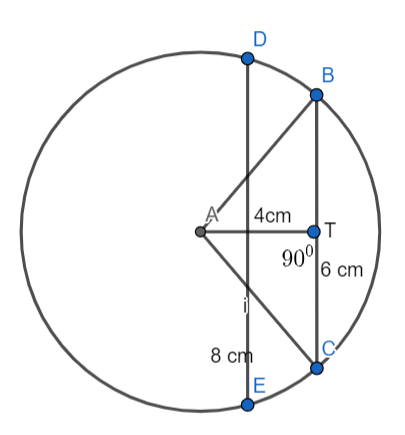
We have a circle with center A. This circle has two chords DE and BC which are parallel to each other. The lengths of the chord DE and BC are 8 cm and 6 cm respectively.
Now, draw a line segment AT perpendicular to the chord BC.
We know the property that the perpendicular from the center to the chord of a circle, bisects the chord.
So, \[BT=TC=\dfrac{6}{2}=3\] …………………….(1)
It is given that the distance from the center to the smaller chord BC of the circle is 4 cm.
AT = 4 cm ………………(2)
In \[\Delta ATC\] we have, TC = 3 cm, AT = 4 cm.
Now, using Pythagoras theorem in \[\Delta ATC\] , we get
\[{{\left( Hypotenuse \right)}^{2}}={{\left( Base \right)}^{2}}+{{\left( Perpendicular \right)}^{2}}\]
\[\Rightarrow {{\left( AC \right)}^{2}}={{\left( TC \right)}^{2}}+{{\left( AT \right)}^{2}}\] …………………….(3)
From equation (1), equation (2), and equation (3), we get
\[\Rightarrow {{\left( AC \right)}^{2}}={{\left( TC \right)}^{2}}+{{\left( AT \right)}^{2}}\]
\[\begin{align}
& \Rightarrow {{\left( AC \right)}^{2}}={{\left( 3 \right)}^{2}}+{{\left( 4 \right)}^{2}} \\
& \Rightarrow {{\left( AC \right)}^{2}}=9+16 \\
& \Rightarrow {{\left( AC \right)}^{2}}=25 \\
& \Rightarrow AC=\sqrt{25} \\
& \Rightarrow AC=5 \\
\end{align}\]
Here, AC is the radius of the circle.
Hence, option (B) is the correct option.
Note: In this question, one might think to draw a perpendicular to the longer chord DE. If we do so, then we need the distance of the longer chord from the center which is not given in the question. We only have the distance of the smaller chord from the center. So, our only option is to draw a perpendicular to the smaller chord BC.
Complete step-by-step answer:
We have a circle with center A. This circle has two chords DE and BC which are parallel to each other. The lengths of the chord DE and BC are 8 cm and 6 cm respectively.
Now, draw a line segment AT perpendicular to the chord BC.
We know the property that the perpendicular from the center to the chord of a circle, bisects the chord.
So, \[BT=TC=\dfrac{6}{2}=3\] …………………….(1)
It is given that the distance from the center to the smaller chord BC of the circle is 4 cm.
AT = 4 cm ………………(2)
In \[\Delta ATC\] we have, TC = 3 cm, AT = 4 cm.
Now, using Pythagoras theorem in \[\Delta ATC\] , we get
\[{{\left( Hypotenuse \right)}^{2}}={{\left( Base \right)}^{2}}+{{\left( Perpendicular \right)}^{2}}\]
\[\Rightarrow {{\left( AC \right)}^{2}}={{\left( TC \right)}^{2}}+{{\left( AT \right)}^{2}}\] …………………….(3)
From equation (1), equation (2), and equation (3), we get
\[\Rightarrow {{\left( AC \right)}^{2}}={{\left( TC \right)}^{2}}+{{\left( AT \right)}^{2}}\]
\[\begin{align}
& \Rightarrow {{\left( AC \right)}^{2}}={{\left( 3 \right)}^{2}}+{{\left( 4 \right)}^{2}} \\
& \Rightarrow {{\left( AC \right)}^{2}}=9+16 \\
& \Rightarrow {{\left( AC \right)}^{2}}=25 \\
& \Rightarrow AC=\sqrt{25} \\
& \Rightarrow AC=5 \\
\end{align}\]
Here, AC is the radius of the circle.
Hence, option (B) is the correct option.
Note: In this question, one might think to draw a perpendicular to the longer chord DE. If we do so, then we need the distance of the longer chord from the center which is not given in the question. We only have the distance of the smaller chord from the center. So, our only option is to draw a perpendicular to the smaller chord BC.
Recently Updated Pages
Master Class 10 Computer Science: Engaging Questions & Answers for Success

Master Class 10 General Knowledge: Engaging Questions & Answers for Success
Master Class 10 English: Engaging Questions & Answers for Success
Master Class 10 Social Science: Engaging Questions & Answers for Success
Master Class 10 Maths: Engaging Questions & Answers for Success
Master Class 10 Science: Engaging Questions & Answers for Success
Trending doubts
What is the median of the first 10 natural numbers class 10 maths CBSE
Which women's tennis player has 24 Grand Slam singles titles?
Who is the Brand Ambassador of Incredible India?
Why is there a time difference of about 5 hours between class 10 social science CBSE
Write a letter to the principal requesting him to grant class 10 english CBSE
A moving boat is observed from the top of a 150 m high class 10 maths CBSE