




The lengths of the triangle are in the ratio \[3:4:5\] then find the area of the triangle if the perimeter is 144 cm.
(a) 864 sq. cm
(b) 874 sq. cm
(c) 854 sq. cm
(d) 884 sq. cm
Answer
 Verified
569.1k+ views
Hint: Let us take a rough figure of the triangle as follows
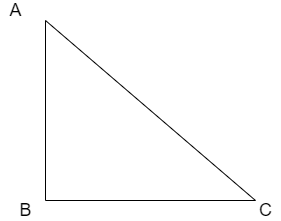
We use the condition of ratios that if three numbers are in the ratio \[a:b:c\] then there exists an integer \[x\] such that the numbers are \[ax,bx,cx\]
We find the sides of the triangle by using the perimeter which is the sum of sides of the triangle.
Then we use the formula of area of triangle that is
\[A=\dfrac{1}{2}\left( base \right)\left( height \right)\]
Complete step by step answer:
We are given that the ratio of sides of the triangle is \[3:4:5\]
Let us assume that from the figure of \[\Delta ABC\]
\[\Rightarrow AB:BC:CA=3:4:5\]
We know that the condition of ratios that if three numbers are in the ratio \[a:b:c\] then there exists an integer \[x\] such that the numbers are \[ax,bx, cx\]
By using the above condition the sides of the triangle are given as
\[\begin{align}
& \Rightarrow AB=3x \\
& \Rightarrow BC=4x \\
& \Rightarrow CA=5x \\
\end{align}\]
Let us assume that the area of the triangle as \[A\]
We know that the formula of area of a triangle that is
\[A=\dfrac{1}{2}\left( base \right)\left( height \right)\]
Here we can see that the square of CA is equal to the sum of squares of AB and BC that is
\[\Rightarrow C{{A}^{2}}=A{{B}^{2}}+B{{C}^{2}}\]
We know that if the square of one side of a triangle is equal to the sum of squares of the other two sides then the triangle is a right-angled triangle and the two sides will be the base and height of the triangle.
By using the above condition we get the area of the triangle as
\[\Rightarrow A=\dfrac{1}{2}\left( AB \right)\left( BC \right).......equation(i)\]
We are given that the perimeter of the triangle as 144 cm
We know that the perimeter of a triangle is given as the sum of sides of the triangle.
By using the above condition we have the perimeter of \[\Delta ABC\] as
\[\Rightarrow AB+BC+CA=144\]
By substituting the required values in above equation we get
\[\begin{align}
& \Rightarrow 3x+4x+5x=144 \\
& \Rightarrow 12x=144 \\
& \Rightarrow x=12 \\
\end{align}\]
By substituting the value of \[x\] in the sides we get
\[\begin{align}
& \Rightarrow AB=3\times 12=36 \\
& \Rightarrow BC=4\times 12=48 \\
& \Rightarrow CA=5\times 12=60 \\
\end{align}\]
By substituting the required sides in the equation (i) we get the area of the triangle as
\[\begin{align}
& \Rightarrow A=\dfrac{1}{2}\times 36\times 48 \\
& \Rightarrow A=864 \\
\end{align}\]
Therefore we can conclude that the area of the given triangle is 864 sq. cm
So, option (a) is the correct answer.
Note:
Students may make mistakes without checking the type of triangle that is given.
We have the heron’s formula for finding the area of triangle irrespective of the type of triangle that is
\[A=\sqrt{s\left( s-a \right)\left( s-b \right)\left( s-c \right)}\]
Where, \[a,b,c\] are sides of triangle and \[s\] is semi – perimeter given as \[s=\dfrac{a+b+c}{2}\]
Students may find the area in this method that is very difficult to find because we can see that the sides are very large.
We need to remember that any triangle having the sides in the ratio \[3:4:5\] always forms a right angles triangle because \[\left( 3,4,5 \right)\] is called Pythagoras triplets.
We use the condition of ratios that if three numbers are in the ratio \[a:b:c\] then there exists an integer \[x\] such that the numbers are \[ax,bx,cx\]
We find the sides of the triangle by using the perimeter which is the sum of sides of the triangle.
Then we use the formula of area of triangle that is
\[A=\dfrac{1}{2}\left( base \right)\left( height \right)\]
Complete step by step answer:
We are given that the ratio of sides of the triangle is \[3:4:5\]
Let us assume that from the figure of \[\Delta ABC\]
\[\Rightarrow AB:BC:CA=3:4:5\]
We know that the condition of ratios that if three numbers are in the ratio \[a:b:c\] then there exists an integer \[x\] such that the numbers are \[ax,bx, cx\]
By using the above condition the sides of the triangle are given as
\[\begin{align}
& \Rightarrow AB=3x \\
& \Rightarrow BC=4x \\
& \Rightarrow CA=5x \\
\end{align}\]
Let us assume that the area of the triangle as \[A\]
We know that the formula of area of a triangle that is
\[A=\dfrac{1}{2}\left( base \right)\left( height \right)\]
Here we can see that the square of CA is equal to the sum of squares of AB and BC that is
\[\Rightarrow C{{A}^{2}}=A{{B}^{2}}+B{{C}^{2}}\]
We know that if the square of one side of a triangle is equal to the sum of squares of the other two sides then the triangle is a right-angled triangle and the two sides will be the base and height of the triangle.
By using the above condition we get the area of the triangle as
\[\Rightarrow A=\dfrac{1}{2}\left( AB \right)\left( BC \right).......equation(i)\]
We are given that the perimeter of the triangle as 144 cm
We know that the perimeter of a triangle is given as the sum of sides of the triangle.
By using the above condition we have the perimeter of \[\Delta ABC\] as
\[\Rightarrow AB+BC+CA=144\]
By substituting the required values in above equation we get
\[\begin{align}
& \Rightarrow 3x+4x+5x=144 \\
& \Rightarrow 12x=144 \\
& \Rightarrow x=12 \\
\end{align}\]
By substituting the value of \[x\] in the sides we get
\[\begin{align}
& \Rightarrow AB=3\times 12=36 \\
& \Rightarrow BC=4\times 12=48 \\
& \Rightarrow CA=5\times 12=60 \\
\end{align}\]
By substituting the required sides in the equation (i) we get the area of the triangle as
\[\begin{align}
& \Rightarrow A=\dfrac{1}{2}\times 36\times 48 \\
& \Rightarrow A=864 \\
\end{align}\]
Therefore we can conclude that the area of the given triangle is 864 sq. cm
So, option (a) is the correct answer.
Note:
Students may make mistakes without checking the type of triangle that is given.
We have the heron’s formula for finding the area of triangle irrespective of the type of triangle that is
\[A=\sqrt{s\left( s-a \right)\left( s-b \right)\left( s-c \right)}\]
Where, \[a,b,c\] are sides of triangle and \[s\] is semi – perimeter given as \[s=\dfrac{a+b+c}{2}\]
Students may find the area in this method that is very difficult to find because we can see that the sides are very large.
We need to remember that any triangle having the sides in the ratio \[3:4:5\] always forms a right angles triangle because \[\left( 3,4,5 \right)\] is called Pythagoras triplets.
Recently Updated Pages
Master Class 10 Computer Science: Engaging Questions & Answers for Success

Master Class 10 General Knowledge: Engaging Questions & Answers for Success
Master Class 10 English: Engaging Questions & Answers for Success
Master Class 10 Social Science: Engaging Questions & Answers for Success
Master Class 10 Maths: Engaging Questions & Answers for Success
Master Class 10 Science: Engaging Questions & Answers for Success
Trending doubts
What is the median of the first 10 natural numbers class 10 maths CBSE
Which women's tennis player has 24 Grand Slam singles titles?
Who is the Brand Ambassador of Incredible India?
Why is there a time difference of about 5 hours between class 10 social science CBSE
Write a letter to the principal requesting him to grant class 10 english CBSE
A moving boat is observed from the top of a 150 m high class 10 maths CBSE